Economy
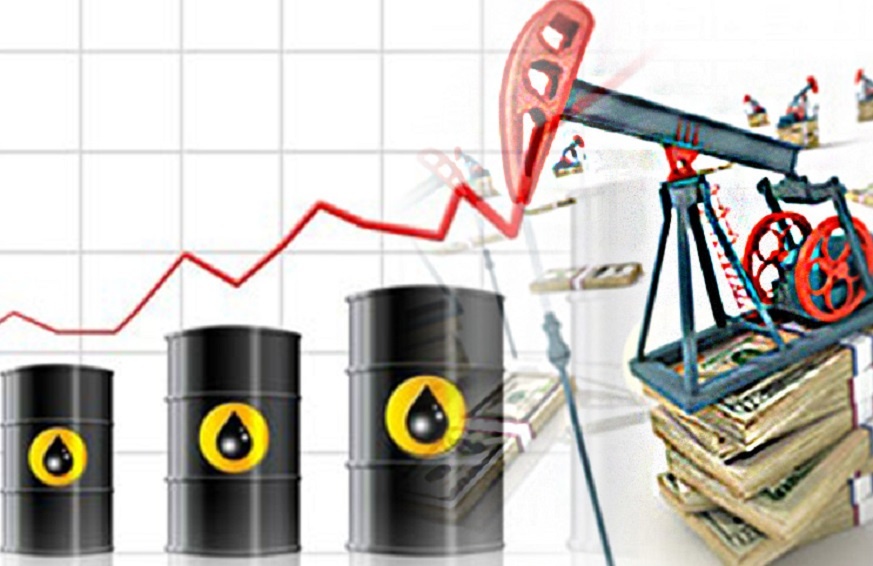
Brent Crude Falls Below $20/b, First Time in 18 Years
By Adedapo Adesanya
The Brent Crude fell below $20 a barrel for the first time in 18 years on Tuesday, April 21 barely 24 hours afterthe United States crude oil prices sold below zero on Monday.
As at 9pm (Nigerian time), the Brent traded at $19.80 per barrel after shedding $5.77 or 22.6 percent. On its part, the West Texas Intermediate (WTI) made a recovery, but selling at $13.05 per barrel.
In the face of demand worries, oil prices have caved in, but this was Brent’s worse level yet since 2002 caused by a technological bust and the 9/11 attacks in the US.
This time around, the market is faced with three major problems – low demand, high supply, and storage problems which analysts have said will further weakened price because there is still a lot of oil being produced that is going into storage and not being used.
After Monday’s trade, when the front-month May US contract fell into negative territory for the first time in history, Tuesday set a new milestone as more than 2 million contracts for US crude for delivery in June changed hands, the busiest day in history, according to market experts.
Oil inventories have been building for weeks after Saudi Arabia and Russia in March failed to come to terms cut production as the coronavirus pandemic worsened and this led to an oil price war which saw the market filled with cheap crude.
In April, the Organization of the Petroleum Exporting Countries (OPEC) and its allies, including Russia, finally announced sweeping cuts in production of up to almost 10 percent of global supplies.
However, with economies at a standstill due to coronavirus lockdowns, that is not enough to offset the declining demand.
Both Saudi Arabia and Russia said on Tuesday that they were ready to take extra measures to stabilize oil markets along with other producers, but they have not taken action yet.
The International Energy Agency (IEA) on Tuesday also called for the OPEC-led group to take more production offline and faster than previously agreed.
Economy
Nigeria’s Headline Inflation Cools to 15.43% in July 2026
By Adedapo Adesanya
Nigeria’s headline inflation rate cooled to 15.43 per cent in July from 15.91 per cent in June, according to the National Bureau of Statistics (NBS) on Monday in its Consumer Price Index (CPI) Report.
“In July 2026, the headline inflation rate stood at 15.43 per cent, down from 15.91 per cent in June 2026 and [lower than the] 24.94 per cent in the same month of the preceding year (July 2025),” the stats office said in the report.
This beat the projection from Coronation Asset Management, which predicted that the July 2026 inflation rate should come at 15.80 per cent, lower than the 15.91 per cent recorded in June 2026.
Coronation explained that it projected a pullback in the rate because of “three primary forces: a fresh energy price shock stemming from renewed Strait of Hormuz hostilities and a domestic refinery pricing disruption, seasonal harvest-related relief on food prices, and continued relative exchange rate stability.”
The organisation noted that the disinflation trend in the first half of the year remained last month, with the fuel price shock denting the pace of improvement rather than reversing it.
Also, the headline inflation rate showed a decrease of 0.48 per cent compared to the June 2026 headline inflation rate.
On a month-on-month basis, the inflation in July 2026 was 1.57 per cent, which is 0.09 per cent lower than the rate recorded in June 2026 (1.66 per cent). This means that in July 2026, the rate of increase in the average price level was lower than the rate of increase in the average price level in June 2026.
The food inflation rate in July 2026 was 20.31 per cent on a year-on-year basis and stood at 26.20 per cent in the same month of the preceding year (July 2025). On a month-on-month basis, the food inflation rate in July 2026 was 5.56 per cent, up by 1.82 per cent from June 2026 (3.75 per cent).
The ease in headline inflation raises expectations that the Central Bank of Nigeria (CBN) may resume cutting interest rates from as early as next month.
Economy
NGX Trading Volume Surges 127%, as Investors Trade 12.2bn Stocks in One Week
By Dipo Olowookere
A total of 12.153 billion shares worth N176.058 billion exchanged hands in 224,146 deals last week on the floor of the Nigerian Exchange (NGX) Limited compared with the 5.359 billion shares valued at N139.053 billion traded in 261,869 deals in the preceding week.
The surge in activity level was triggered by large-ticket transactions in Fortis Global Insurance, Cornerstone Insurance, and Consolidated Hallmark, accounting for 9.488 billion shares worth N36.219 billion in 1,781 deals, contributing 78.07 per cent and 20.57 per cent to the total equity turnover volume and value, respectively.
Analysis showed that the Financial Services space accounted for 11.212 billion shares valued at N88.991 billion in 102,246 deals, contributing 92.25 per cent and 50.55 per cent to the total trading volume and value, respectively.
The ICT sector traded 246.127 million shares worth N51.605 billion in 27,169 deals, and the Services industry transacted 198.195 million shares worth N1.995 billion in 13,747 deals.
In the week, 26 equities gained weight as in the previous week, while 59 equities shed weight versus 63 equities a week earlier, and 62 equities remained unchanged versus 58 equities in the previous week.
Trans-Nationwide Express chalked up 32.09 per cent to trade at N2.84, International Energy Insurance rose by 31.68 per cent to N5.32, Sovereign Trust Insurance expanded by 13.77 per cent to N1.90, Chams grew by 12.25 per cent to N4.58, and CWG increased by 9.74 per cent to N21.40.
On the flip side, AVA Capital lost 34.55 per cent to close at N7.20, Unilever Nigeria declined by 18.94 per cent to N118.30, Zichis depreciated by 15.08 per cent to N18.30, Thomas Wyatt slipped by 14.33 per cent to N2.75, and Dangote Sugar weakened by 11.58 per cent to N64.55.
Business Post reports that Customs Street was under selling pressure last week, depleting the All-Share Index (ASI) by 1.20 per cent to 242,619.20 points and cutting the market capitalisation by 1.19 per cent to N156.624 trillion.
In the same vein, all other indices finished lower while the sovereign bond index was flat.
Economy
DMO to Sell N1.1trn FGN Bonds Today
By Aduragbemi Omiyale
FGN bonds worth N1.1 trillion would be offered for sale to investors by the Debt Management Office (DMO) today, Monday, August 17, 2026.
The debt instruments would be sold through a primary market auction in three tenors: 10, 15, and 20 years. They are all re-opening notes, meaning they have been issued before and do not have the full term.
According to a circular from the debt office,
Business Post reports that the DMO is selling N250 billion worth of the 10-year note with a coupon of 22.60 per cent, while the N750 billion worth of the 15-year paper with a coupon of 15.45 per cent is to be auctioned, and N100 billion worth of the 20-year instrument with a coupon of 16.2499 per cent is on sale today.
To subscribe to the bonds, investors are required to pay N1,000 per unit, subject to a minimum subscription of N50 million and in multiples of N1,000 thereafter. The notes can be purchased through primary dealer market makers, which are the main commercial banks and others.
It was stated that successful bidders will pay a price corresponding to the yield-to-maturity bid that clears the volume being auctioned, plus any accrued interest on the instrument because the papers are reopening, as their coupons (interest) are already set.
Bondholders will receive their interest payment twice a year, with the bullet repayment on the maturity date.
The FGN bond qualifies as securities in which trustees can invest under the Trustee Investment Act. It also qualifies as government securities for tax exemption and can be used as liquid assets for liquidity ratio calculation for banks.
After the exercise today, the bond will be listed on the Nigerian Exchange (NGX) Limited and the FMDQ Securities Exchange to allow for trading in the secondary market, where it can be liquidated before maturity.
The FGN bonds are backed by the full faith and credit of the Federal Government of Nigeria and are charged upon the general assets of Nigeria.