Connect with us

Economy

CBN Seeks Private Sector’s Input in 5-Year Roadmap

Published

on

cbn private sector 5-year roadmap

By Modupe Gbadeyanka

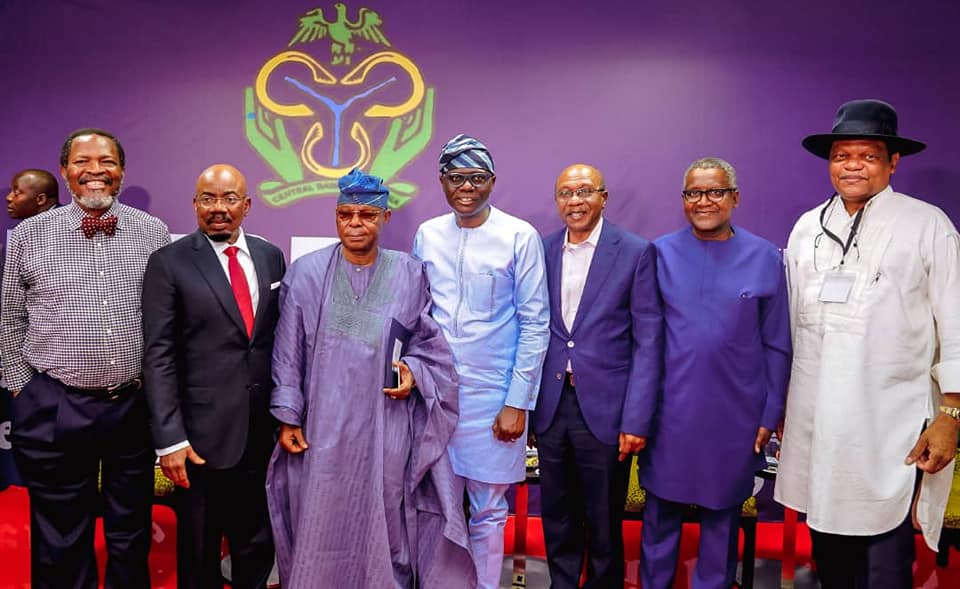
Governor of the Central Bank of Nigeria (CBN), Mr Godwin Emefiele, has held an interactive session with members of the private sector in the country so as to have their views on his five-year roadmap.

This month, Mr Emefiele commenced his second tenure of five years in office after he was reappointed by President Muhammadu Buhari.

At the consultative round table held in Lagos last week and tagged Growing for Growth,’ participants shared with the chief banker how he and his team can help the economy grow faster and better.

Chairman of Dangote Group and Africa’s richest man, Mr Aliko Dangote, said at the meeting that for Nigeria to witness economic growth, government must collaborate with the organised private sector.

He also said the electricity issue in the country must be resolved because no country can record any significant growth when industries are powered with generators.

In addition, Mr Dangote said banks must support the private sector by giving entrepreneurs easy access to consumer credit.

Others things he said must be done are increase house mortgages, increased focus on agriculture and manufacturing sectors.

“Government needs to have partnership with the private companies to access growth. It needs to encourage private sector investors, so that they do not rely on oil to pay salaries. That of oil should go into implementation for perfection of the economy.

“We the local investors should drive this country. No foreigner will invest in the country unless we locals do.

“The other thing that we need to look at is easy access to consumer credit. Consumer credit will help the government in fighting corruption.

“Also, another issue is smuggling. There is no country that can survive near the Republic of Benin because their main job is facilitating smuggling,” Mr Dangote said.

On his part, founder of Stanbic IBTC Bank, Mr Atedo Peterside, listed high tax rates, among others, as harmful to the growth of young and start-ups businesses, exchange rate instability, high

inflationary rate, among others, as bottlenecks impeding growth in the economy.

Speaking at the event, the convener, Mr Emefiele, said the points highlighted by the businessmen would be looked into.

On the smuggling issue, which the CBN chief said was a sabotage to the nation’s economy, he said efforts would be made to punish those encouraging it.

According to him, the CBN would close bank accounts of any company or person caught in smuggling and dumping of banned products into the country.

“Smugglers and dumpers are the major sabotage to the country’s economic policies. Nigeria is very good at making brilliant economic policies but we have identified smugglers and dumpers as those who sabotage these policies and we have decided we will deal with them and the strategy we came up with is that we will not bother ourselves.

“There is an agency of the government that is responsible for border control but that if these people pass through this border control, we would use the instrumentality of being the regulator for the banking system, to make sure that we get the banks to provide all details about these smugglers and dumpers, to provide investigation and if they are found culpable in economic sabotage bordering on dumping and smuggling in Nigeria.

“We will not only block their accounts; we will close their accounts in all the Nigerian banks simultaneously. We will close the accounts of the owners of those companies and we will close the accounts of top management members of those companies because they know that their companies are involved in smuggling and they should not be supporting those keep and of things.”

On the reason for the round table discussion, Mr Emefiele said, “We are here today as part of the engagement that we have planned, preparatory to the CBN releasing another five-year vision and agenda for the next tenure of the Governor of CBN.

“As you can see, we have at this session private sector leaders like Aliko Dangote, people in telecommunications, people in manufacturing, people in the IT sector, people in the agricultural sector and banking sector. All of them are represented.

“Basically, what we are saying here is that we want to give them opportunity, I will use the word to vent their view about what they think the CBN, the monetary policy committee should be doing in the next five years to support the economy and indeed to support the growth of the economy.”


Modupe Gbadeyanka is a fast-rising journalist with Business Post Nigeria. Her passion for journalism is amazing. She is willing to learn more with a view to becoming one of the best pen-pushers in Nigeria. Her role models are the duo of CNN's Richard Quest and Christiane Amanpour.

Click to comment

Leave a Reply

Your email address will not be published. Required fields are marked *

Economy

OTC Securities Exchange Falls 1.31% as Key Stocks Decline

Published

on

NASD OTC securities exchange

By Adedapo Adesanya

Three bellwether stocks weakened the NASD Over-the-Counter (OTC) Securities Exchange by 1.31 per cent on Monday, May 18.

This brought the NASD Unlisted Security Index (NSI) by 54.71 points to 4,133.70 points from 4,188.41 points, and shrank the market capitalisation by N32.73 billion to N2.473 trillion from N2.506 trillion.

Yesterday, FrieslandCampina Wamco Plc contracted by N12.45 to sell at N146.55 per share compared with last Friday’s closing price of N159.00 per share, Central Securities and Clearing System (CSCS) Plc declined by N2.34 to N70.00 per unit from N72.34  per unit, and NASD Plc lost 50 Kobo to trade at N34.50 per share versus N35.00 per share.

The trio overpowered the N5.56 gained Newrest Asl Plc. This stock ended the trading session at N61.15 per unit, in contrast to the previous session’s N55.59 per unit.

During the trading day, the volume of securities traded by investors slid by 56.1 per cent to 514,142 units from 1.2 million units, and the value of securities dropped 29.8 per cent to close at N17.4 million versus N29.8 million, while the number of deals jumped 12.5 per cent to 27 deals from 24 deals.

Great Nigeria Insurance (GNI) Plc remained the most traded stock by value on a year-to-date basis, with 3.4 billion units sold for N8.4 billion, followed by CSCS Plc with 60.8 million units exchanged for N4.1 billion, and Okitipupa Plc with 27.9 million units traded for N1.9 billion.

GNI Plc also ended the day as the most traded stock by volume on a year-to-date basis with 3.4 billion units worth N8.4 billion, trailed by Resourcery Plc with 1.1 billion units valued at N415.7 million, and Infrastructure Guarantee Credit Plc with 400 million units transacted for N1.2 billion.

Continue Reading

Economy

FX Pressure Pushes Naira Lower to N1,373/$1 at Official Market

Published

on

naira official market

By Adedapo Adesanya

It was a horrible day for the Nigerian Naira in the different segments of the foreign exchange (FX) market on Monday, May 15, as its value further weakened against the United States Dollar.

In the black market window, the Naira lost N5 against the Dollar yesterday to sell for N1,390/$1 compared with the previous value of N1,385/$1, but at the GTBank forex counter, it remained unchanged at N1,383/$1.

In the Nigerian Autonomous Foreign Exchange Market (NAFEX), the Nigerian currency depreciated against the greenback by N2.66 or 0.19 per cent to sell for N1,373.70/$1 compared to last Friday’s rate of N1,371.04/$1.

Equally, it fell against the Pound Sterling in the same market segment by N9.05 to trade at N1,839.66/£1 versus N1,830.61/£1, and lost N5.42 on the Euro to close at  N1,600.49/€1 versus N1,595.07/€1.

The performance of the local currency during the session indicates early worries despite all signals pointing to stability, amid improved  Dollar sales by the Central Bank of Nigeria (CBN), with steady, higher oil receipts to bolster the nation’s reserves.

Activity at the market showed that turnover rose 57.3 per cent to $76.29 million on Monday from $48.49 million posted on Friday.

Over the weekend, S&P raised Nigeria’s credit ratings for the first time since 2012 and highlighted improved FX market liquidity and $10 billion turnover recorded in April 2026 as one of the major gains of the CBN-led FX reforms.

The agency said the liberalisation of the exchange rate has bolstered access to foreign currency and enabled a market-driven exchange-rate environment while supporting investor and consumer confidence.

Meanwhile, the cryptocurrency market was bullish on Monday as investors monitored developments in the Iran conflict and weighed the impact of surging oil prices on inflation and US interest-rate expectations.

Ethereum (ETH) gained 0.7 per cent to trade at $2,134.10, Cardano (ADA) rose by 0.6 per cent to $0.2515, Solana (SOL) expanded by 0.3 per cent to $85.11, Binance Coin (BNB) jumped 0.2 per cent to $643.29, TRON (TRX) increased by 0.03 per cent to $0.3565, and Bitcoin (BTC) advanced by 0.02 per cent to $76,912.12.

On the flip side, Dogecoin (DOGE) slid by 1.5 per cent to $0.1044, and Ripple (XRP) decreased by 0.5 per cent to $1.38, while the US Dollar Tether (USDT) and the US Dollar Coin (USDC) traded flat at $1.00 apiece.

Continue Reading

Economy

Customs Street Opens Week Bearish With 0.05% Loss

Published

on

Lagos Customs Street stock exchange

By Dipo Olowookere

A marginal 0.05 per cent loss was recorded by Customs Street on Monday, as sell-offs by market participants remained.

This was driven by the desire of investors to book profits, having witnessed a significant price appreciation on the stocks in their portfolios.

Yesterday, bargain-hunting in the banking space, which resulted in the sector closing 0.17 per cent higher, could not prevent the Nigerian Exchange (NGX) Limited from going down.

Data showed that the consumer goods segment lost 0.26 per cent, the insurance counter depreciated by 0.20 per cent, the industrial goods index shed 0.09 per cent, and the energy industry retreated by 0.03 per cent.

As a result, the All-Share Index (ASI) eased by 126.09 points to 250,204.83 points from 250,330.92 points, and the market capitalisation contracted by N81 billion to N160.363 trillion from N160.444 trillion.

NCR Nigeria and Zichis declined by 9.99 per cent each to sell for N161.20 and N26.49, respectively, Industrial and Medical Gases shrank by 9.93 per cent to N38.10, Sovereign Trust Insurance depreciated by 9.86 per cent to N2.65, and DAAR Communications slipped by 9.78 per cent to N2.03.

On the flip side, Oando gained 10.00 per cent to finish at N51.70, University Press also rose by 10.00 per cent to N5.50, Deap Capital soared by 9.96 per cent to N5.96, May and Baker expanded by 9.94 per cent to N52.00, and Trans-Nationwide Express grew by 9.92 per cent to N7.76.

Yesterday, 800.5 million equities worth N37.1 billion exchanged hands in 87,096 deals compared with the 1.1 billion equities valued at N44.3 billion traded in 65,744 deals last Friday. This showed that the number of deals went up by 32.48 per cent, while the trading volume and value went down by 27.23 per cent and 16.25 per cent, respectively.

The most active stock on the first trading session of this week was UBA with a turnover of 65.0 million units worth N2.8 billion, Fidelity Bank traded 57.3 million units for N1.3 billion, Access Holdings sold 42.3 million units valued at N1.1 billion, DAAR Communications exchanged 36.7 million units for N81.8 million, and Secure Electronic Technology transacted 36.6 million units worth N33.0 million.

Continue Reading

Trending