Feature/OPED
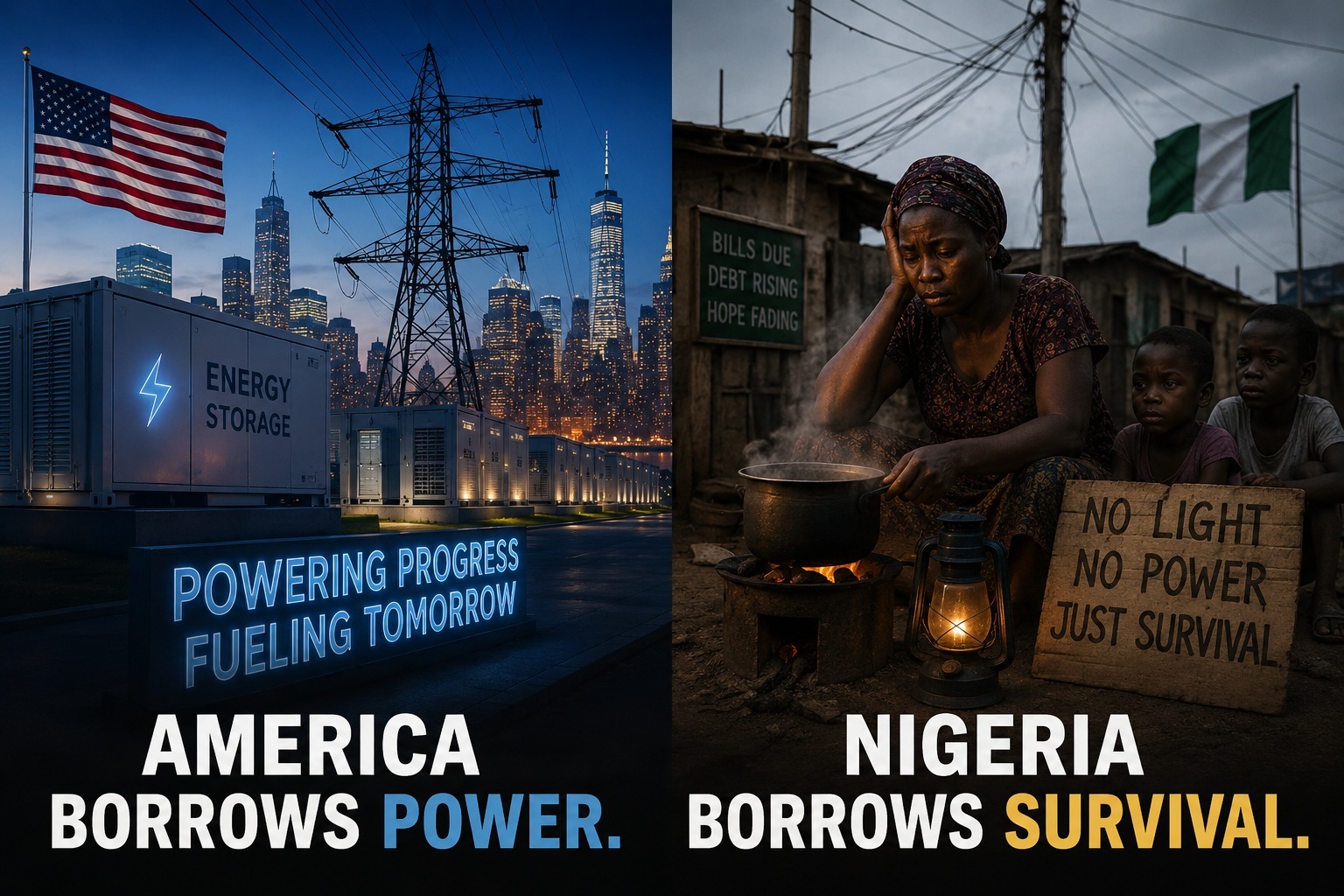
America Borrows Power, Nigeria Borrows Survival
By Blaise Udunze
Findings show that the United States owes more than $36 trillion while Nigeria owes over N159.28 trillion, with external debt now standing at approximately $51.8 billion. At first glance, when comparing the debt profiles of the world’s largest economy and Africa’s largest economy, it may seem misplaced. America can borrow almost indefinitely because it issues the world’s reserve currency. Nigeria cannot. Yet both countries are confronting a similar worry. This has led to asking, when does debt cease to be a tool for development and become a permanent feature of national survival?
The difference is that while America may be testing the limits of how much debt a superpower can carry, Nigeria is testing how much debt a fragile developing economy can sustain before it begins to mortgage its future.
The latest proposal by the federal government to secure another $1.25 billion World Bank facility under the Nigeria Actions for Investment and Jobs Acceleration Programme has once again reignited a debate that refuses to disappear. What appears to be far from the daily lived experience of Nigerians over the years is having government officials insisting that the loan will support investment, expand access to finance, improve electricity, enhance digital services, and create jobs. According to the claims, these are worthy objectives. But Nigerians have heard similar promises before.
The more important question is no longer whether Nigeria should borrow. Virtually every modern economy borrows. The real question which calls for critical concern is what exactly Nigeria is borrowing for, and why the benefits of decades of borrowing remain largely invisible in the everyday lives of millions of citizens. This is where the national conversation becomes uncomfortable.
Funny enough, over the years, successive governments have justified borrowing as a necessary response to development deficits. Yet despite rising debt levels, many Nigerians struggle to identify corresponding improvements in their lived experiences. This justification has kept many wondering as the roads remain dilapidated, public hospitals are overwhelmed, and the electricity supply also remains unreliable. Talk of the public education system, this has continued to deteriorate badly, and unemployment remains stubbornly high. Inflation has eroded incomes, with the cost of cooking gas hitting N2,400 per kg, while businesses struggle under the weight of high operating costs.
If borrowing is supposed to finance development, where is the development? The concern becomes even more urgent and highly alarming when viewed against the backdrop of Nigeria’s worsening fiscal position. According to the Debt Management Office, public debt has climbed to over N159 trillion. With this outrageous figure, more troubling is the fact that debt servicing now consumes an alarming share of government revenue, which has continued to cripple economic growth and compromise the future. This development caught the attention of the Nigerian Economic Summit Group, as it recently noted that Nigeria’s debt-service-to-revenue ratio remains among the highest in the world. In simple and practical terms, this implies that the government is spending an increasingly large portion of what it earns paying creditors rather than investing in infrastructure, healthcare, education, security, or economic expansion.
This is the hallmark of a debt trap. The danger is not necessarily that Nigeria will default tomorrow. The danger is that the nation becomes trapped in a vicious cycle where governments borrow to finance deficits, then borrow again to service existing obligations, and then borrow even more to cover the consequences of previous borrowing. That cycle is already becoming visible.
Come to think of it, President Bola Tinubu’s administration has boldly defended borrowing as necessary to support reforms, cushion economic shocks, and stimulate growth. Yet critics have continued to point to the fact that since May 2023, borrowing has accelerated significantly.
According to economic analyst Dele Oye, the current administration has added approximately N65.9 trillion to Nigeria’s debt stock within just two years, a figure that exceeds several multiples of what Nigeria accumulated during its first five decades after independence.
Whether one agrees with the politics surrounding that claim is secondary. The underlying concern remains valid since debt is growing far faster than the visible capacity of the economy to generate sustainable revenue. This is why comparisons with the United States are useful.
America’s debt is enormous, but debt sustainability is not determined by the size of debt alone. It is determined by economic productivity. The United States supports its debt burden through a diversified economy, deep capital markets, technological innovation, globally competitive corporations, advanced research institutions, and an unmatched ability to attract global investment.
Debt is not what sustains America. Productivity does. Unlike Nigeria, it continues to rely heavily on crude oil revenues, a narrow tax base, volatile foreign exchange earnings, and a fragile manufacturing sector. The critical difference is that every dollar borrowed by Nigeria therefore carries greater risks than every dollar borrowed by the United States.
When America borrows, it borrows largely in its own currency. When Nigeria borrows externally, it exposes itself to exchange-rate risks that can dramatically increase repayment costs whenever the naira weakens, as this calls for utmost caution. Every currency depreciation effectively inflates the burden of external obligations. What appears manageable today can become overwhelming tomorrow. This reality makes Nigeria’s current debt trajectory particularly concerning, which is the truth.
The World Bank itself has raised concerns about governance risks and structural weaknesses within Nigeria’s fiscal architecture. Even more troubling are recent revelations indicating that more than N34.5 trillion was reportedly deducted through pre-distribution mechanisms before revenues reached the Federation Account between 2023 and 2025. According to the findings, approximately 41 per cent of government revenues were removed as first-line charges before distribution.
Whichever way it is viewed, perhaps as fiscal leakages, weak oversight, or institutional inefficiency, the implications are profound and of critical concern. If we must begin to tell ourselves the factual truth, a nation cannot continue borrowing aggressively while simultaneously failing to maximise the value of revenues it already generates.
This brings us to the central question confronting Nigeria today. The point is, are these loans building future productive capacity, or are they merely financing continuity?
Borrowing can be justified when it funds projects that expand economic output. Investments in power generation, transport infrastructure, agriculture, industrialisation, technology, and education can create long-term growth that eventually pays for the debt itself. In such cases, debt becomes a bridge to prosperity.
But it must be known that borrowing to fund recurrent expenditure, sustain bloated government structures, finance consumption, cover inefficiencies, or service previous debts transforms borrowing into a treadmill. The irony here is that the country runs harder every year but remains trapped in the same place. Unfortunately, much of Nigeria’s fiscal reality increasingly resembles the latter.
The tragedy is that this debt burden is not abstract. It is already affecting ordinary Nigerians. The adverse implication and critical point are that every naira directed toward debt servicing is a naira unavailable for schools, hospitals, security, electricity, or social protection. Every external loan increases future repayment obligations. Every missed opportunity to invest borrowed funds productively transfers today’s policy failures to future generations.
The consequences are visible everywhere. Businesses face prohibitively high borrowing costs. Today in Nigeria, it is no longer news that manufacturers struggle with energy expenses, which adversely affect the citizens. The same applies to youth unemployment, which remains widespread. Also, infrastructure deficits persist. Another critical issue is that states remain heavily dependent on monthly allocations from the federal level. With the developments, economic growth remains too weak to significantly improve living standards.
The result is a contradiction in which debt rises while prosperity stagnates. This is perhaps the greatest lesson Nigeria must learn from America’s debt experience.
The debate should not focus exclusively on how much debt a nation carries. The more important progressive question is whether the economy is productive enough to sustain that debt.
What every Nigerian should know is that Nigeria as a country cannot borrow its way to prosperity because it must first strengthen the foundations that generate sustainable growth. With the lingering challenging surrounding the borrowing and the mountain of debts, one key fact is that it cannot rely indefinitely on external creditors while neglecting domestic productivity. Also, it cannot continue to depend on oil revenues while failing to broaden its tax base. Another loose end that has been a critical matter is that it cannot expect debt-financed development without strong institutions, transparency, accountability and effective project execution.
The solutions are neither mysterious nor impossible. This entails that Nigeria must aggressively expand domestic revenue mobilisation without suffocating businesses and ensure it digitises tax administration, eliminates leakages, enforce fiscal responsibility laws. Also, it must reduce the cost of governance, strengthen public procurement systems, while ensuring that every borrowed naira and kobo is linked to measurable economic outcomes.
Equally important, the government must rebuild public trust. The truth is that citizens are more willing to support reforms when they can see tangible results. Some of the developments in the past that have continued to erode public trust are when subsidy savings are announced, people expect better roads, improved healthcare, reliable electricity, and enhanced security. When new loans are obtained, they expect visible projects and measurable returns, but the reverse has been the case. Those at the helm of affairs of this country must understand that transparency is not merely good governance; it is an economic necessity. History offers a warning.
In 2006, under the leadership of Olusegun Obasanjo, Nigeria celebrated its exit from the Paris Club debt burden after securing one of Africa’s most significant debt relief achievements. Not too long but for a brief period, the country stood relatively free from the crushing obligations that had constrained development for decades. Two decades later, that achievement appears increasingly distant.
The danger is not simply that Nigeria is borrowing. The danger is that borrowing is becoming normalised as a substitute for difficult reforms.
A nation can borrow to build industries or borrow to pay bills. It can borrow to create future wealth or borrow to postpone present challenges. One path expands prosperity; the other compounds dependency.
America’s debt mountain demonstrates that even wealthy nations are not immune to the consequences of structural borrowing. Nigeria’s debt burden demonstrates how much more dangerous that reality becomes when economic productivity fails to keep pace. Borrowing can buy time. It cannot buy prosperity.
Sooner or later, every nation must generate the economic value necessary to justify the debts it accumulates. Nigeria’s future will depend not on how much it can borrow, but on how effectively it can produce, innovate, industrialise, and grow.
That is the lesson hidden underneath America’s debt mountain. It is also the lesson Nigeria ignores at its own peril.
Blaise, a journalist and PR professional, writes from Lagos and can be reached via: bl***********@***il.com
Feature/OPED
Preparing Bank Security Operations for Scale, Change, and Long-Term Resilience
By Quintin Roberts
When banks and financial institutions upgrade their physical security systems, they are making decisions that will affect operations for years. Branch formats are changing, cyber risks are increasing, and security teams are being asked to support more sites, more data, and more business functions. The challenge is keeping pace with change in a way that holds up over time.
A modern physical security strategy needs to go beyond protection. It needs to give teams a clearer view across branches, support consistent governance, and provide the flexibility to adapt as technology and operational needs change. The following considerations focus on foundational choices that help banks build security operations that are resilient and can grow with the business.
Choose open architecture to preserve long-term flexibility
Banks and financial institutions often manage a mix of legacy systems, newer technologies, and location-specific requirements. A proprietary system can limit scalability, options for devices, and which systems can connect across the organisation. Over time, this can increase costs and make it harder to modernise without replacing infrastructure that still has value.
Open architecture gives decision-makers more choice and preserves flexibility. It allows financial institutions to select the cameras, access control devices, sensors, analytics, and other technologies that best fit each location and adapt them as their needs change.
This allows teams to modernise in phases. For example, an institution may standardise video management across many sites while keeping existing cameras in place, then replace hardware over time.
Decide how to deploy your security system
Some banks want to keep core systems on-premises at major sites. Others prefer cloud-managed services for smaller branches, remote locations, or new sites that need faster deployment and less local infrastructure. Many need a mix of both. Deployment flexibility gives them the freedom to choose where systems run, how data is stored, and how services are managed.
This is especially important for institutions with different regulatory requirements, bandwidth limitations, and internal IT policies. A flexible deployment model helps banks modernise at their own pace while maintaining control over performance, cybersecurity, compliance, and cost.
Unify operations to improve visibility across branches
Managing video surveillance, access control, intrusion, and other systems separately slows down response time and makes investigations harder. Operators may need to sign into different applications, search through data in different ways, and manually piece together what happened. Across hundreds of branches, these inefficiencies can add up quickly.
A unified security platform gives teams one operating picture across systems and sites. A local team can respond faster to an incident at a single location, while a central security operations centre can monitor trends, support remote sites, and apply consistent procedures across the network.
A unified system that creates a shared context makes incorporating analytics or AI-driven capabilities more effective, further accelerating searches, identifying patterns, and reducing overall investigation time.
Put cybersecurity and governance at the forefront
Physical security systems are connected to the broader IT environment. Devices all need to be managed as part of the bank’s cyber risk profile. If systems are outdated or inconsistently configured across branches, they can create unnecessary exposure and make long-term management harder. When cybersecurity and governance are a foundational part of the system, encryption, authentication, user permissions, system updates, audit trails, retention policies, and privacy controls are applied consistently across locations.
A centralised approach makes this consistency sustainable. It provides accountability for banks, helping teams keep track of who accessed which systems, who changed permissions, how long video is retained, and how evidence is shared. This is important for meeting regulatory expectations and adapting security operations over time. Further, consistent policies make organisational risk management more effective by standardising how risk is handled across the organisation, adding to future resilience.
Automate workflows for better risk mitigation and investigations
Investigations often involve information from several systems and locations. A suspicious ATM transaction may need to be matched with video, or an access event may need to be reviewed alongside intrusion activity. If that information sits in separate systems, investigations take longer and are harder to document.
Unified systems connect the relevant context across video, access control, license plate recognition, and other systems. This supports faster investigations and helps teams share evidence internally or with law enforcement while maintaining the chain of custody.
Improve business operations using physical security data
Physical security systems collect valuable operational data every day, from occupancy levels to device health. A unified platform can turn this data into useful insights, helping security teams identify recurring issues and improve resource planning. Other departments can use the same information to improve customer experience, branch operations, and facility management.
For example, occupancy and queue data help banks understand when branches are busiest. Device health monitoring enables teams to identify maintenance needs before systems fail. And with centralised reporting, leadership can see patterns across the full branch network rather than relying on isolated site-level reports.
Making the right choices for the long term
As banks modernise their physical security infrastructure, long-term resilience will depend on foundational choices. Strategies based on open architecture, deployment flexibility, unification, cybersecurity, governance, and data all help financial institutions build systems that can adapt well into the future.
Quintin Roberts is the Regional Sales Manager for Genetec Africa
Feature/OPED
Strengthening Partnerships Through Dialogue: Okomu’s Engagement with Extension 1 Communities
Corporate organisations have been described as an Open Social System wherein the input of the organisations comes from the environment and the output goes back to the environment. In this equation, therefore, proactive and socially responsible organisations must constantly interface with its environment where the surrounding communities are significant stakeholders.
In line with this thought, Okomu Oil Palm Company constantly engages with all its neighbouring communities on a quarterly basis to discuss issues of mutual concern and to resolve any issues that may degenerate into grievances. Through regular stakeholder meetings, the company continues to foster open communication, address concerns, and strengthen relationships with communities within the company’s concessions. Recently, the company engaged communities around its Extension 1 plantation, including Okomu village, Udo, Madagbayo, Safarogbo, Gbelebu, Inikorogha, and Ofunama, Gbole-Uba.
These engagement meetings serve as an important platform for community leaders, youth representatives, women’s groups, and company representatives to discuss matters affecting the well-being and development of the communities. The sessions reflect Okomu’s commitment to maintaining a transparent and mutually beneficial relationship with its host communities.
During the meetings, representatives from the various communities highlighted issues of importance to residents, including infrastructure needs, educational support, employment opportunities, environmental concerns, and community welfare. Company representatives listened attentively to these concerns, provided updates on ongoing initiatives, and outlined measures being taken to address identified challenges.
A key feature of the engagements was the emphasis on collaboration. Community leaders acknowledged the importance of maintaining open channels of communication and working closely with the company to achieve shared development goals. Discussions focused not only on challenges but also on opportunities for greater partnership and community participation in development initiatives.
One of the key highlights of the meetings was the discussion surrounding Okomu’s collaboration with the Foundation for Partnership Initiatives in the Niger Delta (PIND) an NGO that is focused on human capital development Community members were briefed again on the objectives of the partnership, and the areas of PIND intervention and its potential to create meaningful opportunities for economic empowerment, skills development, and improved livelihoods within host communities.
Health, Safety and Environment (HSE) awareness sessions were also conducted during the meetings. Community members received valuable information on safety practices, environmental stewardship, and measures aimed at promoting healthier and safer communities. The sessions encouraged residents to play an active role in maintaining a safe environment while supporting sustainable practices within their communities.
The meetings also provided an opportunity for the company to share updates on ongoing projects and interventions designed to improve the quality of life within the host communities. Through these engagements, Okomu reaffirmed its dedication to responsible corporate citizenship and its long-standing commitment to supporting the growth and development of neighbouring communities.
As the discussions concluded, participants expressed appreciation for the opportunity to engage directly with company representatives and contribute to conversations that impact their communities. The meetings reinforced the value of dialogue, mutual respect, and partnership in building stronger and more resilient communities.
Okomu remains committed to sustaining these engagements and working alongside its neighbouring communities to create lasting social and economic value. By listening, responding, and collaborating, the company continues to strengthen the bonds that support shared progress and sustainable development across the Extension 1 communities.
Feature/OPED
The Almajiri Question: A Stream Now Watering Northern Nigeria’s Insecurity
By Sani Abdulrazak, PhD
Every civilisation carries within it traditions that define its identity and shape its collective memory. Some traditions withstand the test of time because they continue to serve the purpose for which they were conceived. Others gradually lose their essence, becoming shadows of their original intent, until they begin to produce consequences diametrically opposed to the ideals they once espoused. Wisdom therefore demands that societies periodically interrogate their customs, not with the intention of erasing them, but of preserving their virtues while courageously confronting their deficiencies. Few institutions in Northern Nigeria embody this paradox more markedly than the almajiri system.
For centuries, the system represented discipline, scholarship and spiritual refinement. Young boys travelled from distant communities in pursuit of Islamic knowledge under the tutelage of learned scholars whose influence extended beyond religious instruction to moral formation. Communities embraced the responsibility of caring for these pupils, while the teachers regarded them as their children rather than burdens to be managed. The almajiri system, in its pristine form, produced jurists, judges, administrators, scholars and community leaders whose intellectual contributions shaped the social and religious landscape of Northern Nigeria. What confronts us today, however, is scarcely a reflection of that noble heritage.
It is germane to aver that what many now defend in the name of tradition is, in reality, a tragic mutation of the original institution. Thousands of children roam our streets barefoot, hungry and vulnerable, not because Islam prescribes destitution as a pathway to knowledge, but because decades of poverty, rapid population growth, weak public institutions and societal neglect have gradually transformed an educational model into a humanitarian crisis. We have retained the name but abandoned the substance. We celebrate the tradition while ignoring the conditions that have stripped it of its dignity. The consequences have become too glaring to ignore. Across Northern Nigeria, one encounters children of school age at traffic intersections, markets, motor parks and major highways, stretching out tiny hands for alms instead of reaching for books. Their classrooms have become the streets. Their libraries are the pavements. Their lessons are often dictated not by teachers but by the harsh realities of survival. Every help dropped into their bowls may momentarily satisfy hunger, but it does little to nourish the mind that should ultimately liberate them from the cycle of dependence.
Perhaps the gravest implication of this unfortunate reality lies in its intersection with the insecurity that has continued to plague the region. It would be intellectually dishonest to suggest that every almajiri becomes a criminal. Such a proposition would be unfair, insensitive and patently false. Many have risen from humble beginnings to become respected scholars, professionals and public servants. Yet it would be equally dishonest to deny that large populations of abandoned, uneducated and economically vulnerable children provide fertile ground for recruitment into criminal enterprises. Bandits, terrorists, kidnappers and violent extremists rarely manufacture vulnerability; they exploit it. A hungry child is easier to manipulate than a satisfied one. An ignorant youth is easier to deceive than an educated one. A boy who has never experienced the dignity of opportunity may readily embrace the illusion of belonging offered by criminal networks. This is the painful arithmetic confronting Northern Nigeria today. The stream that once irrigated scholarship is gradually watering insecurity, not because its foundation was defective, but because society abandoned its responsibility to sustain it. The security crisis engulfing Arewa cannot therefore be divorced from the educational crisis confronting the region. Every out-of-school child represents not merely a statistic but a potential casualty of failed governance, economic deprivation and collective negligence. The region has the highest number of out of school children in the world. This frightening population of children outside formal education should disturb every parent, every traditional ruler, every religious leader and every public office holder. It is not simply an educational emergency; it is a national security emergency disguised as a social challenge.
Poverty compounds this tragedy in alarming proportions. Families struggling to secure their next meal often perceive education as a luxury rather than a necessity. Parents burdened by economic hardship relinquish responsibilities they are ill-equipped to shoulder, while many Qur’anic teachers themselves grapple with inadequate resources. The result is a vicious cycle in which deprivation reproduces deprivation across generations. Children born into poverty frequently inherit not only economic disadvantage but educational exclusion, creating an endless conveyor belt of vulnerability.
Culture, too, demands honest interrogation: Respect for tradition is a virtue, but no culture should become impervious to reform when overwhelming evidence demonstrates that its present manifestation inflicts avoidable suffering upon those it was originally designed to uplift. Our forefathers were products of wisdom, not rigidity. They adapted to changing realities without compromising their fundamental values. We dishonour their legacy when we mistake resistance to reform for fidelity to tradition.
The path forward therefore lies neither in abolishing Qur’anic education nor in preserving the status quo. Both extremes are fundamentally flawed. What Northern Nigeria requires is thoughtful integration; an educational model that harmonises religious scholarship with modern knowledge, allowing children to acquire sound Islamic education alongside literacy, numeracy, science, technology and vocational skills. Faith and formal education are not adversaries. They are complementary instruments for developing complete human beings capable of contributing meaningfully to society.
The responsibility for rescuing the North from this precipice cannot be placed upon government alone, though government undoubtedly bears the greatest burden. Parents must reclaim their primary role as the first custodians of their children’s future. No society can outsource parental responsibility indefinitely without paying a devastating price. Bringing children into the world is not merely a biological accomplishment; it is a lifelong commitment to nurturing them intellectually, morally and emotionally. Every father who abandons that sacred obligation contributes, however unintentionally, to the reservoir from which insecurity continually draws its recruits. Religious scholars equally occupy a position of profound influence. The reverence they command across Northern Nigeria places upon them an enormous moral responsibility to champion reforms capable of restoring the dignity of Qur’anic education. There is nothing inherently contradictory about a child memorising the Qur’an while simultaneously learning mathematics, science, languages and digital literacy. Indeed, the earliest Muslim civilisations flourished because they pursued revealed knowledge alongside intellectual inquiry, producing physicians, mathematicians, astronomers, philosophers and jurists whose contributions transformed human civilisation. The false dichotomy between religious and western education has inflicted immeasurable damage upon our society and deserves to be discarded with urgency.
Traditional institutions must also become active participants in this transformation. Emirs, district heads, village chiefs and community leaders remain the custodians of values and possess the moral authority to mobilise their people in ways government policies alone cannot achieve. Throughout history, the North has relied upon these institutions to preserve peace, resolve disputes and safeguard communal interests. The educational future of our children should command the same level of commitment.
Government, on its part, must continue to expand access to free, compulsory and qualitative basic education. Building schools alone will not suffice. Schools must be adequately staffed, properly equipped and strategically located to ensure that no child is denied education simply because of geography or poverty. Teachers must receive continuous professional development and appropriate welfare, for no educational reform can surpass the competence and motivation of those entrusted with delivering it. Beyond infrastructure lies the equally important responsibility of making education attractive enough for parents to embrace and accessible enough for every child to benefit from. Poverty alleviation must accompany educational reforms if lasting success is to be achieved. It is unrealistic to expect families struggling to provide a single daily meal to prioritise education without meaningful economic support. Social investment programmes, school feeding initiatives, conditional cash transfers and vocational empowerment schemes all possess the capacity to reduce the economic pressures that often compel parents to withdraw children from school. The fight against insecurity is therefore inseparable from the fight against poverty. One reinforces the other, just as their solutions complement one another.
Equally imperative is the need for governments at all levels to treat the alarming number of out-of-school children as a national emergency rather than an inconvenient statistic recited during conferences. Every child roaming the streets today represents a future that remains unwritten. Within that child may reside an accomplished surgeon, an innovative engineer, an exceptional teacher or a visionary leader whose potential may never find expression if society continues to look away. Nations are diminished not only by the talents they fail to produce but by the opportunities they fail to provide. Technology, too, offers unprecedented opportunities to bridge educational inequalities. Digital learning platforms, community learning centres and innovative teaching methods can complement conventional classrooms, particularly in underserved rural communities. While technology cannot replace teachers, it can significantly expand access to knowledge and reduce educational disparities if deployed thoughtfully and equitably.
Perhaps the greatest obstacle confronting meaningful reform is neither finance nor policy but our collective reluctance to confront uncomfortable truths. For too long, conversations surrounding the almajiri system have oscillated between sentimental nostalgia and political correctness. We have feared that honest criticism may be interpreted as hostility towards religion or Arewa culture. It is neither. On the contrary, the greatest expression of love for any tradition is the courage to preserve its strengths while correcting its weaknesses. A physician who diagnoses an illness does not hate the patient; he seeks to save him.
Northern Nigeria now stands at a defining moment in its history. The region can continue to watch generations of children drift through lives circumscribed by ignorance, poverty and vulnerability, or it can summon the courage to embrace reforms that reconcile faith with modern education, tradition with progress and cultural identity with contemporary realities. Neutrality is no longer an option. Every year of hesitation condemns another generation to circumstances they did not choose. History is replete with societies that transformed themselves through education. They discovered that classrooms are stronger than prisons, that books are cheaper than bullets and that teachers often accomplish what soldiers cannot. Security agencies can arrest criminals, but only education can reduce the number of those willing to become criminals. Military victories may restore temporary peace, yet enduring peace is cultivated in schools where children are taught not merely to read and write but to think, innovate and hope.
Northern Nigeria has produced some of Africa’s finest scholars, administrators and statesmen. It possesses an enviable intellectual heritage that should inspire confidence rather than despair. Our challenge is therefore not one of capacity but of commitment. We must refuse to surrender our future to a cycle that has already extracted too heavy a toll on our people. We owe our children more than sympathy; we owe them opportunity. We owe them more than charity; we owe them dignity. Above all, we owe them an education capable of liberating both their minds and their circumstances. The almajiri question is not fundamentally about children begging on our streets; it is about the future of Northern Nigeria itself. Every neglected child diminishes our collective tomorrow, while every educated child expands it. The choice before us is remarkably simple, though decisively consequential. We may continue to irrigate the fertile fields of insecurity through neglect, or we may redirect that same stream towards the cultivation of knowledge, productivity and hope. Posterity will judge us not by how passionately we defended inherited systems, but by how courageously we reformed them for the benefit of generations yet unborn.
Long Live Northern Nigeria, Long Live the Federal Republic of Nigeria.
Sani Abdulrazak, PhD, is a researcher, writer and public commentator based in Zaria, Kaduna State.
-
Feature/OPED6 years agoDavos was Different this year
-
Travel/Tourism10 years ago
Lagos Seals Western Lodge Hotel In Ikorodu
-
Showbiz3 years agoEstranged Lover Releases Videos of Empress Njamah Bathing
-
Banking8 years agoSort Codes of GTBank Branches in Nigeria
-
Economy3 years agoSubsidy Removal: CNG at N130 Per Litre Cheaper Than Petrol—IPMAN
-
Banking3 years agoSort Codes of UBA Branches in Nigeria
-
Banking3 years agoFirst Bank Announces Planned Downtime
-
Sports3 years agoHighest Paid Nigerian Footballer – How Much Do Nigerian Footballers Earn