Economy
CBN Seeks Support for PAVE Initiative to Boost Local Patronage, Exports
By Adedapo Adesanya
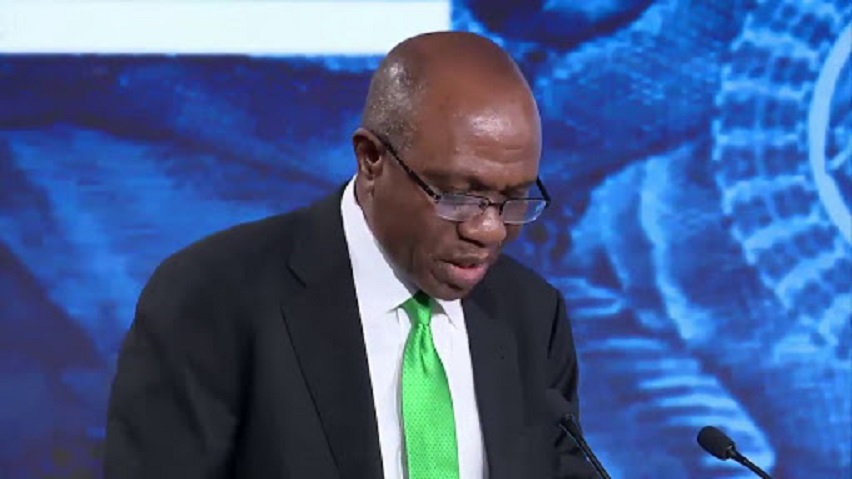
The Central Bank of Nigeria (CBN) has called for the support of the Produce, Add Value and Export (PAVE) initiative which is expected to boost Nigerian consumption and export of local products.
This call was made by the apex bank governor, Mr Godwin Emefiele, who further said the PAVE initiative is akin to South-East Asia’s much referenced export-led industrialization policy which changed the economic fortunes of countries such as South Korea, Taiwan, Malaysia and Singapore.
Delivering a virtual message in Akure, Ondo State at the 32nd Seminar organised by the CBN for Finance Correspondents and Business Editors themed Exchange Rate Management and Economic Diversification in Nigeria: The ‘PAVE’ Option, the Deputy Governor, Corporate Services, CBN, Mr Edward Adamu, said the initiative was designed to be the key for fast-tracking a bucket of substitutes to crude oil export.
According to him, it encourages backward integration for the local production of select items, urging all hands to ensure the success of PAVE, noting that “the initiative would mitigate against future severe consequences of shocks beyond our control.
“I am mindful that our goals may appear ambitious to some. But I am resolute and determined that we can achieve it.
“Many countries that are much less endowed than Nigeria are doing it. Consider for example that agriculture exports alone from the Netherlands was about US$120 billion last year.
“Yet, Netherlands has a landmass of about 42,000 square kilometres, which is much smaller than the landmass of Niger State alone, at over 76,000 square kilometres.”
On COVID-19, he said it was one of the biggest crises that had faced mankind in recent history.
“The pandemic impacted economies, and disrupted business activities globally,” he said.
“Expectedly, Nigeria like most commodity-dependent countries was not spared the deleterious impact of the pandemic, given our dependence on crude oil export as a major source of revenue and foreign exchange.”
He said despite the headwinds associated with the pandemic, the bank would continue to work very hard to ensure that Nigeria remained a vibrant economy.
According to him, it should remain vibrant with a diversified mix of opportunities across sectors such as ICT, Manufacturing, Solid Minerals, Trade and Agriculture.
He said that notwithstanding the modest achievements, the bank would not rest on its oars, as the work was far from over.
Economy
NASD OTC Exchange Sustains Uptrend With 0.52% Gain
By Adedapo Adesanya
The NASD Over-the-Counter (OTC) Securities Exchange started the new week on an upward trajectory after it closed higher by 0.52 per cent on Monday, May 4.
This raised the market capitalisation by N12.48 billion to N2.409 trillion from last Thursday’s N2.396 trillion, and moved the NASD Unlisted Security Index (NSI) higher by 20.86 points to 4,026.64 points from 4,005.78 points.
The unlisted securities market gained weight yesterday despite recording two price gainers and two price losers.
FrieslandCampina Wamco Nigeria Plc added N8.92 to sell at N98.14 per share versus N89.24 per share, and Central Securities Clearing System (CSCS) Plc appreciated by N1.12 to N77.14 per unit from N76.02 per unit.
Conversely, NASD Plc lost N3.47 to sell at N31.23 per share compared with the previous price of N34.70 per share, and Food Concepts Plc declined by 26 Kobo to settle at N2.41 per unit, in contrast to the previous rate of N2.67 per unit.
During the session, the volume of securities traded by investors fell by 14.4 per cent to 751,518 units from 877,682 units, and the number of deals decreased by 44.1 per cent to 31 deals from 56 deals, while the value of securities climbed 32.8 per cent to N35.4 million from N26.7 million.
The most active stock by value on a year-to-date basis remained Great Nigeria Insurance (GNI) Plc with 3.4 billion units worth N8.4 billion, followed by CSCS Plc with 60.2 million units transacted for N4.1 billion, and Okitipupa Plc with 27.8 million units sold for N1.9 billion.
GNI Plc also ended the session as the most traded stock by volume on a year-to-date basis with 3.4 billion units valued at N8.4 billion, trailed by Resourcery Plc with 1.1 billion units exchanged for N415.7 million, and Infrastructure Guarantee Credit Plc with 400 million units traded for N1.2 billion.
Economy
Naira Gains 0.7% to Trade N1,365/$1 at Official Market
By Adedapo Adesanya
The Naira opened the week in the green territory in the Nigerian Autonomous Foreign Exchange Market (NAFEX) on Monday after it further appreciated against the US Dollar by N9.71 or 0.7 per cent to quote at N1,365.23/$1 compared with the previous session’s value of N1,374.94/$1.
The scenario was not different with the Pound Sterling at the same market window, where it gained N6.99 to sell for N1,851.25/£1 versus last Thursday’s closing price of N1,858.24/£1, and appreciated against the Euro by N8.62 to close at N1,607.58/€1, in contrast to the N1,612.87/€1 it was traded in the previous trading day.
Similarly, at the black market, the Naira improved its value against the greenback yesterday by N5 to settle at N1,380/$1 versus the previous rate of N1,385/$1, and at the GTBank FX desk, it closed flat at N1,384/$1.
The Nigerian Naira put up a good performance against the Dollar during the session due to sustained monetary tightening by the Central Bank of Nigeria (CBN) and a steady increase in foreign exchange inflows.
Specifically, stronger diaspora remittances, oil-related inflows, and a decline in speculative demand for the Dollar played pivotal roles in anchoring market expectations.
Sufficient FX liquidity has continued to keep the Naira stable. The local currency stayed strong despite an 83 per cent decline in CBN FX intervention in April to $150 million from $985 million in March.
As for the cryptocurrency market, prices were mixed as broader crypto markets were diverse and macro risks persisted, amid ongoing US-Iran tensions and steady central bank policy, with upcoming US earnings and jobs data seen as potential catalysts for further bitcoin volatility.
Bitcoin (BTC) gained 1.3 per cent to sell at $80,889.94, Ethereum (ETH) jumped 0.3 per cent to $2,376.40, Cardano (ADA) increased by 0.2 per cent to $0.2529, and TRON (TRX) appreciated by 0.2 per cent to $0.3399.
On the flip side, Dogecoin (DOGE) slid 0.8 per cent to $0.1113, Ripple (XRP) went down by 0.5 per cent to $1.40, Binance Coin (BNB) dropped 0.4 per cent to $626.41, and Solana (SOL) shrank by 0.3 per cent to $84.60, while the US Dollar Tether (USDT) and the US Dollar Coin (USDC) remained unchanged at $1.00 apiece.
Economy
Oil Prices Jump 6% as Iran Escalates Attacks in Gulf
By Adedapo Adesanya
Oil prices jumped about 6 per cent on Monday as Iran stepped up attacks on the United Arab Emirates (UAE) and ships in the Middle East over the past 24 hours, the most serious escalation since a US-Iran ceasefire came into force in early April.
This pushed the price of Brent futures higher by $6.27 or 5.8 per cent to $114.44 per barrel, and raised the US West Texas Intermediate (WTI) crude by $4.48 or 4.4 per cent to $106.42 a barrel.
Iran hit several ships in the Strait of Hormuz on Monday and set a UAE oil port ablaze, as President Donald Trump’s attempt to use the US Navy to free up shipping provoked the war’s biggest escalation since a ceasefire was declared last month.
The UAE said its air defences were engaging missile and drone threats on Monday evening as firefighters battled a blaze at a major oil industry zone.
The US military said it destroyed six Iranian small boats and intercepted Iranian cruise missiles and drones fired by Iran as it sought to thwart a new US naval effort to open shipping through the Strait of Hormuz. About 20 per cent of global oil and liquefied natural gas supplies passed through the strait before the US and Israel launched strikes against Iran on February 28.
Meanwhile, Iran’s Revolutionary Guards Navy (IGRC) issued a map that it said was expanding the areas controlled by Iran near the Strait of Hormuz.
The United Kingdom Maritime Trade Operations (UKMTO) said it received a report of an incident involving a cargo vessel about 36 nautical miles north of Dubai. The UKMTO also reported a separate incident earlier in the day near the UAE.
Oil executives from the Gulf and global oil traders have said that even when shipping through the Strait of Hormuz reopens, it will take several weeks, if not months, for flows to normalise.
Separately, the energy minister in the UAE, which left the Organisation of the Petroleum Exporting Countries (OPEC) last week, said the country owes it to its investment partners to produce what global oil markets require without restrictions, while cooperating with other crude producers.
OPEC and its allies, known as OPEC+, said they would raise oil output targets by 188,000 barrels per day in June for seven members, marking the third consecutive monthly increase.
The seven members who met on Sunday were Saudi Arabia, Iraq, Kuwait, Algeria, Kazakhstan, Russia, and Oman. With the UAE leaving, OPEC+ includes 21 members, including Iran. However, in recent years, only the seven nations plus the UAE have been involved in monthly production decisions.
-
Feature/OPED6 years agoDavos was Different this year
-
Travel/Tourism10 years ago
Lagos Seals Western Lodge Hotel In Ikorodu
-
Showbiz3 years agoEstranged Lover Releases Videos of Empress Njamah Bathing
-
Banking8 years agoSort Codes of GTBank Branches in Nigeria
-
Economy3 years agoSubsidy Removal: CNG at N130 Per Litre Cheaper Than Petrol—IPMAN
-
Banking3 years agoSort Codes of UBA Branches in Nigeria
-
Banking3 years agoFirst Bank Announces Planned Downtime
-
Sports3 years agoHighest Paid Nigerian Footballer – How Much Do Nigerian Footballers Earn