Connect with us

Economy

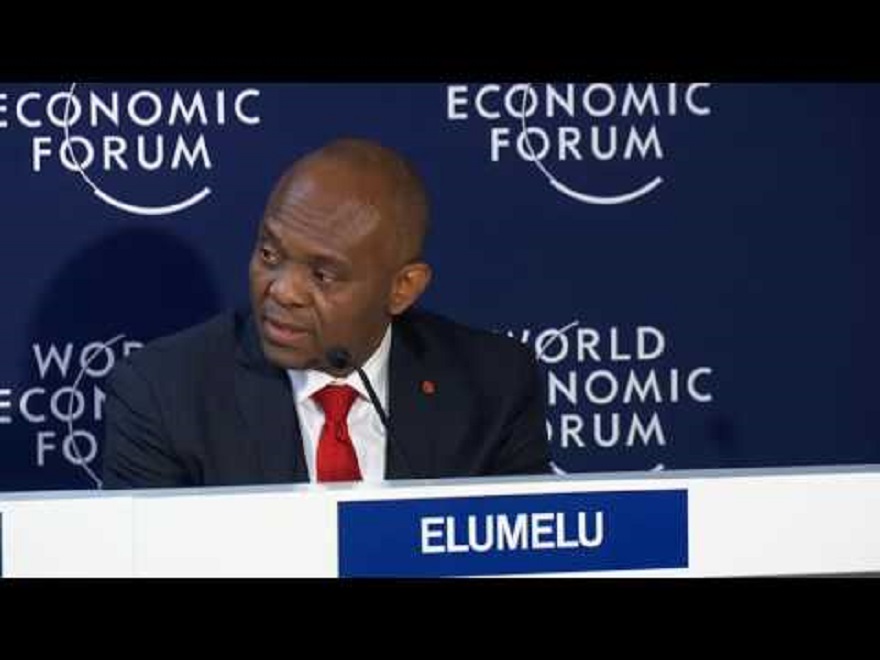
CBN’s Monetary Policies Boosted Economy, Stock Market—Elumelu

Published

on

By Dipo Olowookere

Chairman of United Bank for Africa (UBA) Plc, Mr Tony Elumelu, has heaped praises on Governor of the Central Bank of Nigeria (CBN), Mr Godwin Emefiele.

According to the Chairman of Heirs Holdings and Founder of the Tony Elumelu Foundation, the fiscal and monetary policies put in place by the apex bank when Nigeria was in recession in 2016 helped in the putting back the economy on its feet.

Mr Elumelu further said the interventions of the CBN also buoyed the performance of the stock market last year, which closed over 40 percent higher, making it among the top five performers in the world in 2017.

Speaking in an interview with ThisDay, the serial entrepreneur, who is presently in Davos, Switzerland for the World Economic Forum (WEF), disclosed that he has a huge confidence in the nation’s economic recovery especially with the equities market sustaining its gains.

As at the close of business on Tuesday, January 23, 2018, the Nigerian stock market has risen by 16.07 percent this year alone and analysts believe the market will close 2018 higher than last year.

Mr Elumelu praised the Chief Executive Officer of the Nigerian Stock Exchange (NSE), Mr Oscar Onyema, saying “their commitment to governance and market integrity has increased investors’ confidence in the market.”

He said further that, “Consolidating on the 42 percent rally in 2017, the benchmark All Share Index has gained 18 percent year-to-date, an unprecedented return in recent times, driven by renewed local and foreign investor confidence in the Nigerian economy and markets.

“The valuation of the Nigerian market, which is currently on a 14.5x P/E, still trades at a discount to its frontier market peers and more so, at a gross undervaluation to emerging market peers, especially when we take the improving fundamentals of the economy in perspective.

“Further reinforcing prospects for the equities market, is the moderating yield on fixed income securities, given the lower interest rate outlook. I fully expect fund managers to continue to allocate increasing money to Nigerian equities.”

Speaking further, the Chairman of Transcorp Plc said, “The fruits of patient and judicious central bank interventions are being rewarded by increasing local and international investor confidence, demonstrated by the recent unprecedented performance of the Nigerian equities market and the broader improvement in the domestic macroeconomic environment.”

According to him, “Nigeria’s external reserves, which are now at almost a five-year-high, have grown to over $40 billion, just as trade and current account balances are now positive. This strong performance underpins the naira today and will indeed ensure its stability in the near and medium term.

“Inflation, which peaked at 18.7 percent a year ago, has continuously trended downwards to 15.37 percent in December 2017, with a benign outlook of further moderation, as both food and core inflation ease.

“These impressive positive developments are a clear demonstration of effective monetary policy management and businesses across Nigeria need to recognise the role of the CBN governor.”

“I salute the unwavering tenacity and enterprise of the CBN governor, Godwin Emefiele, for his initiative in creating the Investors’ and Exporters’ (I&E) window and, more importantly, the commitment of the governor in ensuring the efficient functioning of this market.

“The I&E window has attracted over $15 billion to Nigeria, enhanced the liquidity of the FX market, reduced speculative demand for foreign currency, stabilised the naira and provided the vital foundation for renewed local and foreign investors’ confidence in the Nigerian market,” Mr Elumelu said.

He also commended President Muhammadu Buhari the clear and coherent policy-making framework put in place his administration, including “the positive engagement with the Niger Delta people, which has returned calm to this oil-producing region of the country leading to the current daily production of 2.2 million barrels of oil equivalent.”

However, Mr Elumelu cautioned that Nigeria must translate these recent improvements into a long-term strategy of ensuring economic success for all.


Dipo Olowookere is a journalist based in Nigeria that has passion for reporting business news stories. At his leisure time, he watches football and supports 3SC of Ibadan. Mr Olowookere can be reached via [email protected]

Click to comment

Leave a Reply

Your email address will not be published. Required fields are marked *

Economy

4.964 billion Shares Worth N207.5bn Exchange Hands in 235,966 deals in Four Days

Published

on

nigerian shares

By Dipo Olowookere

The Nigerian Exchange (NGX) Limited opened its doors to market participants in four days last week as a result of a public holiday observed on Friday, June 12, for 2026 Democracy Day in the country.

In the week, investors bought and sold 4.964 billion shares worth N207.521 billion in 235,966 deals, as against the 3.966 billion shares valued at N175.659 billion that exchanged hands in 343,587 deals a week earlier.

Analysis showed that the financial services industry led the activity chart with 4.116 billion shares valued at N84.607 billion in 96,165 deals, contributing 82.92 per cent and 40.77 per cent to the total trading volume and value, respectively.

The services sector transacted 232.479 million shares worth N4.955 billion in 17,614 deals, while the industrial goods segment exchanged 144.988 million shares worth N39.077 billion in 24,775 deals.

Sterling Holdings, FCMB, and Access Holdings were the most traded stocks with 2.883 billion units sold for N36.188 billion in 15,533 deals, accounting for 58.09 per cent and 17.44 per cent of the total trading volume and value, respectively.

A total of 40 equities appreciated in the week versus 23 equities in the previous week, 53 equities depreciated versus 65 equities a week earlier, and 53 equities remained unchanged versus 58 equities in the preceding week.

ABC Transport was the best-performing equity for the week after it gained 25.60 per cent to trade at N7.80, Consolidated Hallmark appreciated by 23.13 per cent to N8.25, Abbey Mortgage Bank rose by 21.93 per cent to N11.40, Infinity Trust Mortgage Bank grew by 20.32 per cent to N11.25, and Austin Laz soared by 15.16 per cent to N4.33.

The worst-performing equity last week was Fidson Healthcare because of its 25.86 per cent loss, closing at N101.20. Neimeth declined by 19.14 per cent to N8.55, Union Homes REIT shed 17.36 per cent to close at N70.00, SUNU Assurances slipped by 11.38 per cent to N3.97, and Unilever Nigeria dropped 10.26 per cent to trade at N140.00.

As for the index movement, the All-Share Index (ASI) and the market capitalisation chalked up 0.88 per cent each to settle at 244,738.74 points and N156.970 trillion, respectively.

Similarly, all other indices finished higher apart from the pension, AFR Bank Value, MERI Growth, MERI Value, consumer goods, Lotus II, industrial goods, sovereign bond and commodity indices, which fell by 0.03 per cent, 1.20 per cent, 0.21 per cent, 1.61 per cent, 0.54 per cent, 0.51 per cent, 1.00 per cent, 2.04 per cent and 0.34 per cent, respectively.

Continue Reading

Economy

Brent Falls to $87 Per Barrel on Expected US-Iran Peace Deal

Published

on

Brent crude futures

By Adedapo Adesanya

Brent crude prices fell by $3.05 or 3.37 per cent to $87.33 per barrel on Friday, the lowest level since early March, triggered by expectations of an imminent ‌peace agreement between the United States and Iran.

Also, the US West Texas Intermediate (WTI) crude finished at $84.88 a barrel after it gave up $2.83 or 3.23 per cent. It was its lowest level since April 17.

Reuters reported that a memorandum between the US and Iran to halt the war in the Gulf could be signed as soon as Sunday, citing sources.

The sources indicate that the US would immediately begin releasing billions of Dollars in frozen Iranian assets and waive sanctions on its oil exports, in return for Iran opening the strait.

The proposals also include discussion of possible war reparations for Iran and dropping longstanding US demands for limits on Iran’s missile program, the sources were quoted as saying.

Meanwhile, Iranian Foreign Minister Abbas Araqchi said on Friday that a memorandum of understanding had not yet been signed and could still change.

He also said that management of the Strait of Hormuz would not ⁠return to the pre-war era, that sovereignty over the strait belonged to ⁠Iran and Oman, and that Iran would secure safe ⁠passage for ships through it.

US President Donald Trump called off threatened air strikes against Iran on Thursday, while it was reported that final negotiations on the memorandum would focus on nuclear and economic issues but would exclude discussions about Iran’s missile programme.

On Thursday, Iran ‌announced ⁠a complete closure of the Strait of Hormuz, saying it would fire on any ship trying to pass through.

Traffic through the strait, which normally carries a fifth of global oil and liquefied natural gas shipments, has been extremely limited as a result of the war.

The US military, however, said on social media that commercial ships continued to transit the waterway.

Goldman Sachs lowered its 2027 average Brent forecast to $80 a barrel ⁠on higher supply and lower demand, but expects prices to exceed the 2025 average on stockpiling of OECD commercial oil stocks and a security premium for disruptions.

The Organisation of the Petroleum Exporting Countries (OPEC) on Thursday lowered its forecast for 2026 world oil demand growth to 970,000 barrels per day ⁠from a previous 1.17 million barrels per day, its second straight downward revision.

Continue Reading

Economy

Standard Bank Describes Dangote Refinery as Transformational Industrial Project

Published

on

standard bank dangote refinery

By Modupe Gbadeyanka

The Lagos-based Dangote Petroleum Refinery has been described by Standard Bank Group as a transformational industrial project with far-reaching implications for Nigeria and Africa.

The company, which is Africa’s largest financial institution, gave this description after a tour of the facility recently.

Standard Bank, the parent company of Stanbic IBTC Holdings, has promised to support the planned listing of the 650,000 barrels per day refinery and expressed readiness to finance future expansion projects across the continent.

The chief executive of the lender, Mr Sim Tshabalala, said, “We are here because the Dangote Group is a large and important global player and a significant force on the African continent.”

“Standard Bank is the largest financial institution in Africa, and we have partnered with Dangote on a variety of initiatives. We are here to lend support, to see this magnificent refinery and to discuss Vision 2030 and how we can continue supporting the Group’s growth ambitions,” he added.

Mr Tshabalala disclosed that Standard Bank intends to play a leading role in the refinery’s planned Initial Public Offering and future growth initiatives.

“As Dangote lists, there is an IPO coming up, and we are a leading player in that process,” he said, adding that, “As the group continues to expand in Nigeria and across Africa, there will be opportunities for financial advisory services and balance sheet support, and we stand ready to provide both.”

He further described the refinery as “a wonder of the world,” noting that its impact is already being felt through stronger foreign exchange earnings, improved balance-of-payments performance and enhanced energy security.

“This is a wonder to behold. It is massive, productive and transformative. It is already making a significant contribution to Nigeria’s economy through its impact on foreign reserves, the balance of payments and the lives of ordinary Nigerians,” he said.

The Group Vice President for Oil and Gas at Dangote Industries Limited, Mr Devakumar Edwin, said the visit represented a significant milestone in a partnership that began during the refinery’s construction phase.

“The bank visited us during construction and understood the scale of what we were building,” Mr Edwin said. “Today, the refinery is fully operational, and they can see what their support has helped to create. It is like nurturing a tree and eventually seeing it bear fruit.”

He added that both organisations are exploring opportunities to deepen collaboration as Dangote expands its industrial footprint across Africa.

Also speaking, the chief executive of Dangote Petroleum Refinery, Mr David Bird, said the visit highlighted the importance of long-term partnerships in delivering large-scale industrial projects.

“Standard Bank has been one of our strongest supporters throughout the history of the refinery and the broader Dangote Group.

“This visit was an opportunity to demonstrate what that support has enabled. Seeing is believing, and it allows our partners to appreciate the scale of what has been achieved,” Mr Bird stated.

The visit also coincided with a major operational milestone for the refinery, which has now exceeded its original design capacity.

Mr Bird disclosed that the refinery recently completed performance test runs at 700,000 barrels per day, above its nameplate capacity of 650,000 barrels per day.

“We have always believed there was engineering flexibility built into the design,” he said. “Achieving sustained production of 700,000 barrels per day is a testament to the technical capability of our people and the strength of the systems we have built.”

Continue Reading

Trending