
Economy
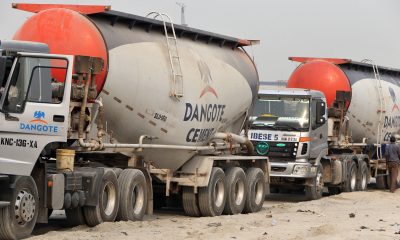
Dangote Cement Leads 18 Other Stocks to Weaken Nigerian Equity Market by N170b


By Dipo Olowookere
The Nigerian stock market kicked off the first trading day on a poor note, losing N170 billion at the close of transactions on Monday.
Business Post reports that profit-taking by investors today depleted the Nigerian Stock Exchange (NSE) by 1.24 percent with the Year-to-Date (YtD) gain shrinking to 41.24 percent.
Specifically, the All-Share Index (ASI) depreciated by 478.12 points to settle at 37,957.96 points, while the market capitalisation decreased by N170.2 billion to close at N13.508 trillion.
The market breadth today settled at equilibrium, as 19 stocks appreciated in price as well as 19 equities, which depreciated in value.
However, the volume of equities transacted increased by 76.86 percent from 425.3 million to 752 million, while the total value of shares traded rose by 1294.55 percent from N9.2 billion to N127.9 billion.
At the close of business on Monday, the Industrial Goods sector led the activity chart with 551.7 million shares exchanged for N124.2 billion, and was followed by the Financial Services industry, which sold 166 million shares valued at N3 billion.
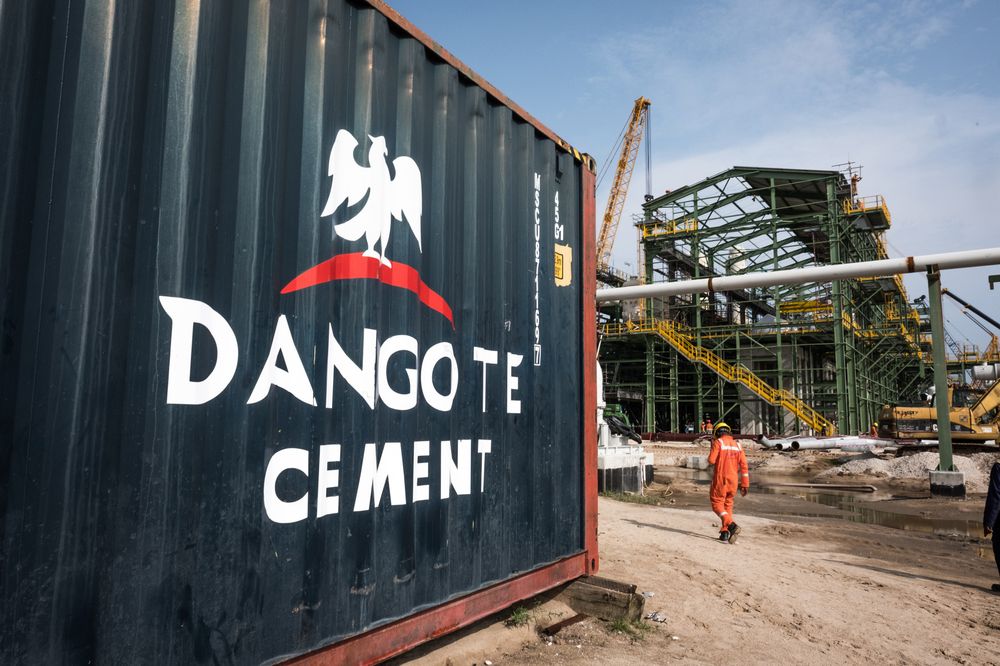
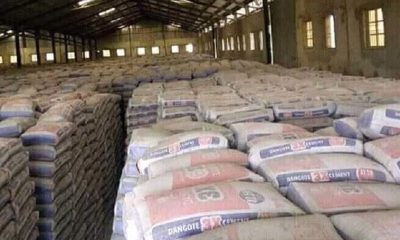
The transactions recorded by the Industrial Goods sector was buoyed by the huge sales recorded by Dangote Cement, which traded 550 million shares worth N124.2 billion.
This transaction was done as an off-market trade at N225.68 in a single deal, which was negotiated between Meristem Stockbrokers Ltd (seller) and CSL Stockbrokers Ltd (buyer).
GTBank emerged the second most traded stock with 41.3 million shares sold for N1.7 billion, while Zenith Bank traded 35.3 million shares valued at N904.3 million.
FBN Holdings exchanged 21.7 million shares worth N192.3 million, and UBA transacted 21.5 million shares for N218 million.
A look at the price movement chart today showed Dangote Cement emerging the biggest price loser, depreciating by N10 to close at N230 per share.
It was trailed by International Breweries, which went down by N2.74k to finish at N52.10k per share, and NASCON, which depreciated by 96k to settle at N18.34k per share.
Cadbury Nigeria lost 87k to close at N13.90k per share, while Flour Mills of Nigeria declined by 83k to end at N30 per share.
On the other hand, Presco gained the highest amount, appreciating by N5.83k to close at N72 per share.
Lafarge increased by 49k to finish at N43.50k per share, and Dangote Flour rose by 38k to end at N12.18k per share.
Furthermore, Union Bank progressed by 37k to settle at N7.92k per share, while FBN Holdings went up by 26k to close at N9 per share.










By Adedapo Adesanya
Oil prices moved up by about 1 per cent on Thursday amid volatile trading due to the fragile Middle East ceasefire, with Brent crude futures gaining $1.17 or 1.2 per cent to sell at $95.92 a barrel, and the US West Texas Intermediate (WTI) crude futures expanding by $3.46 or 3.7 per cent to $97.87 a barrel.
Initially, prices rose over doubts about the two‑week ceasefire between the United States and Iran, as well as concerns about ongoing restrictions to energy flows through the Strait of Hormuz. The waterway connects supply from Gulf producers such as Iraq, Saudi Arabia, Kuwait and Qatar to global markets, and typically carries 20 per cent of global oil and gas supply.
The ceasefire hadn’t held for 24 hours when Israel continued air strikes on Lebanon, which Iran said was a violation of the deal with America and signalled the shutting down of the Strait of Hormuz again.
However, Israeli Prime Minister Benjamin Netanyahu on Thursday said he had instructed officials to open peace talks with Lebanon, including discussions on disarming Hezbollah.
Ship traffic through the Strait of Hormuz fell to well below 10 per cent of normal volumes on Thursday after Iran asserted control by warning vessels to remain within its territorial waters, and prices for some physical oil grades hit fresh all-time highs.
Shippers on Wednesday said they needed clarity on the terms of the ceasefire before resuming transit through the strait. Iran has issued maps to guide ships around mines and show safe paths for passage.
Concerns over supply disruptions in Saudi Arabia resurfaced as the kingdom’s oil production capacity was reduced by about 600,000 barrels per day and cut throughput on its East‑West Pipeline by roughly 700,000 barrels per day.
Regional oil facilities remain under threat, with Iran striking sites in nearby countries after the ceasefire. Kuwait, Bahrain and the UAE also reported missile and drone attacks by Iran.
The ceasefire has led Goldman Sachs to trim its second‑quarter 2026 forecasts for Brent and US crude to $90 and $87 a barrel, respectively, from previous forecasts that Brent and WTI oil prices would average $99 and $91 a barrel, respectively. It also forecast that if the Strait of Hormuz remains essentially closed to normal traffic for another month, Brent Crude prices would average more than $100 per barrel in the second half of 2026 and throughout the year.

By Adedapo Adesanya
Revenue from Company Income Tax (CIT) in the fourth quarter of 2025 decreased by 49.8 per cent to N1.487 trillion from N2.96 trillion in the third quarter of 2025, according to the National Bureau of Statistics (NBS).
The figure was contained in the NBS Company Income Tax (CIT) Q4 2025 Report released in Abuja on Wednesday by the stats office.
CIT is a statutory levy imposed on the profits of incorporated businesses in Nigeria. It is governed primarily by the Companies Income Tax Act (CITA) and administered by the Nigeria Revenue Service (NRS).
The report said domestic CIT received was N819.83 billion (55 per cent), while foreign CIT payment was N668.21 billion (45 per cent) in Q4 2025.
It said on a quarter-on-quarter basis, activities of extraterritorial organisations and bodies recorded the highest growth rate with 75.15 per cent,
The report said this was followed by Education and real estate activities at 54.20 per cent and 27.25 per cent, respectively.
“On the other hand, accommodation and food services activities recorded the least growth rate at -67.11 per cent, followed by activities of households as employers, undifferentiated goods and services producing activities of households for own use at -63.49 per cent.
“It said mining quarrying was recorded at -49.63 per cent.”
In terms of sectoral contributions, the report showed that the top three activities with the highest contribution in Q4 2025 were financial and insurance activities at 18.17 per cent, manufacturing at 17.30 per cent and mining and quarrying at 15.04 per cent.
It said, on the other hand, the activities of households as employers, undifferentiated goods and 0.002 per cent.
“This was followed by water supply, sewage, waste management and remediation activities with 0.04 per cent.
The report, however, said that, on a year-on-year basis, CIT collections in Q4 2025 increased by 13.38 per cent from Q4 2024.

By Adedapo Adesanya
The World Bank has warned that Nigeria’s economic recovery has yet to improve household welfare as wage growth continues to lag behind inflation, leaving real incomes under pressure.
This was disclosed in its April 2026 Nigeria Development Update titled Nigeria’s Tomorrow Must Start Today: The Case for Early Childhood Development.
According to the report, while the Nigerian economy recorded moderate growth in 2026, following expansions of 4.1 per cent in 2024 and 4.0 per cent in 2025, the gains have not translated into improved living standards for most citizens.
It stated that growth was largely driven by the services sector, particularly ICT, financial services, and real estate, while agriculture and crude oil production made modest contributions.
On inflation, the report said price pressures have eased but remain in double digits, partly due to the impact of the Middle East conflict.
The lender noted that multidimensional poverty and weak early childhood development outcomes are threatening Nigeria’s long-term economic potential, despite signs of macroeconomic recovery.
The report explained that Nigeria is facing a deep early childhood development crisis, with poor outcomes in health, nutrition, and learning undermining productivity and future growth.
It emphasised that early childhood development, especially from pregnancy to age five, is critical to reversing the trend.
“Investments during this period generate lasting benefits, including better education outcomes, higher earnings, lower health costs, and stronger social cohesion. Investments during this period are highly cost-effective,” the report said.
The report highlighted alarming child welfare indicators, noting that 110 out of every 1,000 Nigerian children die before the age of five, 40 per cent are stunted, and 52 per cent are not developmentally on track before entering school.
It attributed these outcomes to persistent gaps in maternal healthcare, nutrition, early learning, and access to water and sanitation, particularly within the first 2,000 days of a child’s life.
The bank added that these outcomes remain “weak and highly unequal,” with significant disparities across income levels, regions, and states.
The report further revealed that favourable external inflows boosted reserves, with net external reserves rising to $34.8 billion at the end of 2025, while gross reserves reached $45.5 billion, equivalent to 8.7 months of imports.
However, it noted that Nigeria’s fiscal deficit widened slightly in 2025, as increased non-oil revenues were offset by higher state-level capital spending and federal recurrent expenditure.
“Federation Account Allocation Committee (FAAC) gross revenues rose from 7.9 per cent of GDP in 2024 to 8.5 per cent in 2025, driven by strong non-oil tax collections reflecting improved tax administration.
“This includes expanded e-filing and e-payments, higher compliance ahead of the implementation of the new tax bills, and the rollout of VAT e-invoicing, alongside a 0.2 per cent of GDP rise in subnational internally generated revenues,” the report stated.
-
 Feature/OPED6 years ago
Davos was Different this year
-
Travel/Tourism10 years ago
Lagos Seals Western Lodge Hotel In Ikorodu
-

 Showbiz3 years ago
Estranged Lover Releases Videos of Empress Njamah Bathing
-
 Banking8 years ago
Sort Codes of GTBank Branches in Nigeria
-

 Economy3 years ago
Subsidy Removal: CNG at N130 Per Litre Cheaper Than Petrol—IPMAN
-

 Banking3 years ago
Sort Codes of UBA Branches in Nigeria
-

 Banking3 years ago
First Bank Announces Planned Downtime
-

 Sports3 years ago
Highest Paid Nigerian Footballer – How Much Do Nigerian Footballers Earn