Economy
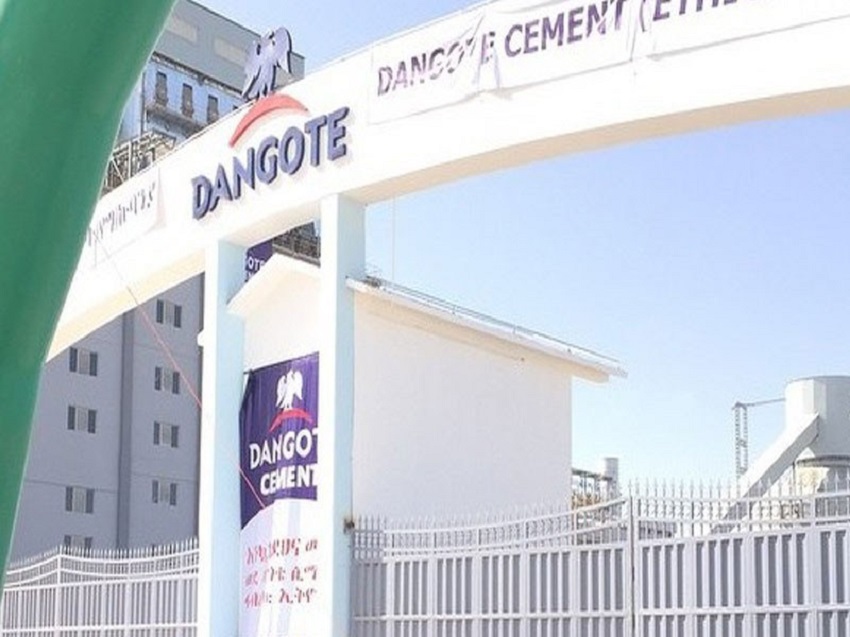
Dangote Cement Targets 35 million tons Capacity by 2020
By Dipo Olowookere
Chairman of Dangote Cement Plc, Mr Aliko Dangote, has disclosed that the cement giant plans to increase its production capacity in Nigeria by six million tons by next year.
Mr Dangote, who is Africa’s richest man, said at a function in Lagos on Thursday that the firm was working to raise the installed capacity for cement production from the present 29 million tons to 35 million by 2020.
“In Nigeria alone, we have 29 million tons installed capacity for cement production and we will be at 35 million by 2020,” Mr Dangote said while speaking at the commissioning of the N85 million Chemical and Non-Metallic Employers Federation (CANMPEF) House.
He described Dangote Cement, which controls a larger market share in the country, as one of the most employer of labour. According to him, “Dangote Cement Plc alone provides employment to over 25,000 people across the nation.”
He said this was made possible as a result of its determination of being importer of cement into the country to an exporter of the product to other nations.
“We have contributed hugely to the nation’s successful transition from being at one time the world’s largest importer of cement to the position we are today where we not only are self-sufficient in cement, but indeed are net exporters of cement,” he said.
Mr Dangote commended CANMPEF for contributing to the development of Nigeria, saying at the event that, “I am aware that CANMPEF is Nigeria’s largest employer’s federation, with your members spread in various locations across Nigeria and fully engaged in various value-added activities that are creating wealth and employment for millions of Nigerians.”
He further applauded the organization for the successful completion of the house, noting that, “I am told that CANMPEF House was built at a cost of about N85 million and that it is a multipurpose facility that will cater for a wide range of developmental work.”
Economy
NGX Market Capitalisation Nears N140trn After 2.49% Gain
By Dipo Olowookere
The total value of stocks on the Nigerian Exchange (NGX) Limited inched closer to N140 trillion after a 2.49 per cent rise on Friday.
Data from Customs Street showed that the market capitalisation increased by N3.391 trillion during the session to N139.827 trillion from the previous day’s N136.436 trillion.
Similarly, the All-Share Index (ASI) of the trading platform went up yesterday by 5,266.56 points to settle at 217,167.57 points compared with the preceding session’s 211,901.01 points.
The continued demand for Nigerian equities, especially MTN Nigeria, Ecobank and others, buoyed the growth achieved by the bourse during the session.
Also, bargain-hunting across the key sectors of the market ensured that the bulls maintained control, with the banking space growing by 3.64 per cent. The energy sector appreciated by 3.29 per cent, the consumer goods index improved by 1.23 per cent, the industrial goods counter expanded by 0.68 per cent, and the insurance segment grew by 0.37 per cent.
Investor sentiment remained strong after a positive market breadth index, with 43 appreciating shares and 27 depreciating shares.
NAHCO chalked up 10.00 per cent to close at N220.00, Trans-Nationwide Express advanced by 10.00 per cent to N6.05, Ecobank gained 9.97 per cent to finish at N67.30, Access Holdings increased by 9.93 per cent to N29.90, and DAAR Communications jumped 9.64 per cent to N1.82.
Conversely, Mecure lost 9.96 per cent to trade at N60.60, Honeywell Flour declined by 9.52 per cent to N19.00, Abbey Mortgage Bank dropped 9.50 per cent to quote at N8.10, eTranzact crashed by 9.27 per cent to N18.60, and Caverton gave up 9.02 per cent to close at N5.55.
It was a busy day for the NGX as market activity improved, with the trading volume rising by 122.22 per cent to 1.3 billion stocks from the 585.0 million stocks transacted a day earlier.
Also, the trading value went up by 56.32 per cent to 54.4 billion from 34.8 billion, while the number of deals soared by 24.94 per cent to 56,923 deals from 45,559 deals.
Leading the activity log on the last trading day of this week was Sterling Holdco with 383.9 million equities valued at N3.1 billion. Access Holdings traded 90.3 million shares worth N2.7 billion, Zenith Bank transacted 70.8 million stocks for N8.8 billion, UBA exchanged 54.6 million equities worth N2.6 billion, and Japaul sold 44.4 million shares valued at N146.4 million.
Economy
Crude Oil Slips to $88 Per Barrel as Iran Reopens Strait of Hormuz
By Dipo Olowookere
The price of crude oil on the global market dropped below the $90 per barrel mark on Friday after Iran announced the reopening of the Strait of Hormuz.
About 20 per cent of the world’s total oil and liquefied natural gas (LNG) consumption passes through this narrow body of water between Iran and Oman.
It was shut down by Iran after the United States and Israel launched airstrikes on it in late February 2026.
For the past few days, there have been talks between the US and Iran over the reopening of the Strait. The Middle East country reopened it after Israel and Lebanon struck a deal.
This action crashed the price of crude oil today, with the Brent grade selling at about $88 per barrel and the West Texas Intermediate (WTI) grade trading at $83 per barrel as of the time of filing this report.
Iranian Foreign Minister, Mr Abbas Araghchi, announced the reopening of the Strait of Hormuz, with the move already welcomed by President Donald Trump of the United States.
It will remain open during the ceasefire while further negotiations continue between America and Iran.
“In line with the ceasefire in Lebanon, the passage for all commercial vessels through the Strait of Hormuz is declared completely open for the remaining period of the ceasefire, on the coordinated route as already announced by Ports and Maritime Organisation of the Islamic Republic of Iran,” the Minister posted on X, formerly Twitter, on Friday.
This news will surely excite Nigerians, who have been forced to pay more to buy petroleum products since the war started, despite living in an oil-producing country.
The price of petrol jumped from about N827 per litre before the war to N1,250 and almost N1,300 per litre because of the Middle East crisis.
Dangote Refinery, which majorly supplies the local market, claimed it was buying crude oil at an international price.
Economy
Tinubu Signs N68.32trn 2026 Budget into Law, Extends Implementation Period
By Adedapo Adesanya
President Bola Tinubu has signed the 2026 Appropriation Bill into law, authorising an aggregate expenditure of N68.32 trillion for the current fiscal year.
He also signed a separate bill extending the implementation period of the 2025 budget from March 31 to June 30, 2026.
The budget allocates N4.799 trillion for statutory transfers and N15.8 trillion for debt service.
It further sets aside N15.4 trillion for recurrent expenditure and N32.2 trillion for capital expenditure through the Development Fund.
In a statement signed by Special Adviser to the President on Information and Strategy, Mr Bayo Onanuga, on Friday, it was that, “The N68.32 trillion budget for this year earmarks N4.799 trillion for statutory transfers and N15.8 trillion for debt service. It allocates N15.4 trillion to recurrent expenditure and N32.2 trillion to the Development Fund for Capital Expenditure.”
“With capital expenditure accounting for about 50 per cent, the 2026 budget underscores the administration’s continued commitment to economic stability, national security, infrastructure development, and inclusive growth.
“The allocations reflect a strategic balance between statutory obligations, debt servicing, recurrent expenditure, and capital investments critical to driving productivity and improving the quality of life for Nigerians,” it added.
The 2026 Appropriation Act took effect on April 1, with the federal government commencing full implementation in line with what the presidency describes as the Renewed Hope Agenda.
President Tinubu also assented to the Appropriation (Repeal and Enactment) (Amendment) Bill, 2026, which extends the capital component of the 2025 Appropriation Act by three months to June 30.
The presidency said the extension would ensure the full utilisation of appropriated funds, particularly for critical infrastructure projects at advanced stages of implementation.
“The extension will ensure the full and effective utilisation of appropriated funds, particularly for critical infrastructure and development projects that are at advanced stages of implementation across the country.
“It will enable Ministries, Departments, and Agencies (MDAs) to consolidate ongoing works, enhance project completion rates, and maximise value for public expenditure,” the statement read.
He directed MDAs to ensure disciplined, transparent, and efficient utilisation of allocated resources, with strong emphasis on value for money and timely project delivery.
The President reaffirmed the importance of sustained collaboration between the Executive and Legislative arms of government in advancing national development objectives, the statement noted.
President Tinubu also assured Nigerians of his administration’s resolve to deepen fiscal reforms and boost revenue generation.
-
Feature/OPED6 years agoDavos was Different this year
-
Travel/Tourism10 years ago
Lagos Seals Western Lodge Hotel In Ikorodu
-
Showbiz3 years agoEstranged Lover Releases Videos of Empress Njamah Bathing
-
Banking8 years agoSort Codes of GTBank Branches in Nigeria
-
Economy3 years agoSubsidy Removal: CNG at N130 Per Litre Cheaper Than Petrol—IPMAN
-
Banking3 years agoSort Codes of UBA Branches in Nigeria
-
Banking3 years agoFirst Bank Announces Planned Downtime
-
Sports3 years agoHighest Paid Nigerian Footballer – How Much Do Nigerian Footballers Earn