Economy
Dangote Refinery Acquires Trucks for Free Delivery of Petrol, Diesel Nationwide
By Aduragbemi Omiyale
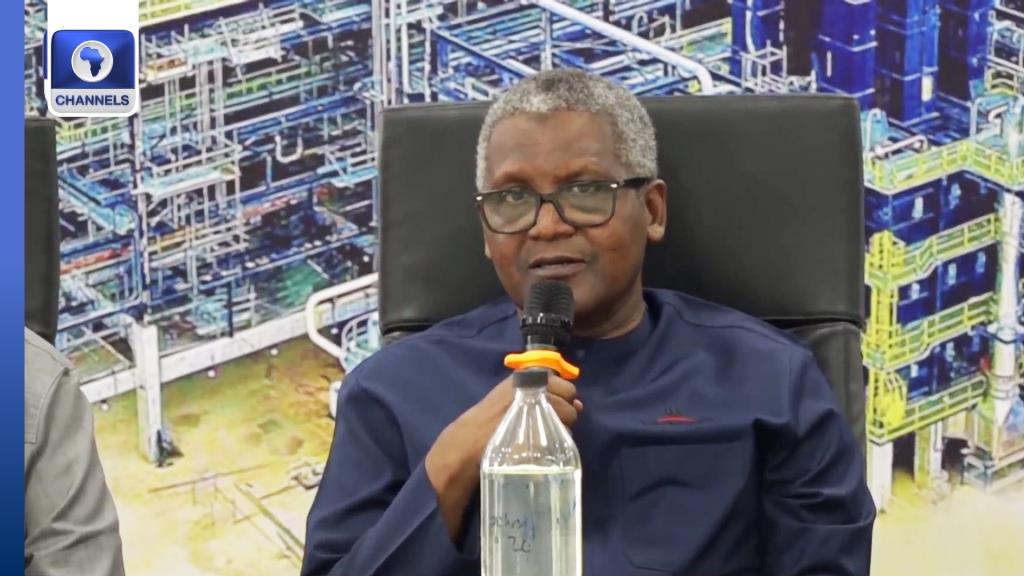
From Friday, August 15, 2025, Dangote Petroleum Refinery will commence the distribution of Premium Motor Spirit (PMS), otherwise known as petrol, and diesel across the nation to marketers, petrol dealers, manufacturers, telecoms firms, aviation, and other large users with free logistics to boost distribution network.
The company disclosed in a statement on Sunday that this initiative is to transform Nigeria’s fuel distribution landscape.
To ensure smooth take-off of this scheme, Dangote Refinery has invested in the procurement of 4,000 brand-new Compressed Natural Gas (CNG)-powered tankers.
This phase of the programme will continue over an extended timeframe. The refinery is also investing in Compressed Natural Gas (CNG) stations, commonly referred to as daughter booster stations, supported by a fleet of over 100 CNG tankers across the country to ensure seamless product distribution.
This strategic programme is part of our broader commitment to eliminating logistics costs, enhancing energy efficiency, promoting sustainability and supporting Nigeria’s economic development. It affirms our dedication to improving the availability and affordability of fuel, in support of broader efforts to strengthen the economy and improve the well-being of all Nigerians.
Under this initiative, all petrol stations purchasing PMS and diesel from the Dangote Petroleum Refinery will benefit from this enhanced logistics support. Key sectors such as manufacturing, telecommunications, and others will also gain from this transformative initiative, as reduced fuel costs will contribute to lower production costs, reduced inflation, and foster economic growth. Players in these key sectors and others can purchase directly from the Dangote Petroleum Refinery.
In addition, the refinery will offer a credit facility to those purchasing a minimum of 500,000 litres—allowing them to obtain an additional 500,000 litres on credit for two weeks, under bank guarantee.
This pioneering effort marks a major milestone in our vision to revolutionise Nigeria’s energy sector. Dangote Refinery is dedicated to ensuring that no place is left behind.
“Our goal is to provide equitable access to affordable fuel for all Nigerians, regardless of location, making energy more accessible and sustainable for everyone, wherever they may be.
“It is expected to revitalise previously inactive petrol stations, thereby driving job creation, stimulating small and medium-sized enterprises (SMEs), increasing government revenue, improving fuel access in rural and underserved communities, and strengthening investor confidence in Nigeria’s downstream petroleum sector.
“This initiative is in line with the Renewed Hope Agenda of President Bola Ahmed Tinubu, reflecting our shared commitment to economic progress, stability, and inclusive development. “We sincerely thank the Federal Government for its continued support, especially through the Naira-for-Crude scheme, which has helped stabilise fuel supply amid global price volatility. It marks a major revolution in the midstream and downstream sectors and stands as a key example of President Bola Tinubu’s bold and reformative economic policies.
“We invite marketers, petrol dealers, manufacturers, telecom companies, and all key stakeholders to embrace this landmark initiative. The registration process, including Know Your Customer (KYC) verification, will take place from 16 June to 15 August, spanning a total of 60 days. For enquiries, please call +234 707 470 2099, +234 707 470 2100, +234 816 961 8390, +234 703 796 8308, +234 812 362 2893. Email: Email: [email protected],” the statement said.
Economy
NASD Unlisted Security Index Crosses 4,000-point Benchmark Again
By Adedapo Adesanya
The NASD Over-the-Counter (OTC) Securities Exchange achieved a milestone on Friday, April 24, 2026, after five securities on the platform helped with a 1.85 per cent growth.
Data showed that the NASD Unlisted Security Index (NSI) again crossed the 4,000-point benchmark yesterday.
The index chalked up 73.64 points during the trading day to close at 4,052.59 points compared with the preceding session’s 3,978.95 points, while the market capitalisation added N5.38 billion to finish at N2.424 trillion versus Thursday’s closing value of N2.380 trillion.
The price gainers were led by Okitipupa Plc, which grew by N25.00 to sell at N305.00 per share compared with the previous price of N280.00 per share. Central Securities Clearing System (CSCS) Plc gained N6.92 to close at N76.26 per unit versus N69.34 per unit, Afriland Properties Plc appreciated by N1.00 to N17.00 per share from N18.00 per share, FrieslandCampina Wamco Nigeria Plc improved by 55 Kobo to N99.55 per unit from N99.00 per unit, and Food Concepts Plc increased by 5 Kobo to N2.70 per share from N2.65 per share.
However, there was a price loser, MRS Oil, which dipped by N21.75 to N195.75 per unit from N217.50 per unit.
During the final session of the week, the value of securities jumped 75.2 per cent to N41.3 million from N23.6 million units, and the number of deals expanded by 62.9 per cent to 44 deals from 27 deals, while the volume of securities declined marginally by 0.9 per cent to 447,403 units from 451,522 units.
At the close of trades, Great Nigeria Insurance (GNI) Plc was the most traded stock by volume (year-to-date) with 3.4 billion units worth N8.4 billion, trailed by Resourcery Plc with 1.1 billion units valued at N415.7 million, and Infrastructure Guarantee Credit Plc with 400 million units traded for N1.2 billion.
GNI was also the most active stock by value (year-to-date) with 3.4 billion units sold for N8.4 billion, followed by CSCS Plc with 59.6 million units transacted for N4.0 billion, and Okitipupa Plc with 27.8 million units exchanged for N1.9 billion.
Economy
Naira Slips to N1,358/$1 as FX Reserves, Policy Uncertainty Concerns
By Adedapo Adesanya
It was not a good day for the Nigerian Naira in the currency market on Friday, April 24, as its value depreciated against the major foreign currencies at the close of transactions.
In the Nigerian Autonomous Foreign Exchange Market (NAFEX), it lost N4.53 or 0.33 per cent against the United States Dollar yesterday to trade at N1,358.44/$1, in contrast to the N1,353.91/$1 it was exchanged on Thursday.
Equally, the domestic currency slipped against the Pound Sterling in the official market during the session by N8.14 to close at N1,834.02/£1, compared with the previous rate of N1,825.88/£1 and dropped N8.01 against the Euro to sell at N1,590.73/€1 versus N1,582.72/€1.
Also, the Naira depreciated against the US Dollar at the GTBank FX desk on Friday by N4 to quote at N1,370/$1 compared with the previous session’s N1,366/$1, and at the parallel market, it depleted by N5 to settle at N1,380/$1 versus the preceding day’s N1,375/$1.
Data published by the Central Bank of Nigeria (CBN) indicated that NFEM interbank turnover surged to N43.562 million across 68 deals, up from N28.117 million the previous day.
Despite the CBN’s reassurance that the recent drop in external reserves is not worrisome, the market remains unsettled by persistent concerns over liquidity constraints, policy transparency, and weakening confidence in Nigeria’s FX market as gross reserves continue to decline to $48.4 billion.
The outlook for the Dollar appears supported by broader macro risks, including elevated oil prices tied to the tanker traffic disruptions in the Strait of Hormuz and a continued US-Iran standoff over ceasefire negotiations.
A look at the digital currency market showed that investors are sitting on the edge as the US Dollar rebounded amid geopolitical and inflation risks despite continued inflows into US spot bitcoin Exchange Traded Funds (ETFs).
Solana (SOL) rose by 1.2 per cent to sell $86.45, Cardano (ADA) appreciated by 1.1 per cent to $0.2517, Dogecoin (DOGE) grew by 0.9 per cent to $0.0989, Ripple (XRP) improved by 0.3 per cent to $1.43, Ethereum (ETH) soared by 0.2 per cent to $2,316.83, and Binance Coin (BNB) chalked up 0.1 per cent to sell for $637.44.
However, TRON (TRX) depreciated by 1.3 per cent to $0.3235, and Bitcoin (BTC) lost 0.2 per cent to close at $77,562.27, while the US Dollar Tether (USDT) and the US Dollar Coin (USDC) closed flat at $1.00 each.
Economy
Oil Market Mixed Amid Supply Disruptions, US–Iran Peace Talk Prospects
By Adedapo Adesanya
The oil market was mixed on Friday as traders weighed supply disruptions against the potential restart of peace talks between the US and Iran that could help limit those shortfalls.
Brent crude futures settled at $105.33 a barrel after rising by 26 cents or 0.3 per cent, while the US West Texas Intermediate (WTI) crude futures traded at $94.40 a barrel after falling by $1.45 or 1.5 per cent. For the week, Brent gained about 16 per cent and WTI rose nearly 13 per cent.
Reuters reported that Iranian Foreign Minister Abbas Araqchi was expected to arrive in Islamabad late on Friday to discuss proposals for resuming peace talks with the U.S. after talks collapsed earlier this week.
Also, CNN reported that US President Donald Trump was sending special envoy Steve Witkoff and Jared Kushner to Pakistan for talks with Iran’s foreign minister.
The American President also told Reuters on Friday that Iran plans to make an offer aimed at satisfying US demands. On Thursday, he said Iran may have loaded up its weaponry “a little bit” during a two-week ceasefire, but added that the US military could eliminate it in a single day. On Wednesday, he said he would indefinitely extend the ceasefire to allow for further peace talks.
Meanwhile, navigation through the Strait of Hormuz, which before the war carried about a fifth of global oil output, remains effectively blocked.
Iran’s Islamic Revolutionary Guard Corps seized two container ships – MSC Francesca and Epaminondas – following the US’ seizure of the Iranian cargo ship Touska, putting a drastic halt to attempts to pass through the Strait of Hormuz by non-oil tankers.
The head of the International Energy Agency (IEA), Mr Fatih Birol, said that the Iran war has permanently changed the fossil fuel industry, adding that the damage to confidence in fossil fuel security is permanent, and that countries exposed to the Strait of Hormuz disruption will rethink how much geopolitical risk they are willing to embed in their energy systems.
Analysts from JPMorgan argued that prices may need to rise further to force additional demand destruction. Goldman Sachs estimates Gulf oil production is down 57 per cent from pre-war levels, which are shortage signals, not evidence of a fossil fuel system in retreat.
-
Feature/OPED6 years agoDavos was Different this year
-
Travel/Tourism10 years ago
Lagos Seals Western Lodge Hotel In Ikorodu
-
Showbiz3 years agoEstranged Lover Releases Videos of Empress Njamah Bathing
-
Banking8 years agoSort Codes of GTBank Branches in Nigeria
-
Economy3 years agoSubsidy Removal: CNG at N130 Per Litre Cheaper Than Petrol—IPMAN
-
Banking3 years agoSort Codes of UBA Branches in Nigeria
-
Banking3 years agoFirst Bank Announces Planned Downtime
-
Sports3 years agoHighest Paid Nigerian Footballer – How Much Do Nigerian Footballers Earn