Economy
Dangote, Rewane, Others Make Tinubu’s Economic Advisory Team
By Aduragbemi Omiyale
An economic advisory team has been instituted by President Bola Tinubu as his government intensifies efforts to ease the hardship Nigerians are going through.
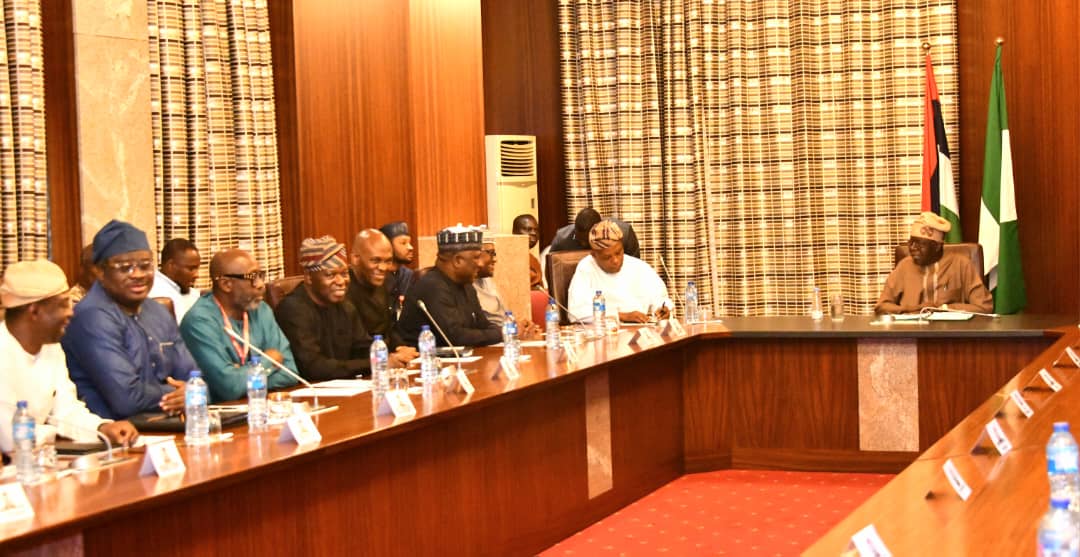
On Sunday, Mr Tinubu had a meeting with some state governors and some key stakeholders in the organised private sector.
At the gathering, the President disclosed how he’s working to ensure the dividends of democracy are delivered to the people he promised Renewed Hope while he was campaigning for the position last year.
Since he assumed office on May 29, 2023, the country’s economy has tumbled, with the prices of goods and services rising at abnormal rates, and the exchange rate going berserk in the foreign exchange (FX) market.
Already, some Nigerians have expressed their displeasure over the economic crisis through a pocket of protests in Niger, Kano, Lagos, Ogun, and Oyo States.
The Nigeria Labour Congress (NLC) has also called for a two-day nationwide demonstration from Tuesday, February 27, 2024, over the high cost of living. Efforts are being made to stop the labour protest tomorrow.
To deescalate the tension, President Tinubu formed his economic advisory panel comprising Governor Dapo Abiodun of Ogun State, Governor Charles Soludo of Anambra State, Mr Aliko Dangote, Mr Abdul Samad Rabiu, Mr Tony Elumelu, Mr Bismarck Rewane, and Mr Segun Ajayi-Kadir of the Manufacturers Association of Nigeria (MAN), among others.
The President informed them at the meeting held at the State House in Abuja that the goal is to “bring life back to the economy” and ensure the “best economic future” for Nigerians.
“Let’s look at what we’re doing right and what we’re doing wrong to bring life back to the economy. As I have said many times, the people of this country are only the people we have to please.
“And we are very much concerned from students to mothers and fathers, farmers, the traders and realising that every one of us will have to fetch water from the same well.
“We’re looking for additional efforts that might help the downtrodden Nigerians and we will provide hope and reassurance that economic recovery is on its way.
“We are not saying that we have all the answers. But we will not be blamed for not trying. We assure Nigerians that we will do our best to get our marshal plan in place and fashion out the best economic future for this country,” he said.
Addressing newsmen after the gathering, Mr Soludo assured that the team would meet “from time to time to evaluate how things are going and make recommendations to Mr President and the nation as well,” while Mr Dangote said “the economic presidential advisory committee [would] look at all the issues and address them.”
Economy
NASD Exchange Falls 0.22% After Investors Lose N4.8bn
By Adedapo Adesanya
The NASD Over-the-Counter (OTC) Securities Exchange weakened by 0.22 per cent on Tuesday, April 28, with the market capitalisation down by N4.8 billion to N2.420 trillion from N2.425 trillion, and the NASD Unlisted Security Index (NSI) down by 9.01 points to 4,044.96 points from 4,053.97 points.
During the session, the price of Central Securities Clearing System (CSCS) Plc went down by N1.82 to N767.05 per share from N78.87 per share, while FrieslandCampina Wamco Nigeria Plc appreciated by N1.90 to N100.00 per unit from N98.10 per unit.
According to data, the value of trades increased by 265.7 per cent to N27.1 million from N7.4 million units, and the volume of transactions surged by 305.2 per cent to 1.3 million units from 319,831 units, while the number of deals decreased by 6.9 per cent to 27 deals from 29 deals.
Great Nigeria Insurance (GNI) Plc remained the most traded stock by value on a year-to-date basis, with the sale of 3.4 billion units valued at N8.4 billion, followed by CSCS Plc with 59.8 million units exchanged for N4.0 billion, and Okitipupa Plc with 27.8 million units traded for N1.9 billion.
GNI Plc also finished as the most traded stock by volume on a year-to-date basis, with a turnover of 3.4 billion units worth N8.4 billion, trailed by Resourcery Plc with 1.1 billion units transacted for N415.7 million, and Infrastructure Guarantee Credit Plc with 400 million units sold for N1.2 billion.
Economy
Naira Crashes to N1,380/$ at Official Market, N1,390/$1 at Black Market
By Adedapo Adesanya
Pressure is beginning to mount on the Nigerian Naira in the different segments of the foreign exchange (FX) market despite an oil windfall triggered by the Middle East crisis.
On Monday, April 27, the domestic currency further weakened against the United States Dollar in the Nigerian Autonomous Foreign Exchange Market (NAFEX) by N16.47 or 1.2 per cent to N1,380.71/$1 from the previous day’s N1,364.24/$1.
It was not different against the Pound Sterling in the same market window, as it lost N16.04 to trade at N1,863.76/£1 versus Monday’s closing rate of N1,847.72/£1, and against the Euro, it slipped by N12.72 to close at N1,615.01/€1 versus N1,602.29/€1.
The Naira also depreciated against the Dollar at the black market yesterday by N5 to quote at N1,390/$1 compared with the previous price of N1,385, and at the GTBank forex counter, it further crashed by N9 to settle at N1,379/$1 compared with the preceding session’s N1,370/$1.
The continued decline of the Naira comes as traders increasingly seek other safe-haven currencies amid continued global disruptions.
The benefit awash in the global market is making foreign portfolio investors stay short in Nigerian markets. Despite this, the daily FX publication released showed that interbank turnover rose to $98.829 million across 78 deals, up from $76.65 million.
Meanwhile, the cryptocurrency market remained cautious, with Bitcoin (BTC) trading at $77,216.66 despite surging oil prices and geopolitical tensions over a potential extended US naval blockade of the Strait of Hormuz.
Analysts say the supply overhang has finally dried up, and the sellers who were spooked by macro shifts or quantum fears have already exited, leaving the market much thinner on the sell-side.
Investors will await decisions made by central banks this week. The US Federal Reserve will announce its rate decision later on Wednesday, while the European Central Bank (ECB) follows on Thursday.
Ethereum (ETH) gained 1.5 per cent to trade at $2,324.59, Dogecoin (DOGE) chalked up 1.4 per cent to sell for $0.1016, Solana (SOL) appreciated by 0.6 per cent to $84.85, Cardano (ADA) grew by 0.5 per cent to $0.2483, and Binance Coin (BNB) advanced by 0.2 per cent to $627.15.
However, TRON (TRX) depreciated by 0.6 per cent to $0.3224, and Ripple (XRP) lost 0.03 per cent to sell at $1.39, while the US Dollar Tether (USDT) and the US Dollar Coin (USDC) were unchanged at $1.00 each.
Economy
Oil up 3% as Hormuz Disruption Outweighs UAE OPEC Exit
By Adedapo Adesanya
Oil was up by nearly 3 per cent on Tuesday as persistent worries about supply constraints from the closed Strait of Hormuz continued, with Brent futures for June rising by $3.03 or 2.8 per cent to $111.26 a barrel, and the US West Texas Intermediate (WTI) crude futures growing by $3.56 or 3.7 per cent to $99.93 a barrel.
An earlier round of negotiations between the United States and Iran collapsed last week after face-to-face talks failed.
Ship-tracking data showed significant disruptions in the region, with six Iranian oil tankers forced to turn back due to the US blockade, but some traffic is still moving.
Prices trimmed some of the advances after the United Arab Emirates (UAE), the fourth-largest producer in the Organisation of the Petroleum Exporting Countries (OPEC), said on Tuesday it would exit the group on this Friday, May 1, 2026.
This dealt a blow to the oil-exporting group and its de facto leader, Saudi Arabia.
The UAE could quickly add between 1 million and 1.5 million barrels per day of output. However, with the Strait of Hormuz effectively closed, analysts said that there’s nowhere for that supply to go.
The UAE joined OPEC in 1967, but tension with Saudi Arabia over production quotas has been building for years.
Under the OPEC+ deal, the country has been held to roughly 3 million barrels per day while sitting on capacity above 4 million. It has been pushing toward 5 million barrels per day by 2027, and that target is hard to achieve with quotas built around someone else’s view of the market.
The war in Yemen broke whatever was left of diplomatic patience.
President Donald Trump said he was unhappy with the latest Iranian proposal to end the war. The proposal would avoid addressing the nuclear programme until hostilities cease and Gulf shipping disputes are resolved.
The Idemitsu Maru, a Panama-flagged tanker carrying 2 million barrels of Saudi oil, and an LNG tanker managed by the Abu Dhabi National Oil Company (ADNOC) crossed the Strait on Tuesday, shipping data showed.
Vortexa data showed that the amount of crude oil held around the world on tankers that have been stationary for at least seven days rose to 153.11 million barrels as of April 24.
The American Petroleum Institute (API) estimated that crude oil inventories in the United States fell by 1.79 million barrels in the week ending April 24. The official data from the US Energy Information Administration (EIA) will be released later on Wednesday.
-
Feature/OPED6 years agoDavos was Different this year
-
Travel/Tourism10 years ago
Lagos Seals Western Lodge Hotel In Ikorodu
-
Showbiz3 years agoEstranged Lover Releases Videos of Empress Njamah Bathing
-
Banking8 years agoSort Codes of GTBank Branches in Nigeria
-
Economy3 years agoSubsidy Removal: CNG at N130 Per Litre Cheaper Than Petrol—IPMAN
-
Banking3 years agoSort Codes of UBA Branches in Nigeria
-
Banking3 years agoFirst Bank Announces Planned Downtime
-
Sports3 years agoHighest Paid Nigerian Footballer – How Much Do Nigerian Footballers Earn