Connect with us

Economy

Dangote’s N720bn Investment in CNG Trucks to Benefit 42 million MSMEs

Published

on

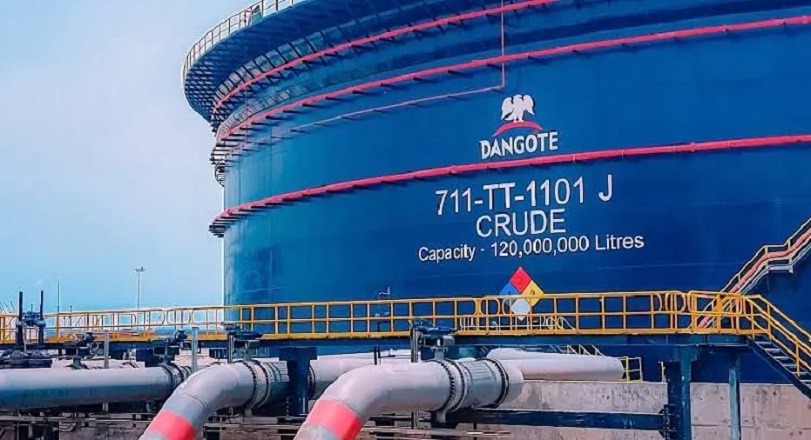
Fifth Crude Cargo Dangote Refinery

By Aduragbemi Omiyale

Over 42 million Micro, Small and Medium Enterprises (MSMEs) in the country will benefit from the N720 billion invested for the acquisition of 4,000 Compressed Natural Gas (CNG)-powered trucks by Dangote Petroleum Refinery for the nationwide distribution of petroleum products.

This action by the local crude oil refiner will help the small business operators reduce their energy costs and enhance profitability.

The decision of Dangote Refinery to supply petroleum products to retailers across the country will also help Nigeria to save over N1.07 trillion in distribution costs annually.

From August 15, the company will begin the direct delivery of petrol and diesel to filling stations, industrial facilities, and other high-volume consumers to meet the nation’s daily consumption of 65 million litres of refined petroleum products.

At the moment, Nigeria reportedly consumes about 45 million litres of Premium Motor Spirit (PMS), otherwise known as petrol, 15 million litres of diesel, and 5 million litres of aviation fuel.

With the average logistics cost estimated at N45 per litre, the refinery will cover over N1.07 trillion annually in free distribution expenses.

As part of its broader commitment to eliminating logistics bottlenecks, enhancing energy efficiency, promoting environmental sustainability, and supporting Nigeria’s economic development, the refinery is using CNG trucks to supply consumers.

The initiative is also expected to resuscitate dormant filling stations, fostering job creation in the process. Over 15,000 direct jobs are projected to be created across the logistics chain, including drivers, station managers, and attendants at the CNG stations.

The refinery also emphasised that this programme would help curb cross-border smuggling of petroleum products and support a more efficient and environmentally friendly distribution system.

Presidential Endorsement and Industry Praise

The presidency has described the initiative as a pivotal moment in the federal government’s push to mainstream gas-powered transportation.

The Commercial Coordinator of the Presidential Compressed Natural Gas Initiative (PCNGI), Mr Tosin Coker, praised the move as a strong vote of confidence in Nigeria’s gas-fuelled future.

“Dangote Group’s acquisition of 4,000 CNG trucks is not only impressive in scale but also highly strategic,” he said. “It signals to the market that CNG is no longer a distant prospect but a current, practical solution to high energy costs, emissions, and supply chain challenges. PCNGI regards this as a milestone achievement in our efforts to accelerate gas-powered transport adoption.”

Also, the Independent Petroleum Marketers Association of Nigeria (IPMAN) commended the development, calling it a timely resolution to longstanding challenges in the downstream sector.

Experts speak

IPMAN’s National Publicity Secretary, Chinedu Ukadike, stated that the new model would significantly reduce logistical burdens for independent marketers by delivering more affordable fuel directly to filling stations.

“Our pipelines have been non-functional for years, yet nothing has been done to revive the infrastructure linking the country’s 21 depots. We’ve had to rely on expensive transport from coastal depots,” Ukadike said. “Dangote’s intervention lifts a huge burden off the shoulders of independent marketers.”

Development Economist and Policy Analyst, Professor Ken Ife, said the initiative would drive down the price of PMS and yield widespread benefits for Nigerians.

The chief executive of Financial Derivatives Company, Mr Bismarck Rewane, dismissed concerns about the refinery becoming a monopoly, arguing that inefficiencies in the sector have been systemic and long-standing, adding that the scheme would help curb the parasitic role traditionally played by middlemen.

“What Dangote is doing achieves two key objectives: delivering products across the entire country at a uniform price by eliminating bridging costs, and significantly reducing logistics expenses through the use of CNG-powered trucks to reach every corner of the nation.

“In economic terms, middlemen—who typically do not invest—are often viewed as parasitic, extracting margins simply for distributing goods. Dangote is bypassing this layer by directly handling distribution and, notably, providing credit facilities to the retail end of the business,” he said.

An Energy expert and co-founder of Dairy Hills, Mr Kelvin Emmanuel, said Dangote’s decision to absorb logistics costs marks a turning point that could finally allow Nigerians to enjoy the benefits of local refining.

Another Energy analyst, Ms Ibukun Phillips, described the move as “revolutionary”, suggesting it could reshape Nigeria’s energy sector by improving affordability and access, particularly in rural communities.

“Rural consumers, who typically pay more despite earning less, stand to benefit immensely. This could also revive abandoned filling stations and promote equitable distribution,” she explained.


Economy

Nigerian Equity Market Surpasses N145trn After 1.30% Expansion

Published

on

Nigerian equity market

By Dipo Olowookere

The Nigerian equity market showed no signs of slowing down, as it further appreciated by 1.30 per cent on Friday on the back of sustained buying pressure.

Unlike the preceding sessions, investor sentiment was bullish yesterday after the Nigerian Exchange (NGX) Limited ended with 43 price gainers and 26 price losers, implying a positive market breadth index, the first this week.

UPDC gained 10.00 per cent to close at N4.40, Academy Press also appreciated by 10.00 per cent to quote at N7.70, Haldane McCall improved by 9.97 per cent to N3.97, Zichis soared by 9.94 per cent to N15.60, and Wema Bank added 9.84 per cent to settle at N31.25.

Conversely, Meyer lost 9.92 per cent to sell for N16.80, Trans-Nationwide Express also crashed by 9.92 per cent to end at N7.90, C&I Leasing slipped by 8.53 per cent to N5.90, Omatek dipped by 7.34 per cent to N2.02, and eTranzact decreased by 5.28 per cent to N17.05.

When the bourse closed its doors to business, the All-Share Index (ASI) rose by 2,884.81 points to 225,722.49 points from 222,837.68 points, and the market capitalisation grew by N1.858 trillion to N145.335 trillion from N143.477 trillion.

A look at the activity chart showed that market participants transacted 627.6 million shares worth N44.5 billion in 55,232 deals during the trading day compared with the 667.9 million shares valued at N38.1 billion traded in 53,062 deals a day earlier.

This indicated that the volume of transactions went down by 6.03 per cent, the value of trades went up by 16.80 per cent, and the number of deals jumped by 4.09 per cent.

Access Holdings closed the session as investors’ toast, with a turnover of 75.6 million units worth N2.4 billion. UBA transacted 43.1 million units valued at N2.3 billion, Wema Bank exchanged 41.5 million units for N1.3 billion, Zenith Bank traded 38.4 million units valued at N5.2 billion, and Universal Insurance sold 29.5 million units for N35.9 million.

Continue Reading

Economy

Oyedele Eyes Fiscal Discipline, Investor-friendly Environment, Fair Taxation

Published

on

taiwo oyedele wale edun

By Aduragbemi Omiyale

Mr Taiwo Oyedele has set some goals he intends to achieve as Nigeria’s Minister of Finance and Coordinating Minister of the Economy.

While taking over from his predecessor, Mr Wale Edun, on Thursday, the tax expert assured that he has no plans to overturn some of the reforms already put in place by the former occupier of the seat.

In a message on Friday, he emphasised that, “Our immediate task is to consolidate these gains, deepen ongoing reforms, and ensure they translate into tangible benefits for all Nigerians.”

He promised to ensure fiscal discipline by embracing transparent and prudent management of public resources, while also harmonising revenue administration, broadening the tax base, reducing the burden on the vulnerable population, and supporting economic growth.

Mr Oyedele further said his other strategic priorities include creating a predictable and investor-friendly environment anchored on policy coherence, consistency, and clarity; and aligning efforts across all tiers and institutions to maximise policy impact.

He also said efforts would be made to deepen collaboration with the private sector and other key stakeholders for data-driven policy design, co-implementation, and feedback for continuous improvement.

According to him, “Good policy design alone is not enough; success will be defined by execution. We are committed to disciplined implementation, accountability, and measurable results.”

“I look forward to working with colleagues across government, the private sector, and all Nigerians as we move from reform to result, accelerate growth and build a more stable, inclusive, and prosperous economy,” he stated.

Continue Reading

Economy

NASD Bourse Edges Up 0.23% as NSI Nears 3,970 Points

Published

on

NASD OTC Bourse

By Adedapo Adesanya

The NASD Over-the-Counter (OTC) Securities Exchange further appreciated by 0.23 per cent on Thursday, April 23, with the Unlisted Security Index (NSI) adding 8.99 points to close at 3,969.96 points against the previous day’s 3,968 points.

The rise in the share price of Central Securities Clearing System (CSCS) Plc by N2.86 to N69.34 per unit from N66.48 per unit raised the market capitalisation of the NASD bourse by N5.38 billion to N2.380 trillion from N2.375 trillion.

Yesterday, there were two price losers, led by Food Concepts Plc, which lost 29 Kobo to sell at N2.65 per share versus N2.94 per share, while UBN Property Plc dipped by 22 Kobo to N2.03 per unit from N2.25 per unit.

During the session, the volume of securities traded declined by 97.9 per cent to 451,522 units from 21.5 million units on Wednesday, the value of securities depreciated by 52.32 per cent to N23.6 million from N49.5 million, and the number of deals depreciated by 3.6 per cent to 27 deals from 28 deals.

At the close of business, Great Nigeria Insurance (GNI) Plc remained the most active stock by value on a year-to-date basis with 3.4 billion units valued at N8.4 billion, followed by CSCS Plc with 59.5 million units exchanged for N4.0 billion, and Okitipupa Plc with 27.8 million units traded for N1.9 billion.

GNI Plc also closed the day as the most traded stock by volume on a year-to-date basis with 3.4 billion units worth N8.4 billion, trailed by Resourcery Plc with 1.1 billion units transacted for N415.7 million, and Infrastructure Guarantee Credit Plc with 400 million units sold for N1.2 billion.

Continue Reading

Trending