Economy
Easy Set-up of a Virtual Dollar Card for African Residents
Africa is currently experiencing a digital boom. The number of internet users in Nigeria, Rwanda, South Africa, and other countries is rapidly rising, with most users relying on mobile internet. As a result, the demand for convenient payment solutions for mobile app and service purchases is more relevant than ever. Platforms like Spotify and Apple Music, the AppStore and Google Play, as well as shopping platforms like ASOS, eBay, and AliExpress are particularly popular. However, cards issued by local African banks are often either incompatible with these services or come with high currency conversion fees.
In this article, we’ll explain how to set up a virtual dollar card in just one minute, with no documentation required. Read on for a full review of the Ultima virtual cards from PSTNET.
What is the Ultima card from PSTNET?
PST.NET is a financial platform that issues virtual cards for international payments and ad expenses. All of its cards are issued through banks in the United States and Europe. One of the most popular products from the platform is the Ultima credit card. This is a dollar-denominated card that uses the Visa/Mastercard payment networks, making it widely accepted for payments in any app store or online marketplace.
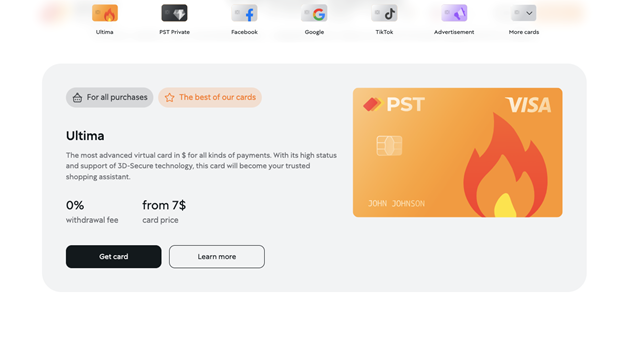
Benefits of the Ultima card:
- Zero fees: No fees are charged for transactions, withdrawals, or operations involving blocked/frozen cards
- Low top-up fee: Just 2%, with a fixed rate that does not change based on top-up conditions
- No limits on top-ups and spending: You can top up the card with any amount and spend as much as you want
- Unlimited card issuance: You can create multiple cards to manage your expenses. For example, use one card for subscriptions and another exclusively for online shopping
- High security: The card is equipped with 3D Secure technology and two-factor authentication. Each transaction requires confirmation with a unique code, which can be received via SMS or through the platform’s secure Telegram bot, enhancing protection against fraud and unauthorized transactions
How to get the Ultima card in Africa
Setting up the Ultima card is a quick process. To sign up, choose one of the available sign-in options: Google, Telegram, WhatsApp, Apple ID, or email. After registration, you’ll have access to your personal account, where you can issue your first card with just a few clicks. No documentation is required.
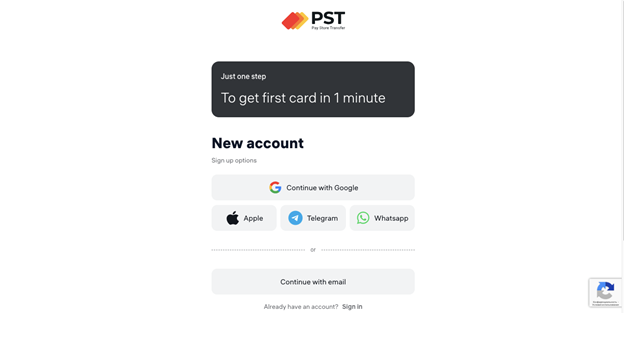
The card becomes active immediately — just top it up, and you’re good to go.
You can choose between a weekly plan at $7 or an annual plan. Currently, there’s a 48% discount on the annual plan, making it just $99.
If you have any questions or run into any issues, PSTNET’s customer service is available 24/7 and responds quickly on Telegram, WhatsApp, or through the live-chat.
Additional features:
- Crypto top-ups available: USDT (TRC20/ERC20), BTC, ETH, BNB, XRP, TRX, BCH, USDC (Ethereum), USDC (Tron), ADA, SOL, MATIC, BUSD, LTC, DASH, DOGE, TON
- Traditional funding options: SWIFT/SEPA bank transfers, other Visa/Mastercard cards
- Withdrawals: Available in USDT with no fees
To pay for international services and apps, African residents can use Ultima virtual cards, which are easy to set up without any documentation. These cards come with zero fees, no spending or top-up limits, a low balance top-up fee, and many other advantages.
Thanks to 3D Secure technology, these cards provide robust protection for your funds against fraud. Overall, the Ultima card is a great solution for both small daily payments and larger transactions on international platforms. Additionally, these cards can be used to receive payments from foreign employers or to crypto withdraw.
Economy
Nigerian Equity Market Surpasses N145trn After 1.30% Expansion
By Dipo Olowookere
The Nigerian equity market showed no signs of slowing down, as it further appreciated by 1.30 per cent on Friday on the back of sustained buying pressure.
Unlike the preceding sessions, investor sentiment was bullish yesterday after the Nigerian Exchange (NGX) Limited ended with 43 price gainers and 26 price losers, implying a positive market breadth index, the first this week.
UPDC gained 10.00 per cent to close at N4.40, Academy Press also appreciated by 10.00 per cent to quote at N7.70, Haldane McCall improved by 9.97 per cent to N3.97, Zichis soared by 9.94 per cent to N15.60, and Wema Bank added 9.84 per cent to settle at N31.25.
Conversely, Meyer lost 9.92 per cent to sell for N16.80, Trans-Nationwide Express also crashed by 9.92 per cent to end at N7.90, C&I Leasing slipped by 8.53 per cent to N5.90, Omatek dipped by 7.34 per cent to N2.02, and eTranzact decreased by 5.28 per cent to N17.05.
When the bourse closed its doors to business, the All-Share Index (ASI) rose by 2,884.81 points to 225,722.49 points from 222,837.68 points, and the market capitalisation grew by N1.858 trillion to N145.335 trillion from N143.477 trillion.
A look at the activity chart showed that market participants transacted 627.6 million shares worth N44.5 billion in 55,232 deals during the trading day compared with the 667.9 million shares valued at N38.1 billion traded in 53,062 deals a day earlier.
This indicated that the volume of transactions went down by 6.03 per cent, the value of trades went up by 16.80 per cent, and the number of deals jumped by 4.09 per cent.
Access Holdings closed the session as investors’ toast, with a turnover of 75.6 million units worth N2.4 billion. UBA transacted 43.1 million units valued at N2.3 billion, Wema Bank exchanged 41.5 million units for N1.3 billion, Zenith Bank traded 38.4 million units valued at N5.2 billion, and Universal Insurance sold 29.5 million units for N35.9 million.
Economy
Oyedele Eyes Fiscal Discipline, Investor-friendly Environment, Fair Taxation
By Aduragbemi Omiyale
Mr Taiwo Oyedele has set some goals he intends to achieve as Nigeria’s Minister of Finance and Coordinating Minister of the Economy.
While taking over from his predecessor, Mr Wale Edun, on Thursday, the tax expert assured that he has no plans to overturn some of the reforms already put in place by the former occupier of the seat.
In a message on Friday, he emphasised that, “Our immediate task is to consolidate these gains, deepen ongoing reforms, and ensure they translate into tangible benefits for all Nigerians.”
He promised to ensure fiscal discipline by embracing transparent and prudent management of public resources, while also harmonising revenue administration, broadening the tax base, reducing the burden on the vulnerable population, and supporting economic growth.
Mr Oyedele further said his other strategic priorities include creating a predictable and investor-friendly environment anchored on policy coherence, consistency, and clarity; and aligning efforts across all tiers and institutions to maximise policy impact.
He also said efforts would be made to deepen collaboration with the private sector and other key stakeholders for data-driven policy design, co-implementation, and feedback for continuous improvement.
According to him, “Good policy design alone is not enough; success will be defined by execution. We are committed to disciplined implementation, accountability, and measurable results.”
“I look forward to working with colleagues across government, the private sector, and all Nigerians as we move from reform to result, accelerate growth and build a more stable, inclusive, and prosperous economy,” he stated.
Economy
NASD Bourse Edges Up 0.23% as NSI Nears 3,970 Points
By Adedapo Adesanya
The NASD Over-the-Counter (OTC) Securities Exchange further appreciated by 0.23 per cent on Thursday, April 23, with the Unlisted Security Index (NSI) adding 8.99 points to close at 3,969.96 points against the previous day’s 3,968 points.
The rise in the share price of Central Securities Clearing System (CSCS) Plc by N2.86 to N69.34 per unit from N66.48 per unit raised the market capitalisation of the NASD bourse by N5.38 billion to N2.380 trillion from N2.375 trillion.
Yesterday, there were two price losers, led by Food Concepts Plc, which lost 29 Kobo to sell at N2.65 per share versus N2.94 per share, while UBN Property Plc dipped by 22 Kobo to N2.03 per unit from N2.25 per unit.
During the session, the volume of securities traded declined by 97.9 per cent to 451,522 units from 21.5 million units on Wednesday, the value of securities depreciated by 52.32 per cent to N23.6 million from N49.5 million, and the number of deals depreciated by 3.6 per cent to 27 deals from 28 deals.
At the close of business, Great Nigeria Insurance (GNI) Plc remained the most active stock by value on a year-to-date basis with 3.4 billion units valued at N8.4 billion, followed by CSCS Plc with 59.5 million units exchanged for N4.0 billion, and Okitipupa Plc with 27.8 million units traded for N1.9 billion.
GNI Plc also closed the day as the most traded stock by volume on a year-to-date basis with 3.4 billion units worth N8.4 billion, trailed by Resourcery Plc with 1.1 billion units transacted for N415.7 million, and Infrastructure Guarantee Credit Plc with 400 million units sold for N1.2 billion.
-
Feature/OPED6 years agoDavos was Different this year
-
Travel/Tourism10 years ago
Lagos Seals Western Lodge Hotel In Ikorodu
-
Showbiz3 years agoEstranged Lover Releases Videos of Empress Njamah Bathing
-
Banking8 years agoSort Codes of GTBank Branches in Nigeria
-
Economy3 years agoSubsidy Removal: CNG at N130 Per Litre Cheaper Than Petrol—IPMAN
-
Banking3 years agoSort Codes of UBA Branches in Nigeria
-
Banking3 years agoFirst Bank Announces Planned Downtime
-
Sports3 years agoHighest Paid Nigerian Footballer – How Much Do Nigerian Footballers Earn