Economy
FEC Okays Supplementary Budget of N2.17trn for 2023
By Modupe Gbadeyanka
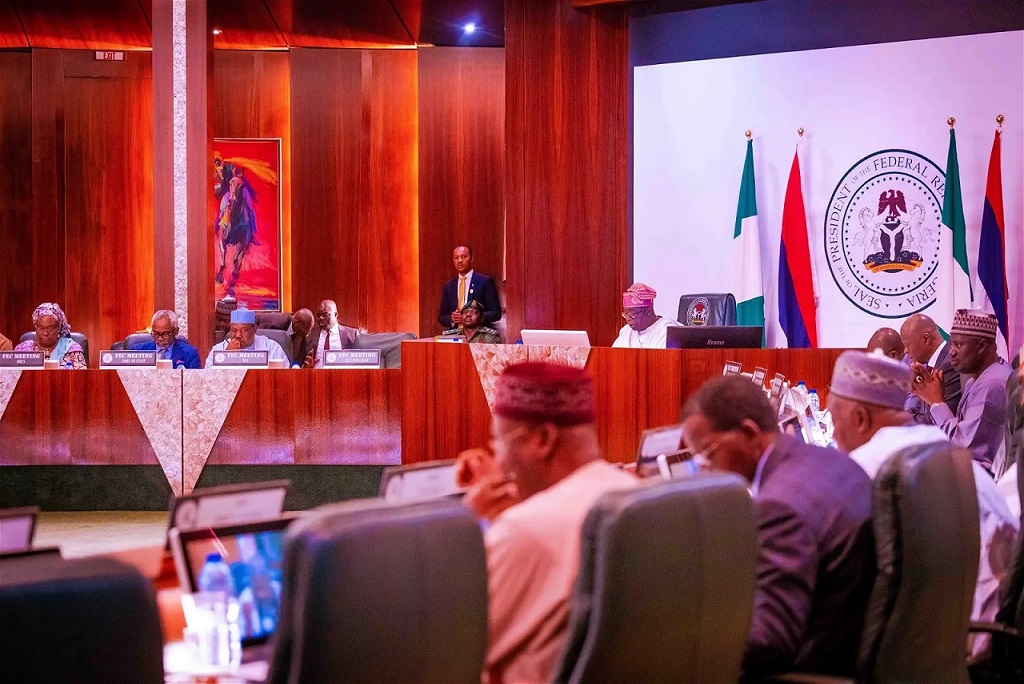
A supplementary budget of N2.17 trillion was on Monday approved by the Federal Executive Council (FEC) for 2023.
The Minister of Budget and Economic Planning, Mr Atiku Buguda, disclosed this after the FEC meeting held yesterday in Abuja presided over by President Bola Tinubu.
Addressing newsmen at the State House after the gathering held at the Presidential Villa, the Minister noted that the N2.17 trillion supplementary budget would be used for urgent national issues, including N605 billion for security and national defence as well as N200 billion for the supply of agricultural production, and N5.5 billion for the student loan initiative expected to fully commence next January.
Mr Buguda further informed journalists that the sum of N210 billion has been earmarked for wage awards recently approved for Nigerian workers covering the period from September to December, N400 billion would be used for cash transfers to vulnerable and poor Nigerians for the period October and November, and N200 billion for capital supplementation.
He also stated that N100 billion has been budgeted for the Federal Capital Territory (FCT), and N18 billion has been approved for the prosecution of next month’s governorship elections in Bayelsa, Imo and Kogi States by the Independent National Electoral Commission (INEC).
Economy
Oyedele Responds to KPMG’s Observations on Nigeria’s New Tax Laws
By Modupe Gbadeyanka
The chairman of the Presidential Fiscal Policy and Tax Reforms Committee, Mr Taiwo Oyedele, has responded to the alleged errors and others observed in the controversial tax laws of Nigeria, which fully became effective January 1, 2026.
In an analysis posted in a newsletter posted on its website, the Nigerian arm of a global consultancy firm, KPMG, highlighted some sections of the laws that look confusing, making some recommendations.
The company disclosed that if the errors were not addressed, they could discourage investors from the country.
But responding to these observations, Mr Oyedele, who acknowledged that a few points raised by KPMG were useful, particularly where they relate to implementation risks and clerical or cross-referencing issues, stressed that the majority of the publication reflected a misunderstanding of the policy intent, a mischaracterisation of deliberate policy choices, and, in several instances, repetitions and presentation of opinion and preferences as facts.
According to him, a significant proportion of the issues described as “errors,” “gaps,” or “omissions” by KPMG are either the firm’s errors and invalid conclusions or the issues are not properly understood by them.
The tax expert also noted that KPMG may have missed context on broader reforms objectives, or are areas where KPMG prefer different outcomes than the choices deliberately made in the new tax laws.
“While it is legitimate to disagree with policy direction, disagreements should not be framed as errors or gaps. KPMG would have been more effective if the firm adopted a similar approach like other professional firms who engaged directly providing the opportunity for clarifications and mutual-learning.
It is equally important to distinguish between policy choices designed to achieve the reform objectives and proposals that merely represent a firm’s preference,” he added.
Speaking on the taxation of shares and the stock market, the former PwC man said, “Contrary to the presumption that the new tax provisions on chargeable gains would trigger a sell-off on the stock market, the fact is that the applicable tax rate on share gains is not a flat 30 per cent. The tax framework is structured from zero per cent to a maximum of 30 per cent, which is set to reduce to 25 per cent. Furthermore, a significant majority of investors (99 per cent) are entitled to unconditional exemption, with others qualifying subject to reinvestment.
“The market’s performance, which is at an all-time high with increased investment flow, demonstrates investors understanding that the tax changes will enhance the fundamentals of firms both in terms of profitability and cash flows. The sell-off narrative is unsubstantiated as any disposals in December 2025 would have benefited from the re-investment exemption or enhanced deductions under the new law.”
He also clarified that the suggestion to set the commencement date as the start of an accounting period (e.g., 1 January 2026) takes a narrow view of the complex transition issues.
“A wholesale reform affects myriad issues beyond the accounting period, spanning multiple periods, different bases of assessment (preceding year, actual year), as well as issues related to audit, deductions, credits, and penalties. Limiting the commencement to a single date for accounting periods would fail to address the intricacies of continuous transactions and other transition matters. KPMG’s proposal is therefore not a “gold standard” to be applied to all new laws as suggested,” he said.
Below are the other areas he clarified in his post;
Indirect Transfer of Shares
The new provision to tax indirect transfer of shares is a policy choice aligned with global best practices and BEPS initiatives. Its objective is to block a long-exploited tax loophole by multinationals and other investors, not to affect competitiveness. This is a common provision in international tax, and the assertion that it may affect the country’s economic stability is disingenuous.
VAT Exemption on Insurance Premium
KPMG’s point regarding a specific VAT exemption on insurance premium is technically unnecessary, as an insurance premium is not a “taxable supply” defined under the Nigeria Tax Act. Insurance relates to risk transfer, not the supply of goods or services subject to VAT. As this has always been the administrative and legal position, a specific amendment for exemption is academic. If it is not broken, don’t fix it.
Inclusion of ‘Community’ in Definition
The concern about the inclusion of “community” in the definition of a ‘person’ but its omission from the charging section does not constitute a gap or ambiguity. In statutory interpretation, definitions provided in the law apply wherever the defined term appears, unless the context requires otherwise. Hence, ‘person’ and ‘taxable person’ are used in the charging section, and both definitions include ‘community.’ This approach is consistent with modern legislative drafting principles, which use comprehensive definitions to streamline operative provisions and avoid redundancy. This is similar to the inclusion of partnerships and executors in the definition but not under the charging section. The use of the word “includes” further signifies that the list of taxable persons is not exhaustive.
Joint Revenue Board (JRB) Composition
The composition and mandate of the Joint Revenue Board (JRB) are intentional. Its policy advisory role is specifically to provide a subnational tax and revenue perspective that complements the fiscal policy mandate of the Ministry of Finance. Its membership is appropriately limited to revenue-focused agencies, which is why it is called the Joint Revenue Board. This is a similar composition under which the former JTB operated effectively, and its functions remain consistent with the need for inter-agency coordination.
Distinction in Dividend Treatment
KPMG’s analysis appears to mix the distinction between a foreign-controlled company and a foreign operation of a Nigerian company. Dividends distributed by a foreign company cannot be “franked” since no Nigerian Withholding Tax (WHT) would have been deducted. Section 162(1)(s) confers exemption on dividend, interest, rent, or royalty derived from outside Nigeria and brought into Nigeria through approved channels. The choice to treat dividends distributed by Nigerian companies differently from foreign companies is a deliberate policy choice, as they are fundamentally different for tax purposes.
Non-Resident Registration and Final Tax
The view that a payment subject to deduction as final tax should automatically exempt the non-resident recipient from tax registration misses a critical distinction. While the law conditionally exempts passive income from registration, the deduction of tax on non-passive income is not synonymous with an exemption from registration or filing of returns. The same way that residents are required to file returns on income such as interest (in the case of individuals) and dividend where WHT is final. Returns serve a broader purpose beyond solely generating tax revenue.
Tax on Foreign Insurance Premiums
The proposal to exempt foreign insurance companies from tax on premiums from insurance written in Nigeria to deepen penetration, while local insurance companies continue to pay tax, would be detrimental to the domestic insurance sector. This would create an unfair and harmful competitive disadvantage for local firms in their own market. The current policy is designed to protect and promote local industry and ensure a level playing field.
Parallel Market Forex Deduction
The new law disallows tax deduction for the difference where a business buys foreign exchange in the parallel market at a premium over the official rate. This is a critical fiscal policy choice designed to complement monetary policy, strengthen, and stabilise the Naira. By removing the tax subsidy for patronage of the parallel market, the policy aims to reduce incentives for round-tripping and redirect legitimate FX demands to the official market. This is policy congruence, not an error.
VAT Compliance-Linked Deductibility
The non-tax deduction for taxable transactions on which VAT has not been charged is a necessary anti-avoidance measure. It removes the advantage that some taxpayers previously enjoyed by patronising suppliers who evade VAT. This is a matter of fairness and is squarely within the control of a business to manage, especially given the provision for the self-charge of VAT. It also ensures that responsible businesses play their part in promoting voluntary tax compliance across the ecosystem.
Progressive Personal Income Tax
While KPMG acknowledges the reform objective of fairness and progressivity, the firm disagrees with a top marginal tax rate of 25% for the highest earners. In reality, the effective tax rate can be as low as 22% for an individual earning billions a year simply by contributing 10% to pension. This rate is competitive when compared to many other countries, including Angola 25%, Egypt 27.5%, Ghana 35%, Kenya 35%, the U.S. (Federal) 37%, South Africa 45%, and the U.K. 45%. So, the rate is not “oppressive” or one that will negatively affect economic growth as claimed, rather it ensures progressivity without compromising competitiveness. From a broader policy objective perspective, the increase in top marginal rate for high income earners and the reduction in corporate tax rate is designed to address the existing higher tax burden associated with business formalisation.
Police Trust Fund
The Police Trust Fund was signed into law on May 24, 2019, with a six-year lifespan under section 2(2) of the Act, which ended in June 2025. Therefore, KPMG’s point that the new tax law should be amended to repeal the taxing section of the Police Trust Fund Act is needless, as the provision no longer exists.
Small Company Verification
The analysis concerning the tax exemptions for small companies affecting large companies’ obligations is not a new issue or an inconsistency in the new law. The small business threshold was introduced via the Finance Act 2021. This issue pre-dates the current tax laws and should not be presented as an error or omission simply by virtue of a higher tax exemption threshold under the new law.
What KPMG Left Out
While acknowledging the objectives of the reform, KPMG could have highlighted the major structural improvements under the new laws, including:
– simplification and tax harmonisation,
– the scope for reduction in corporate tax rate from 30% to 25%,
– expanded input VAT credits for businesses,
– tax exemption for low-income earners and small businesses,
– elimination of minimum tax on turnover and capital, and
– improved investment incentives for priority sectors.
A balanced assessment would have recognised these transformative elements, among others.
Conclusion and Way Forward
The tax reform is the result of an extensive consultation with various stakeholder groups in addition to the legislative process that included widely publicised public hearings, avenues intended for all stakeholders including international firms to provide technical expertise at the formative stage.
In any comprehensive overhaul of a nation’s tax framework, clerical inconsistencies or cross-referencing gaps may occur, and these are already being identified within the government. The tax reform represents a bold step toward a self-sustaining and competitive Nigeria.
An effective review needs to connect identified gaps to clear policy intents and the reality of modern-day tax systems within the context of economic development and global competitiveness.
At this stage, the effectiveness of the tax law depends on administrative guidance, clarifications from the tax authority, and regulations to complement precise statutory provisions where necessary pending future amendments.
We urge all stakeholders to pivot from a static critique to a dynamic engagement model, which allows for clarifications and a productive partnership in the implementation of the new tax laws.
Economy
IPMAN Rejects Fuel Imports as Dangote Refinery Denies Supply Disruption Claims
The Independent Petroleum Marketers Association of Nigeria (IPMAN) has voiced strong opposition to the continued importation of Premium Motor Spirit (PMS) into the country. The association also distanced itself from reports suggesting that the surge in petrol imports in November 2025 was linked to a breakdown in supply arrangements between Dangote Refinery and petroleum marketers, describing such claims as inaccurate and misleading.
According to IPMAN, the report does not reflect the reality experienced by its members. The association emphasised that the commencement of supply from Dangote Refinery has significantly improved product availability nationwide.
Speaking on the issue, IPMAN National President, Abubakar Maigandi Shettima, stated:
“Our members fully support Dangote Refinery. Since supply began, marketers have consistently lifted products without any complaints. We oppose continued importation because Dangote Refinery has the capacity to meet the country’s entire PMS demand.”
Shettima further noted that members are satisfied with the reliability of supply and welcomed the refinery’s commitment to direct delivery to filling stations—a move he described as critical to stabilizing distribution and benefiting consumers. He stressed that improved access to locally refined products has eased supply pressures and boosted confidence among independent marketers, reaffirming IPMAN’s commitment to domestic refining as a sustainable solution for Nigeria’s downstream petroleum sector.
Similarly, Dangote Petroleum Refinery dismissed the media reports as baseless and inaccurate. In its statement, the refinery clarified that no supply agreement with marketers had collapsed, adding that its engagement with the downstream market was deliberately structured to meet rising demand and enhance access, competition, and efficiency.
The refinery disclosed that supply under the marketers’ arrangement began in October 2025 with an agreed offtake volume of 600 million litres of PMS. This was later increased to 900 million litres in November and further expanded to 1.5 billion litres in December.
“In line with market growth and absorption capacity, volumes were scaled up accordingly. Subsequently, and in line with downstream market liberalisation, we opened PMS supply to all qualified marketers, bulk consumers, and filling station operators,” the statement signed by Group Chief Branding and Communications Officer, Anthony Chiejina, read.
Since December 16, 2025, Dangote Refinery has consistently loaded between 31 million and 48 million litres of PMS daily from its gantry, subject to market demand. These figures, the refinery noted, are verifiable against depot and loading records maintained under routine regulatory oversight.
To broaden participation and improve distribution efficiency, the refinery introduced several measures, including reducing minimum purchase volumes from two million litres to 250,000 litres and offering a 10-day credit facility backed by bank guarantees. These initiatives aim to enhance liquidity, support small and medium-sized operators, and reduce reliance on imported fuel.
The refinery added that this expanded access framework has driven higher utilisation of locally refined PMS and contributed to more competitive retail pricing, with domestic products priced significantly lower than imported alternatives. It also dismissed claims that marketers withdrew due to pricing concerns, affirming that its ex-gantry prices remain competitive, market-responsive, and aligned with import parity indicators while meeting all regulatory and quality standards.
Addressing the surge in petrol imports recorded in November, Dangote Refinery explained that the increase coincided with import licensing decisions approved by the former leadership of the Nigerian Midstream and Downstream Petroleum Regulatory Authority (NMDPRA), which sanctioned volumes beyond prevailing domestic demand. The refinery stressed that this development was unrelated to its operational capacity or supply commitments.
Dangote Refinery reaffirmed its commitment to reliable supply, transparency, and the orderly development of a competitive downstream petroleum market. It pledged continued collaboration with regulators and industry stakeholders to support Nigeria’s domestic refining, conserve foreign exchange, moderate prices, and strengthen long-term energy security.
Economy
Investors Pocket N954bn on Renewed Demand for Domestic Equities
By Dipo Olowookere
After what looked like the bears was plotting a comeback, the Nigerian Exchange (NGX) Limited witnessed a renewed appetite for domestic equities, causing the bourse to close higher by 0.93 per cent on Friday.
Business Post reports that 48 shares ended on the gainers’ chart and 28 shares finished on the losers’ table, representing a positive market breadth index and strong investor sentiment.
Industrial and Medical Gases, SCOA Nigeria, and McNichols gained 10.00 per cent each to quote at N35.20, N9.35, and N5.50 apiece, May and Baker appreciated by 9.92 per cent to N28.80, and FTN Cocoa chalked up 9.90 per cent to sell for N6.66.
On the flip side, Aluminium Extrusion retreated by 9.91 per cent to N19.10, Austin Laz depleted by 9.83 per cent to N4.13, Sovereign Trust Insurance slumped by 9.63 per cent to N3.38, Prestige Assurance dropped 9.57 per cent to sell for N1.70, and UPDC gave up 9.09 per cent to trade at N5.00.
Yesterday, the energy index was down by 0.15 per cent, and the banking sector tumbled by 0.13 per cent, but could not impact the outcome of the market.
However, the industrial goods space improved by 0.44 per cent, the consumer goods counter gained 0.20 per cent, the insurance counter expanded by 0.06 per cent, and the commodity industry soared by 0.02 per cent.
Consequently, the All-Share Index (ASI) went up by 1,491.52 points to 162,298.08 points from 160,806.56 points and the market capitalisation advanced by N954 billion to N103.776 trillion from Thursday’s closing value of N102.822 trillion.
During the trading day, investors transacted 624.1 million units of stocks worth N18.5 billion in 43,816 deals versus the 645.1 million units of stocks valued at N16.5 billion traded in 44,410 deals in the preceding session, implying a decline in the trading volume and the number of deals by 3.26 per cent and 1.34 per cent apiece, and a spike in the trading value by 12.12 per cent.
Topping the activity chart for the session was eTranzact with 73.0 million units valued at N1.1 billion, Chams sold 30.3 million units worth N115.8 million, Access Holdings transacted 27.9 million units for N638.2 million, Linkage Assurance exchanged 25.0 million units valued at N44.4 million, and Sovereign Trust Insurance traded 24.5 million units worth N84.5 million.
-
Feature/OPED6 years agoDavos was Different this year
-
Travel/Tourism9 years ago
Lagos Seals Western Lodge Hotel In Ikorodu
-

Showbiz3 years agoEstranged Lover Releases Videos of Empress Njamah Bathing
-

Banking8 years agoSort Codes of GTBank Branches in Nigeria
-

Economy3 years agoSubsidy Removal: CNG at N130 Per Litre Cheaper Than Petrol—IPMAN
-

Banking3 years agoFirst Bank Announces Planned Downtime
-
Banking3 years agoSort Codes of UBA Branches in Nigeria
-

Sports3 years agoHighest Paid Nigerian Footballer – How Much Do Nigerian Footballers Earn