Connect with us

Economy

FG Builds Lab to Analyse Petroleum Products

Published

on

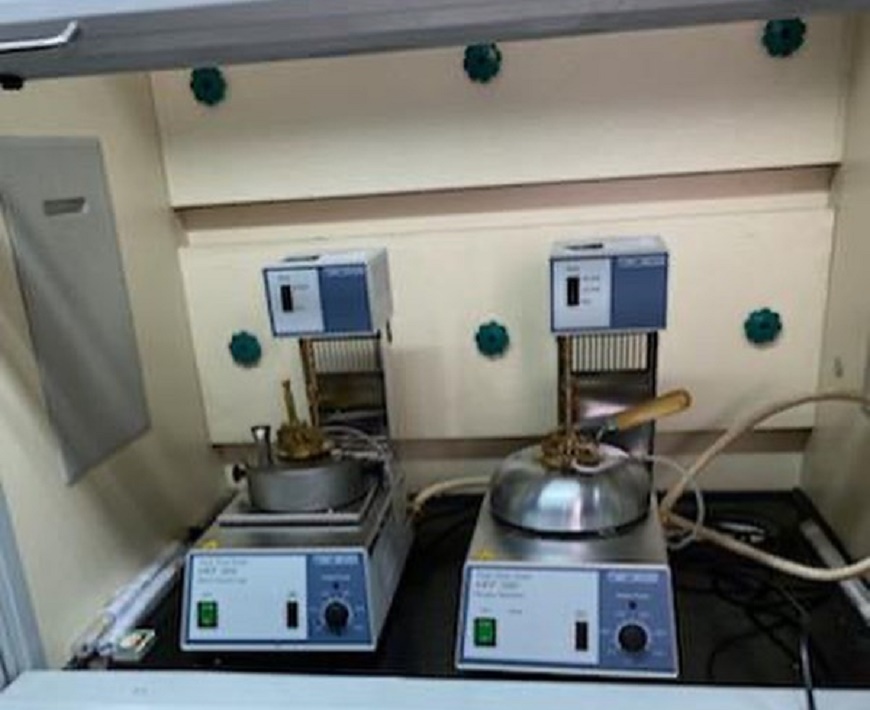
Lab analyse petroleum products

By Modupe Gbadeyanka

A multi-million-Naira laboratory for the analysis of petroleum products to ascertain their quality has been commissioned in Imo State by federal government.

The facility was opened for public use last Wednesday by the Department of Petroleum Resources (DPR) and is equipped with Vapour Pressure Texter, Closed Flashpoint tester for gas inlet, Lovibonid, and Sulphur Meter for sample testing, refrigerator to retain volatile samples before the tests are carried out, and distil water for reagents, aside others.

Director of DPR, Mr Ahmed Shakur, who was represented at the commissioning by Mr Peter Ijeh, the Zonal Operations Controller of DPR South East, said the laboratory was an answer to request by government agencies and individuals to test petroleum products suspected to be adulterated in the zone.

According to him, before now, a lab in Port Harcourt and some third party laboratories were relied on to analyse petroleum products in the region, but with the support and partnership of stakeholders, the new facility will make things easier.

“This laboratory is a significant achievement for Owerri Zone and a testament to the success which are positive through public/private partnership.

“It is a mini laboratory, but I assure you that great and formidable results will come out of it as we commence operations.

“The commissioning holds a lot of promises of better things to come for Owerri and other eastern states,” he said.

Mr Shakar warned that any marketer caught with adulterated petroleum product would face the full wrath of the law as stipulated and depending on the level of adulteration, might have his product seized or discharged, assuring motorists and marketers in the zone that with the laboratory in place, the issue of determining product quality would be realised and in a good record time.

He urged marketers, individuals, motorists and consumers of petroleum products to report any case of adulteration to the department for possible sanction and prosecution.

Mrs Nwando Awiaka, Chief Environment Officer and Team Head, Quality Control and Analysis DPR, Lagos Laboratory Services, who represented the DPR management Lagos, expressed delight at the commissioning of the project in the zone.

She said that management was keen at ensuring that DPR laboratory was established across the nation adding that the agency currently had six laboratries situated in Warri, Lagos, Port Harcourt, Kaduna, Abuja and now in Owerri.

According to her, more laboratories would soon be inaugurated in Kano and Calabar.

Modupe Gbadeyanka is a fast-rising journalist with Business Post Nigeria. Her passion for journalism is amazing. She is willing to learn more with a view to becoming one of the best pen-pushers in Nigeria. Her role models are the duo of CNN's Richard Quest and Christiane Amanpour.

Click to comment

Leave a Reply

Your email address will not be published. Required fields are marked *

Economy

Dangote Refinery Targets Congo in Regional Expansion Push

Published

on

Dangote monopoly Political Economy of Failure

By Adedapo Adesanya

Dangote Petroleum Refinery & Petrochemicals has advanced talks with the Société Nationale des Pétroles du Congo (SNPC) on a strategic partnership to supply refined petroleum products to the Republic of the Congo, in a move aimed at expanding its regional footprint.

The talks followed a visit by an SNPC delegation to the Dangote Refinery in Lekki, Lagos, led by the Congo state oil company’s Managing Director, Mr Maixent Raoul Ominga.

During the visit, Mr Ominga described the refinery as one of Africa’s most significant industrial achievements and said the Congolese national oil company was interested in building a long-term partnership with Dangote.

According to Mr Ominga, discussions centred on opportunities for collaboration in crude refining, petroleum products supply, energy security, industrial development and technical knowledge exchange. He noted that although the Republic of the Congo has its own refining capacity, working with Dangote would strengthen fuel supply, improve value creation and deepen cooperation between the two organisations.

The SNPC chief also praised the Dangote Group for demonstrating that African companies can finance, build and operate world-class industrial infrastructure.

He further commended the group’s investments in Congo’s cement industry, saying they have expanded local production capacity and improved the availability of construction materials.

On his part, the chief executive of Dangote Industries Limited, Mr Aliko Dangote, reaffirmed the company’s commitment to Africa’s industrialisation agenda through regional partnerships and value addition.

“We are for Africa, not just Nigeria. Tell us what you need, and we will see how we can work together,” Mr Dangote said.

He added that the Dangote Refinery has established a new benchmark for fuel quality on the continent by producing petroleum products that meet international specifications, while helping African countries reduce dependence on imported refined fuels from outside the continent.

Group Vice President, Oil and Gas, Dangote Industries Limited, Mr Devakumar Edwin, outlined the company’s long-term expansion strategy, revealing plans to increase its total refining capacity to 2.1 million barrels per day. The expansion will comprise 1.4 million barrels per day in Nigeria and a proposed 700,000-barrel-per-day refinery in Kenya to serve East African markets.

Mr Edwin also disclosed that the Dangote Group plans to invest an additional $46 billion between 2026 and 2028 across its refining, cement and fertiliser businesses as part of its broader strategy to accelerate industrialisation across Africa.

Continue Reading

Economy

Unilever, NASCON Join NGX 30 Index as Oando, Transcorp Exit

Published

on

oando stocks

By Aduragbemi Omiyale

The duo of Oando Plc and Transcorp Plc have been evicted from the NGX 30 Index by the Nigerian Exchange (NGX) Limited in the 2026 half-year review of market indices.

In a statement from Customs Street on Wednesday, it was disclosed that Unilever Nigeria Plc and NASCON Plc are the new members of the elite index.

Designed using the market capitalisation methodology, NGX indices are reviewed semi-annually on the first business day of January and July to ensure they remain aligned with evolving market dynamics and international best practices.

The exchange reserves the right to make further adjustments where necessary in the event of mergers, acquisitions, trading suspensions, resumptions or other corporate actions prior to the effective date of an index review.

Business Post reports that the consumer goods, banking, insurance, industrial goods, energy, pension, and pension broad indices did not witness any entry or exit.

However, the Lotus Islamic index saw the inclusion of Nestle Nigeria and Cadbury Nigeria and the exit of NASCON. Stanbic IBTC Holdings was added to the Afrinvest Bank Value index, with Access Holdings leaving the Afrinvest Div Yield index after the inclusion of Seplat Energy, Fidelity Bank, Stanbic IBTC Holdings, Custodian Investment, and NAHCO.

Further, the Meristem Growth index welcomed Eterna and PZ Cussons and bid farewell to BUA Cement, GTCO, AXA Mansard Insurance, NAHCO, NASCON, Okomu Oil, HBM Nigeria (Lafarge Africa) and Wema Bank.

As for the Meristem Value index, the NGX added Chemical and Allied Products, Honeywell Flour Mills, Dangote Cement, Linkage Assurance, Livestock Feeds, NASCON, Okomu Oil, and TotalEnergies, but removed Ecobank, Guinness Nigeria, and Zenith Bank.

Continue Reading

Economy

IMF Says Nigeria Omitted Public Spending Worth 2% of GDP From Budgets

Published

on

Rethink Relationship With IMF Nigeria

By Adedapo Adesanya

The International Monetary Fund (IMF) has revealed that Nigeria had about 2 per cent of GDP worth of public spending not recorded in recent official budgets, creating a gap between its reported deficit and actual financing needs.

IMF resident representative in Nigeria, Mr Christian Ebeke, said on Wednesday, during a session with business executives in Lagos, the country’s commercial capital.

The discrepancy means the country’s fiscal deficit appears smaller than the level of borrowing, because some capital spending was not included in budget documents or implementation reports.

Mr Ebeke said these unreported expenditures are linked, in part, to large government projects carried out off-budget, distorting assessments of Nigeria’s fiscal stance and public investment levels.

“So far, we think that there are about 2 per cent of GDP of expenditure that were not reported that should be reported and should be recorded, so that this statistical discrepancy will disappear,” said Mr Ebeke.

The lack of full reporting can also complicate coordination between fiscal and monetary policy, as policymakers may not have a clear picture of the true deficit, he added.

Mr Ebeke also clarified that the Nigerian government has begun addressing the issue by repealing and revising recent budget laws to incorporate previously unrecorded spending, though updated implementation reports are still needed.

He added that improving transparency is critical, noting that off-budget spending raises concerns about procurement processes and oversight.

In its latest Article IV review, the IMF praised Nigeria’s sweeping reforms, saying they had strengthened economic stability and investor confidence, but warned that the benefits had yet to reach millions of citizens and could be undermined by global shocks, including the Middle East conflict.

According to the Bretton Woods institution, the implementation of Nigeria’s new tax laws should gradually increase revenue collection, while the use of digital tools to track, verify and collect revenues could reduce leakages and corruption vulnerabilities.

The IMF said higher revenues would create fiscal space for development projects and social spending, but warned that the timing of any additional taxes should take into account the country’s worsening social conditions.

Continue Reading

Trending