Connect with us

Economy

FG Pledges 5,000 Housing Units in Each State

Published

on

housing units FG

By Modupe Gbadeyanka

Federal Government has assured public workers in Nigeria of adequate and informed plans for the provision of affordable houses as a panacea to the challenges of housing shortage in the country with an ambitious and unprecedented National Housing Programme aimed at constructing 5,000 units of houses in every state, over the next three years.

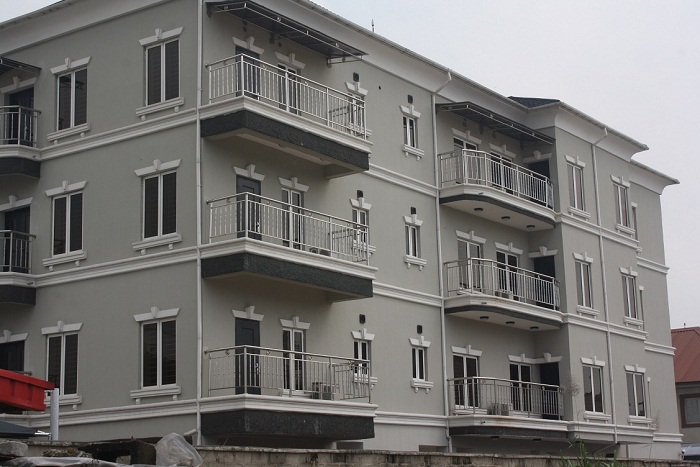
This was disclosed by the Minister of State for Power, Works and Housing, Mr Mustapha Baba Shehuri, during the commissioning of a 202-Unit Ministerial Pilot Housing Scheme being financed by the Federal Mortgage Bank of Nigeria (FMBN) and built by a Private Developer, Black Afrik (Nig) Limited, in Jalingo, Taraba State.

Mr Baba Shehuri stated that “National Housing Models have been designed for each geo-political zone, taking into cognizance our cultural diversities and climate conditions and, most importantly, in line with the present Administration’s vision of standardizing building materials to boost local content by encouraging indigenous Artisans and Craftsmen, as well as the creation of employment for Nigeria’s teaming youth”.

The Minister congratulated the Management and Staff of FMBN for the success recorded with the completion of the Estate and its peers in other states of the Federation scheduled for commissioning between now and early March, 2017, while re-affirming the resolve of the present Administration to recapitalize the Bank to the tune of N500billion to enable it adequately and efficiently carry out its Mandate under the National Housing Programme.

In his address at the occasion, the Executive Governor of Taraba State, represented by the Deputy Governor, Mr Haruna Manu, described the delivery of the estate as a delightful relief to the housing gap in the state which is constantly being widen by population explosion and exigencies incidental to the displacement of people due to insurgency within the North-East zone.

Earlier in his opening remarks, the Acting Managing Director of FMBN, Mr Richard Esin, informed the gathering that the two-phased Estate consists of 88, 3-bedroom semi-detached bungalows, 90, 2-bedroom semi-detached bungalows and 24, 1-bedroom terraces, adding that “concessionary terms of the National Housing Fund (NHF) Mortgage loans are in conformity with the Bank’s mandate of proving Nigerians with access to mortgage finance at affordable rates” to enable them transit from tenants to proud home owners.

Delivering a goodwill message at the Commissioning Ceremony, the President-General, Trade Union Congress (TUC), Comrade Bobboi Kaigama, lauded the initiative, while appealing to the Taraba State government to aid workers key into the window opportunity by subsidizing the cost of the houses. At a courtesy call on the Executive Governor of Taraba State, Mr Darius Ishaku Dickson, the Minister intimated his host that the Federal Government has already paid mobilization fees to contractors for the construction of houses in all the 36 states of Nigeria plus the FCT, being the first set under the National Housing Programme and will soon award the contract for the rehabilitation of Numan-Jalingo Road traversing Adamawa and Taraba States.

In his response, the Governor praised the National Housing Programme as the solution to Nigeria’s housing needs, while urging the Ministry to expedite action on the procurement process for the 3,050MW Mambila Hydro Project, also promising the Ministry that additional land will be allocated for affordable housing developments in the state.


Modupe Gbadeyanka is a fast-rising journalist with Business Post Nigeria. Her passion for journalism is amazing. She is willing to learn more with a view to becoming one of the best pen-pushers in Nigeria. Her role models are the duo of CNN's Richard Quest and Christiane Amanpour.

Click to comment

Leave a Reply

Your email address will not be published. Required fields are marked *

Economy

NASD Exchange Falls 0.22% After Investors Lose N4.8bn

Published

on

NASD securities exchange

By Adedapo Adesanya

The NASD Over-the-Counter (OTC) Securities Exchange weakened by 0.22 per cent on Tuesday, April 28, with the market capitalisation down by N4.8 billion to N2.420 trillion from N2.425 trillion, and the NASD Unlisted Security Index (NSI) down by 9.01 points to 4,044.96 points from 4,053.97 points.

During the session, the price of Central Securities Clearing System (CSCS) Plc went down by N1.82 to N767.05 per share from N78.87 per share, while FrieslandCampina Wamco Nigeria Plc appreciated by N1.90 to N100.00 per unit from N98.10 per unit.

According to data, the value of trades increased by 265.7 per cent to N27.1 million from N7.4 million units, and the volume of transactions surged by 305.2 per cent to 1.3 million units from 319,831 units, while the number of deals decreased by 6.9 per cent to 27 deals from 29 deals.

Great Nigeria Insurance (GNI) Plc remained the most traded stock by value on a year-to-date basis, with the sale of 3.4 billion units valued at N8.4 billion, followed by CSCS Plc with 59.8 million units exchanged for N4.0 billion, and Okitipupa Plc with 27.8 million units traded for N1.9 billion.

GNI Plc also finished as the most traded stock by volume on a year-to-date basis, with a turnover of 3.4 billion units worth N8.4 billion, trailed by Resourcery Plc with 1.1 billion units transacted for N415.7 million, and Infrastructure Guarantee Credit Plc with 400 million units sold for N1.2 billion.

Continue Reading

Economy

Naira Crashes to N1,380/$ at Official Market, N1,390/$1 at Black Market

Published

on

forex black market

By Adedapo Adesanya

Pressure is beginning to mount on the Nigerian Naira in the different segments of the foreign exchange (FX) market despite an oil windfall triggered by the Middle East crisis.

On Monday, April 27, the domestic currency further weakened against the United States Dollar in the Nigerian Autonomous Foreign Exchange Market (NAFEX) by N16.47 or 1.2 per cent to N1,380.71/$1 from the previous day’s N1,364.24/$1.

It was not different against the Pound Sterling in the same market window, as it lost N16.04 to trade at N1,863.76/£1 versus Monday’s closing rate of N1,847.72/£1, and against the Euro, it slipped by N12.72 to close at N1,615.01/€1 versus N1,602.29/€1.

The Naira also depreciated against the Dollar at the black market yesterday by N5 to quote at N1,390/$1 compared with the previous price of N1,385, and at the GTBank forex counter, it further crashed by N9 to settle at N1,379/$1 compared with the preceding session’s N1,370/$1.

The continued decline of the Naira comes as traders increasingly seek other safe-haven currencies amid continued global disruptions.

The benefit awash in the global market is making foreign portfolio investors stay short in Nigerian markets. Despite this, the daily FX publication released showed that interbank turnover rose to $98.829 million across 78 deals, up from $76.65 million.

Meanwhile, the cryptocurrency market remained cautious, with Bitcoin (BTC) trading at $77,216.66 despite surging oil prices and geopolitical tensions over a potential extended US naval blockade of the Strait of Hormuz.

Analysts say the supply overhang has finally dried up, and the sellers who were spooked by macro shifts or quantum fears have already exited, leaving the market much thinner on the sell-side.

Investors will await decisions made by central banks this week. The US Federal Reserve will announce its rate decision later on Wednesday, while the European Central Bank (ECB) follows on Thursday.

Ethereum (ETH) gained 1.5 per cent to trade at $2,324.59, Dogecoin (DOGE) chalked up 1.4 per cent to sell for $0.1016, Solana (SOL) appreciated by 0.6 per cent to $84.85, Cardano (ADA) grew by 0.5 per cent to $0.2483, and Binance Coin (BNB) advanced by 0.2 per cent to $627.15.

However, TRON (TRX) depreciated by 0.6 per cent to $0.3224, and Ripple (XRP) lost 0.03 per cent to sell at $1.39, while the US Dollar Tether (USDT) and the US Dollar Coin (USDC) were unchanged at $1.00 each.

Continue Reading

Economy

Oil up 3% as Hormuz Disruption Outweighs UAE OPEC Exit

Published

on

Oil Licensing Round

By Adedapo Adesanya

Oil was up by nearly 3 per cent on Tuesday as persistent worries about supply constraints from the closed Strait of Hormuz continued, with Brent futures for June rising by $3.03 or 2.8 per cent to $111.26 a barrel, and the US West Texas Intermediate (WTI) crude futures growing by $3.56 or 3.7 per cent to $99.93 a barrel.

An earlier round of negotiations between the United States and Iran collapsed last week after face-to-face talks failed.

Ship-tracking data showed significant disruptions in the region, with six Iranian oil tankers forced to turn back due to the US blockade, but some traffic is still moving.

Prices trimmed some of the advances after the United Arab Emirates (UAE), the fourth-largest producer in the Organisation of the Petroleum Exporting Countries (OPEC), said on Tuesday it would exit the group on this Friday, May 1, 2026.

This dealt a blow to the oil-exporting group and its de facto leader, Saudi Arabia.

The UAE could quickly ⁠add between 1 million and 1.5 million barrels per day of output. However, with the Strait of Hormuz effectively closed, analysts said that there’s nowhere for that supply to go.

The UAE joined OPEC in 1967, but tension with Saudi Arabia over production quotas has been building for years.

Under the OPEC+ deal, the country has been held to roughly 3 million barrels per day while sitting on capacity above 4 million. It has been pushing toward 5 million barrels per day by 2027, and that target is hard to achieve with quotas built around someone else’s view of the market.

The war in Yemen broke whatever was left of diplomatic patience.

President Donald Trump said he was unhappy with the latest Iranian proposal to end the war. The proposal would avoid addressing the nuclear programme until hostilities cease and Gulf shipping disputes are resolved.

The Idemitsu Maru, ‌a Panama-flagged ⁠tanker carrying 2 million barrels of Saudi oil, and an LNG tanker managed by the Abu Dhabi National Oil Company (ADNOC) crossed the Strait on Tuesday, shipping data showed.

Vortexa data showed that the amount of crude oil held around the world on tankers that have been stationary for at least seven days rose to 153.11 million barrels as of April 24.

The American Petroleum Institute (API) estimated that crude oil inventories in the United States fell by 1.79 million barrels in the week ending April 24. The official data from the US Energy Information Administration (EIA) will be released later on Wednesday.

Continue Reading

Trending