Connect with us

Economy

Futures Pointing to Pullback on Wall Street

Published

on

By Investors Hub

The major U.S. index futures are pointing to a lower opening on Tuesday following the strong upward move seen last week.

Profit taking may contribute to initial weakness on Wall Street, although trading activity may remain somewhat subdued ahead of the release of the minutes of the latest Federal Reserve meeting on Wednesday.

Stocks moved mostly higher in morning trading on Friday but turned mixed over the course of the session. The major averages eventually ended the day on opposite sides of the unchanged line.

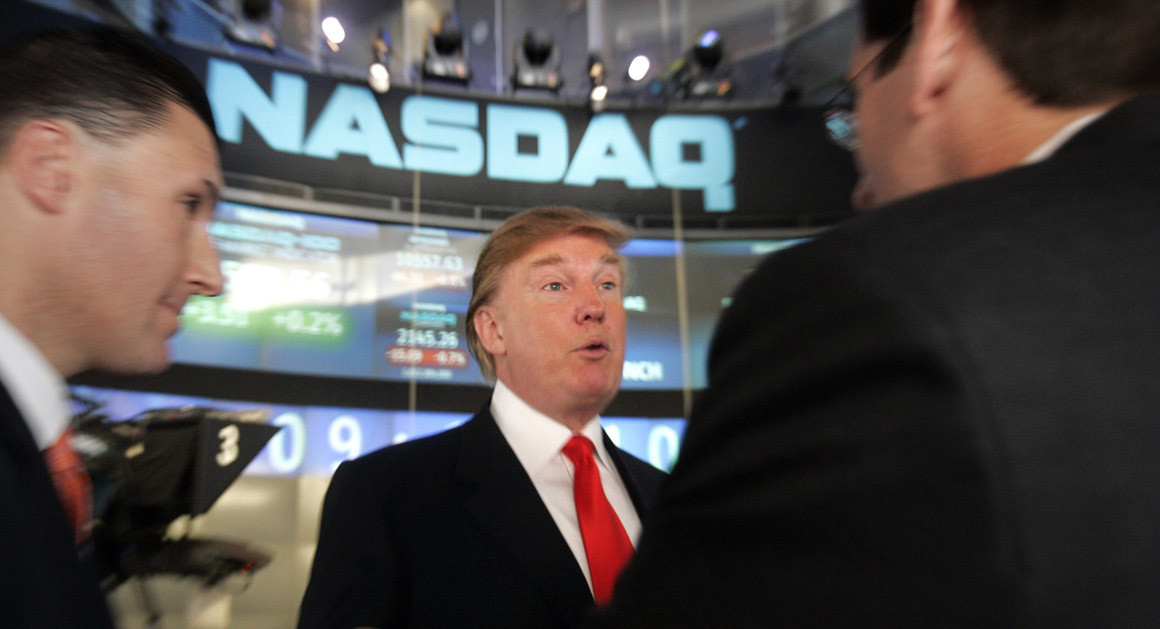
While the Dow and the S&P 500 closed higher for sixth consecutive session, the tech-heavy Nasdaq dipped 16.96 points or 0.2 percent to 7,239.47. The Dow edged up 19.01 points or 0.1 percent to 25,219.38 and the S&P 500 inched up 1.02 points or less than a tenth of a percent to 2,732.22.

Despite the mixed performance on the day, the major averages all moved sharply higher for the week. The Nasdaq spiked by 5.3 percent, while the Dow and the S&P 500 both surged up by 4.3 percent.

The mixed close on Wall Street came after Special Counsel Robert Mueller’s office revealed that a federal grand jury has indicted several Russian nationals for allegedly interfering in the 2016 presidential election.

The indictment does not allege collusion between the Russians and President Donald Trump’s campaign but could still cause headaches for the president.

The strength seen earlier in the day came as traders once again shrugged off further indications of rising inflation, with a report from the Labor Department showing import prices jumped by more than expected in the month of January.

The Labor Department said import prices surged up by 1.0 percent in January after edging up by a revised 0.2 percent in December.

Economists had expected import prices to climb by 0.6 percent compared to the 0.1 percent uptick originally reported for the previous month.

The report also said export prices increased by 0.8 percent in January after inching up by a revised 0.1 percent in December.

Export prices had been expected to rise by 0.3 percent compared to the 0.1 percent drop originally reported for the previous month.

A separate report from the Commerce Department showed a much bigger than expected rebound in new residential construction in January.

The Commerce Department said housing starts soared by 9.7 percent to an annual rate of 1.326 million in January after tumbling by 6.9 percent to a revised 1.209 million in December.

Economists had expected housing starts to climb by 3.5 percent to an annual rate of 1.234 million from the 1.192 million originally reported for the previous month.

Building permits, an indicator of future housing demand, also surged up by 7.4 percent to an annual rate of 1.396 million in January from the revised December rate of 1.300 million.

The University of Michigan also released a report unexpectedly showing a significant improvement in consumer sentiment in the month of February.

The preliminary reading on the consumer sentiment index for February came in at 99.9, up from the final January reading of 95.7. Economists had expected the index to edge down to 95.5.

“Consumer sentiment rose in early February to its second highest level since 2004 despite lower and much more volatile stock prices,” said Richard Curtin, the survey’s chief economist.

Curtin said stock market gyrations were overshadowed by rising incomes, employment growth, and net favorable perceptions of tax reform.

Most of the major sectors ended the day showing only modest moves, contributing to the lackluster close by the broader markets.

Pharmaceutical stocks saw considerable strength, however, with the NYSE Arca Pharmaceutical Index climbing by 1 percent.

Biopharmaceutical company Alkermes (ALKS) posted a standout gain, surging up by 5.5 percent to a two-year closing high.

On the other hand, substantial weakness was visible among gold stocks, as reflected by the 2.3 percent slump by the NYSE Arca Gold Bugs Index. Gold stocks came under pressure despite a modest increase by the price of the precious metal.


Dipo Olowookere is a journalist based in Nigeria that has passion for reporting business news stories. At his leisure time, he watches football and supports 3SC of Ibadan. Mr Olowookere can be reached via [email protected]

Click to comment

Leave a Reply

Your email address will not be published. Required fields are marked *

Economy

MRS Oil, FrieslandCampina Wamco Shrink NASD Index by 0.68%

Published

on

MRS Oil voluntary delisting

By Adedapo Adesanya

The duo of MRS Oil and FrieslandCampina Wamco Nigeria Plc weakened the NASD Over-the-Counter (OTC) Securities Exchange by 0.68 per cent on Friday, June 5.

MRS Plc lost N19.00 during the session to sell at N171.00 per share compared with Thursday’s value of N190.00 per share, and FrieslandCampina Wamco Nigeria Plc depreciated by N8.70 to finish at N181.68 per unit compared with the preceding session’s N190.38 per unit.

As a result, the market capitalisation further lost N22.59 billion to close at N2.607 trillion versus the N2.630 trillion it ended a day earlier, and the NASD Unlisted Security Index (NSI) dropped 37.76 points to settle at 4,358.32 points, in contrast to the previous day’s 4,396.08 points.

The alternative stock market closed the last trading day of this week with a price gainer, Central Securities Clearing System (CSCS) Plc, which gained 6 Kobo to quote at N78.40 per share compared with the preceding session’s N78.34 per share. However, it could not prevent the market from going down at the close of business.

Yesterday, the volume of securities bought and sold by investors went down by 50.0 per cent to 140,345 units from the preceding day’s 280,714 units, the value of stocks decreased by 16.5 per cent to N17.9 million from the previous session’s N21.5 million, and the number of deals carried out by market participants fell by 35.7 per cent to 27 deals from the 42 deals recorded on Thursday.

When trading activities closed for the day, Great Nigeria Insurance (GNI) Plc remained the most active stock by value on a year-to-date basis, with 3.4 billion units exchanged for N8.4 billion, trailed by Infrastructure Credit Guarantee (Infracredit) Plc with 2.3 billion units sold for N6.5 billion, and CSCS Plc with 64.7 million units traded for N4.4 billion.

GNI Plc also ended the session as the most traded stock by volume on a year-to-date basis, with 3.4 billion units worth N8.4 billion, followed by Infracredit Plc with 2.3 billion units transacted for N6.5 billion, and Resourcery Plc with 1.1 billion units valued at N415.7 million.

Continue Reading

Economy

NGX Index Rebounds 0.15% on Renewed Interest in Financial Stocks

Published

on

Financial Stocks

By Dipo Olowookere

Renewed interest in financial stocks and others lifted the Nigerian Exchange (NGX) Limited by 0.15 per cent on Friday.

Customs Street closed higher yesterday despite the 1.37 per cent loss recorded by the consumer goods sector as a result of profit-taking.

This was offset by gains in the other key sectors of the local bourse, as the insurance counter chalked up 1,14 per cent. The banking space appreciated by 0.90 per cent, the industrial goods segment grew by 0.46 per cent, and the energy sector expanded by 0.01 per cent.

Consequently, the All-Share Index (ASI) went up by 366.00 points to 242,593.31 points from 242,227.31 points, and the market capitalisation gained N235 billion to close at N155.594 trillion compared with the previous day’s N155.359 trillion.

The trio of International Energy Insurance, Abbey Mortgage Bank, and DAAR Communications improved by 10.00 per cent each yesterday to N7.26, N9.35, and N1.98, respectively, while Zichis advanced by 9.39 per cent to N32.38, with Sovereign Trust Insurance up by 8.70 per cent to N2.50.

On the flip side, Academy Press lost 9.84 per cent to quote at N8.25, University Press depreciated by 9.73 per cent to N5.10, Africa Prudential dipped by 2.63 per cent to N12.95, Chams crumbled by 2.44 per cent to N4.00, and International Breweries slipped by 1.59 per cent to N12.35.

Business Post reports that the market breadth index was positive during the session after recording 37 appreciating equities and 14 depreciating equities, implying strong investor sentiment.

Abbey Mortgage Bank led the activity chart with a turnover of 164.1 million units worth N1.5 billion, Ellah Lakes sold 76.7 million units for N767.2 million, Access Holdings transacted 44.8 million units valued at N1.1 billion, Linkage Assurance exchanged 23.0 million units worth N41.2 million, and The Initiates traded 20.2 million units for N562.1 million.

At the close of trades, market participants transacted 608.5 million units worth N32.0 billion in 53,826 deals versus the 588.5 million units valued at N27.9 billion executed in 57,352 deals in the previous session. This showed that the number of deals eased by 6.15 per cent, the volume of transactions rose by 3.40 per cent, and the value of transactions soared by 14.70 per cent.

Continue Reading

Economy

Naira Depreciates to N1,362/$1 at Official Market

Published

on

Naira 4 Dollar

By Adedapo Adesanya

The Naira further depreciated against the United States Dollar by N3.46 or 0.25 per cent to N1,362.21/$1 from N1,358.75/$1 in the Nigerian Autonomous Foreign Exchange Market (NAFEX) on Friday, June 5.

However, it appreciated against the Pound Sterling in the same market window during the session by N4.47 to trade at N1,823.59/£1 compared with the previous day’s N1,828.06/£1, and gained N7.00 against the Euro to sell at N1,574.58/€1, in contrast to Thursday’s closing price of N1,581.58/€1.

For another trading session, the Nigerian Naira maintained stability against the Dollar in the parallel market and the GTBank forex counter on Friday at N1,375/$1 and N1,372/$1, respectively.

The Naira is expected to remain strong in the near term, backed by a rise in external reserves, which are nearing $50 billion, enhancing analysts’ confidence about its outlook in the second half of 2026.

Heightened global uncertainty has reduced the incentive for importers and corporates to demand FX, as cautious trade weighs on import needs. Analysts estimate a $40 billion net FX position for the year, a projection anchored in oil windfall gains.

As for the cryptocurrency market, prices remained depressed following a strong US jobs report that spurred markets to price in higher-for-longer interest rates, sending Treasury yields and the dollar up while hammering stocks, especially AI-related names. Crypto markets saw heavy leverage washouts with about $1.6 billion in positions liquidated over 24 hours.

Ethereum (ETH) gave up 4.9 per cent to trade at $1,584.68, Solana (SOL) fell by 3.3 per cent to $63.22, Bitcoin (BTC) crashed by 1.9 per cent to $61,333.23, Dogecoin (DOGE) slipped by 1.8 per cent to $0.0821, and Ripple (XRP) moderated by 1.8 per cent to $1.09.

Further, TRON (TRX) dropped 1.6 per cent to sell at $0.3197, Binance Coin (BNB) slumped by 1.0 per cent to $581.18, and  Cardano (ADA) declined by 0.4 per cent to $0.1589, while the US Dollar Tether (USDT) gained 0.07 to sell at $0.9997, and US Dollar Coin (USDC) closed flat at $0.9998.

Continue Reading

Trending