Economy
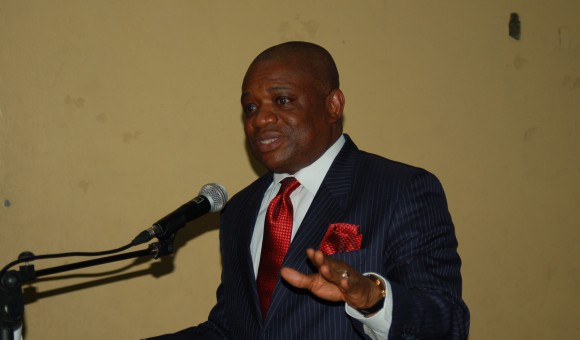
Government has no Business in Business—Kalu

By Modupe Gbadeyanka
Former Governor of Abia State, Mr Orji Uzor Kalu, has disclosed that government has no business in business, but to create an enabling environment for businesses to thrive.
Speaking at a dinner he hosted in honour of a cross-section of Abuja-based entrepreneurs at his residence in Abuja, the business mogul also called on the Federal Government to abolish the current dual exchange rate regime as a way of attracting foreign investors and discouraging imports.
He pointed out that the current forex regime has further widened the gap between the rich and the poor with the huge differential between the inter-bank and the parallel markets.
According to him, the President Muhammadu Buhari administration must provide a conducive environment by investing in infrastructure.
He said, “despite the current state of the Nigerian economy, I am optimistic that the future is bright if government implements practical policies that will stimulate the economy.
“The Central Bank of Nigeria (CBN) cannot continue to regulate the economy by actively pegging the exchange rate. Market forces should determine the value of the naira.
“In the long run, a flexible exchange regime will attract foreign investments and ultimately lead to generation of foreign exchange while discouraging imports.
“The local economy needs stimulus to foster growth and development and one of such initiatives is to immediately promote a market-driven exchange regime.
“As it is now, banks and other financial institutions, which are key players in the economy, can no longer withstand the pressure of forex demand, hence the need to allow demand and supply factors determine the exchange rate.
“As an established businessman, I feel the pains of business owners, who don’t have access to the inter-bank rate and as such will remain disadvantaged in doing business with those that have the leverage of getting forex at the inter-bank rate.
“The only way to achieve sustainable growth and development is by allowing a market-driven process determine the forex rate,” he said.
Speaking on his defection to the All Progressives Congress (APC), Mr Kalu stated that his membership of the party was borne out of the desire to attract more federal presence in terms of infrastructure to the South East for the sake of development.
Mr Kalu reaffirmed that the APC will continue to keep to its manifesto and as such will not betray the trust of Nigerians, adding that the APC remains a strong and united political party.
Economy
Senate Pushes for Ban on Textile Imports
By Aduragbemi Omiyale
To revive the local industry and create jobs to boost the economy, the Senate has advised the federal government to ban textile imports.
The upper chamber of the federal parliament made this suggestion on Tuesday at the plenary presided over by the Deputy Senate President, Mr Jibrin Barau.
They noted that to resuscitate textile industries in the country, the Federal Ministry of Industry, Trade and Investment, and the Federal Ministry of Agriculture should immediately implement investment-friendly policies.
The red chamber of the National Assembly recalled when Nigeria used to have a vibrant textile industry, but lamented that the influx of foreign fabrics destroyed the sector.
The Senate emphasised that to stimulate economic growth and tackle insecurity in the country, there must be a total ban on the importation of textile materials into Nigeria.
“With the lifting of the ban on textile importation in 2010, Nigeria now has almost 80 per cent of its textiles imported from China, Indonesia, Taiwan and other countries.
“This trend is definitely not helping the Nigerian economy in terms of employment generation and the conservation of foreign exchange,” Mr Katung Marshall, who co-sponsored a motion on the Urgent Need to Revive the Textile Industries in Nigeria, said on the floor of the Senate yesterday.
The Senator informed his colleagues that the government protection policies in the 1960s and 1970s, particularly the restrictions on textile imports, attracted investors and helped the sector to flourish.
According to him, during the period, Nigeria’s textile industry accommodated about 167 mills and directly employed over 500,000 people, making it the nation’s second-largest employer after the federal government.
But he said this went south in the late 1990s due to obsolete machinery, inadequate capital and persistent power supply challenges, adding that by 2007, major companies, including Kaduna Textile Limited, Arewa Textiles and United Nigerian Textiles Limited, had shut down operations, leading to the loss of over 7,000 jobs.
Economy
FrieslandCampina, Nitrox, Others Further Weaken NASD Index by 0.48%
By Adedapo Adesanya
Six securities led by FrieslandCampina Wamco Nigeria Plc further weakened the NASD Over-the-Counter (OTC) Securities Exchange by 0.48 per cent on Tuesday, June 9.
The notable dairy firm lost N7.87 during the trading day to close at N173.81 per unit compared with the previous session’s N181.68 per unit, Nitrox Industrial Gases Plc depreciated by N2.42 to N21.88 per share from N24.30 per share, Afriland Properties Plc dipped by N1.25 to N15.55 per unit from N16.80 per unit, Food Concepts Plc stumbled by 27 Kobo to N2.48 per share from N2.75 per share, UBN Property Plc dropped 9 Kobo to settle at N2.11 per unit versus N2.20 per unit, and Industrial and General Insurance (IGI) Plc crashed by 4 Kobo to 50 Kobo per share from 54 Kobo per share.
As a result of these losses, the market capitalisation went down by N12.50 billion to N2.593 trillion from N2.606 trillion, and the NASD Unlisted Security Index (NSI) declined by 20.89 points to 4,335.31 points from 4,356.20 points.
Business Post reports that there was a price gainer yesterday, and this was Central Securities Clearing System (CSCS) Plc, which improved its value by N2.65 to N81.13 per unit from N78.48 per unit.
The volume of transactions soared on Tuesday by 644.3 per cent to 1.6 million units from 213,188 units, the value of trades increased by 208.6 per cent to N62.3 million from N20.2 million, and the number of deals surged by 64 per cent to 41 deals from 25 deals.
The most active stock by value on a year-to-date basis remained Great Nigeria Insurance (GNI) Plc, with 3.4 billion units worth N8.4 billion, trailed by Infrastructure Credit Guarantee (Infracredit) Plc with 2.3 billion units transacted for N6.5 billion, and CSCS Plc with 65.1 million units sold for N4.4 billion.
GNI Plc was also the most traded stock by volume on a year-to-date basis, with 3.4 billion units valued at N8.4 billion, followed by Infracredit Plc with 2.3 billion units exchanged for N6.5 billion, and Resourcery Plc with 1.1 billion units traded for N415.7 million.
Economy
Naira Appreciates to N1,360.55/$1 at Official Market
By Adedapo Adesanya
The Naira was exchanged at N1,360.55/$1 in the Nigerian Autonomous Foreign Exchange Market (NAFEX) on Tuesday, June 9, compared with the N1,362.84/$1 it was exchanged a day earlier, indicating an appreciation of N2.29 or 0.17 per cent against the United States Dollar.
It also gained 74 Kobo against the Euro in the same market segment to quote at N1,573.61/€1, in contrast to Monday’s closing price of N1,574.35/€1, but lost N1.71 against the Pound Sterling to trade at N1,823.00/£1 versus the preceding day’s N1,821.29/£1.
At the black market window, the Nigerian currency maintained stability against the greenback during the session at N1,380/$1, and also traded flat at the GTBank FX counter at N1,373/$1.
Market analysts say the ongoing implementation of the fourth edition of the Foreign Exchange Manual by the Central Bank of Nigeria (CBN) since June 1 has strengthened the Naira and the country’s foreign reserves, bolstering confidence in the market.
The new manual is expected to deepen FX transparency, improve liquidity and strengthen market confidence and liquidity, as it aligns with the apex bank’s broader vision of ensuring that businesses and individuals have equal access to FX in a transparent and liquid market.
The gross external reserves have climbed to a record $50.04 billion, reinforcing investor confidence and boosting the CBN’s capacity to support the local currency.
As for the cryptocurrency market, expectations for higher interest rates sapped demand for non-yielding assets. The latest crypto pullback appears driven by a short squeeze rather than fresh buying, as more than $500 million in bearish bets were liquidated and spot demand.
Cardano (ADA) depreciated by 5.5 per cent to $0.1603, Ripple (XRP) declined by 5.2 per cent to $1.11, Solana (SOL) fell by 4.6 per cent to $64.05, Ethereum (ETH) tumbled by 3.5 per cent to $1,626.51, Dogecoin (DOGE) crashed by 3.6 per cent to $0.0835, Bitcoin (BTC) dropped 3.2 per cent to trade at $61,292.98, Binance Coin (BNB) slumped by 2.9 per cent to $585.26, and TRON (TRX) slipped by 0.9 per cent to $0.3220, while the US Dollar Tether (USDT) and the US Dollar Coin (USDC) remained unchanged at $0.9997 and $0.9998, respectively.
-
Feature/OPED6 years agoDavos was Different this year
-
Travel/Tourism10 years ago
Lagos Seals Western Lodge Hotel In Ikorodu
-
Showbiz3 years agoEstranged Lover Releases Videos of Empress Njamah Bathing
-
Banking8 years agoSort Codes of GTBank Branches in Nigeria
-
Economy3 years agoSubsidy Removal: CNG at N130 Per Litre Cheaper Than Petrol—IPMAN
-
Banking3 years agoSort Codes of UBA Branches in Nigeria
-
Banking3 years agoFirst Bank Announces Planned Downtime
-
Sports3 years agoHighest Paid Nigerian Footballer – How Much Do Nigerian Footballers Earn