Connect with us

Economy

Investors of Unlisted Securities Gain N2.07bn in First Week of 2024

Published

on

Nigeria's unlisted securities

By Adedapo Adesanya

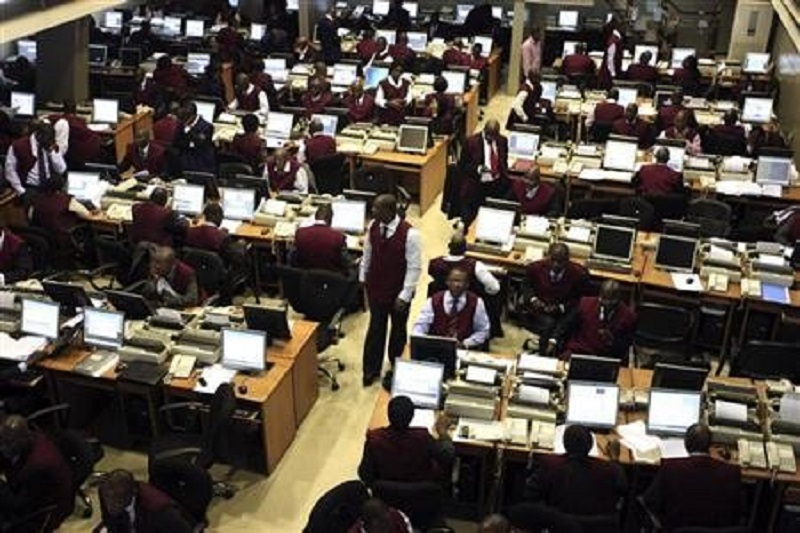
The NASD Over-the-Counter (OTC) Securities Exchange ended the first trading week of 2024 on a positive note as it appreciated by 0.16 per cent on a week-on-week basis last Friday.

The market had four trading sessions as a result of the public holiday observed last Monday for the New Year’s Day celebration, with 11 Plc rising by 9.4 per cent to N197.00 per share from the preceding week’s N180.00 per share.

Industrial and General Insurance (IGI) Plc gained 8 per cent to close at 27 Kobo per unit compared with the preceding week’s 25 Kobo per unit, and NASD Plc jumped by 4.0 per cent to N13.50 per share from N12.95 per share.

Further, FrieslandCampina Wamco Nigeria Plc increased by 2.5 per cent to trade at N82.00 per unit from N80.00 per unit, and Aradel Holdings Plc rose by 2.4 per cent to N1,115.00 per share from N1,089.00 per share.

As a result, the market capitalisation of the bourse expanded by N2.07 billion to N1.259 trillion from N1.257 trillion, and the NASD OTC Security Index improved by 1.52 points to 928.99 points from 927.47 points.

In the week, Central Securities Clearing System (CSCS) Plc lost 12.8 per cent to close at N17.31 per share from N19.84 per share, and Nipco Plc declined by 10 per cent to N72.00 per unit from the previous close of N80.00 per unit.

Last week, there was a 118.4 per cent increase in the total value of transactions to N73.7 million from N33.8 million, there was a 75.6 per cent growth in the volume of trades to 10.3 million units from 5.9 million units in Week 52 of 2023, and there was a 9.7 per cent rise in the number of deals to 34 trades from 31 transactions.

At the close of the week, Purple Real Estate Plc was the most traded security by volume with 5.5 million units, UBN Property Plc traded 3.6 million units, IGI Plc exchanged 0.71 million units, CSCS Plc transacted 0.21 million units, and Food Concepts Plc traded 0.17 million units.

Also, Purple Real Estate Plc was the most active with N28.8 million, Aradel Plc traded N27.9 million, UBN Property Plc recorded N6.3 million, CSCS Plc posted N3.8 million, and FrieslandCampina WAMCO Nigeria Plc expended N2.3 million.


Adedapo Adesanya is a journalist, polymath, and connoisseur of everything art. When he is not writing, he has his nose buried in one of the many books or articles he has bookmarked or simply listening to good music with a bottle of beer or wine. He supports the greatest club in the world, Manchester United F.C.

Economy

NGX Posts Turnover of 7.772 billion Equities Worth N374bn in Five Days

Published

on

VFD Group Lists NGX

By Dipo Olowookere

A total turnover of 7.772 billion equities worth N374.040 billion in 402,945 deals was recorded by the Nigerian Exchange (NGX) Limited last week compared with the 7.075 billion equities worth N324.351 billion traded in 474,436 deals a week earlier.

Data from the stock exchange showed that the financial services industry led the activity chart with 4.774 billion shares valued at N196.352 billion in 153,515 deals, contributing 61.43 per cent and 52.49 per cent to the total trading volume and value, respectively.

The ICT segment followed with 1.118 billion stocks worth N57.825 billion in 44,622 deals, and the services sector transacted 601.745 million equities for N6.984 billion in 27,653 deals.

First Holdco, UBA, and Chams accounted for 2.195 billion shares worth N99.820 billion in 30,056 deals, contributing 28.24 per cent and 26.69 per cent to the total trading volume and value, respectively.

Berger Pains led the gainers’ chart after gaining 55.57 per cent to trade at N168.95, SCOA Nigeria improved by 45.92 per cent to N33.05, DAAR Communications expanded by 42.41 per cent to N2.25, Fidson rose by 32.52 per cent to N136.50, and Learn Africa grew by 32.32 per cent to N10.85.

On the flip side, Zichis led the losers’ table after it gave up 11.78 per cent to settle at N29.43, The Initiates declined by 10.03 per cent to N32.30, NPF Microfinance Bank depreciated by 10.00 per cent to N5.76, NCR Nigeria shed 10.00 per cent to quote at N179.10, and Custodian Investment crashed by 9.52 per cent to N81.25.

At the close of transactions in the five-day trading week, 74 equities appreciated versus 69 equities in the previous week, 24 stocks depreciated versus 36 stocks a week earlier, and 48 shares closed flat versus 41 shares of the preceding week.

Last week, the All-Share Index (ASI) gained 2.27 per cent to finish at 250,330.92 points, and the market capitalisation chalked up 2.13 per cent to end at N160.444 trillion.

Similarly, all other indices finished higher apart from the energy, sovereign bond, and commodity indices, which fell by 1.19 per cent, 0.08 per cent and 0.80 per cent, respectively.

Continue Reading

Economy

CPPE Warns CBN Against Further Rate Hikes as MPC Meeting Kicks Off

Published

on

muda yusuf

By Adedapo Adesanya

The Centre for the Promotion of Private Enterprise (CPPE) has urged policymakers to adopt a cautious approach to further interest rate hikes, warning that rising political spending ahead of the 2027 elections and growing geopolitical tensions could complicate monetary policy decisions.

The Monetary Policy Committee (MPC) of the central bank will hold its 305th meeting starting Monday, May 19 (today) to Tuesday, May 20, after which the monetary policy decisions will be announced.

The centre said while inflation control remains critical, excessive monetary tightening could weaken credit growth, discourage private investment and slow Nigeria’s fragile economic recovery.

Last week, the National Bureau of Statistics (NBS) said the country’s inflation increased to 15.69 per cent in April amid the impact of the continued tension in the Middle East.

According to the chief executive of CPPE, Mr Muda Yusuf, the MPC will need to carefully weigh domestic economic realities alongside global developments before taking any decision on rates.

He stated that geopolitical tensions involving the United States, Israel and Iran were already fueling uncertainty in the global energy market, with rising crude oil prices expected to increase domestic energy, logistics and production costs, noting that the global developments could further intensify inflationary pressures within the Nigerian economy.

On the domestic front, Mr Yusuf said signs of rising liquidity linked to preparations for the 2027 general elections are becoming more evident, explaining that political spending by candidates and parties, combined with increasing allocations from the Federation Account Allocation Committee (FAAC) to state governments, could create fresh liquidity management and inflation challenges for monetary authorities.

“Indications of increased liquidity related to the upcoming 2027 elections are becoming more prominent. Political spending from candidates and parties, coupled with enhanced disbursements from FAAC to state governments, presents important considerations for liquidity management and inflation control,” he said.

Mr Yusuf stated that, given the current environment, there is a strong possibility that the MPC may either retain the current policy stance or opt for only moderate tightening.

The CPPE warned that sustained high interest rates could hurt economic growth, weaken industrial productivity and undermine job creation and acknowledged the need to manage inflation expectations

The centre argued that Nigeria’s inflation challenges are largely supply-driven, particularly due to high energy costs, logistics bottlenecks and structural inefficiencies, limiting the effectiveness of aggressive monetary tightening.

According to Mr Yusuf, monetary tightening is generally more effective in tackling demand-pull inflation than supply-side inflation.

He stressed that higher interest rates could increase borrowing costs for businesses, reduce manufacturing competitiveness, constrain small and medium-scale enterprises and discourage investment at a time when the economy requires stronger productivity growth.

The CPPE also warned that elevated rates could heighten the risk of loan defaults and place additional pressure on businesses already struggling with high operating costs.

Mr Yusuf advocated a more balanced and development-focused monetary policy framework suited to the realities of emerging economies like Nigeria, where infrastructure gaps, weak productive capacity, unemployment and financing constraints remain major challenges.

He maintained that sustainable disinflation in Nigeria would depend more on supply-side reforms, energy security, improved logistics, stable exchange rates and increased domestic refining capacity than solely on aggressive monetary tightening.

“The primary focus should be on fostering investor confidence, encouraging productive investments, enhancing output growth and improving the economy’s supply-side capacity while remaining attentive to inflation management,” he said.

Continue Reading

Economy

Dangote Raises Investment in Ethiopia to $4bn, Promises Food Security

Published

on

Dangote investment Ethiopia

By Modupe Gbadeyanka

Nigerian businessman, Mr Aliko Dangote, has increased his investment in Ethiopia to over $4 billion from $2.5 billion.

During a high-profile visit hosted by Prime Minister Abiy Ahmed, the business mogul informed newsmen in Gode, in Ethiopia’s Somali region, that the expanded scope includes critical infrastructure such as a 110-kilometre pipeline, a 120MW power plant, a polypropylene packaging facility, and a two-million-tonne NPK blending plant, among other new components.

The richest man in Africa described Ethiopia as a key strategic destination for Dangote Group’s long-term investments.

“In total, our declared and signed investments in Ethiopia now exceed $4 billion. This makes Ethiopia the second-largest recipient of our investments in Africa, accounting for nearly nine per cent of our continental outlay between now and 2030,” he said.

He also reaffirmed his commitment to boosting food security across Africa through large-scale fertiliser investments, declaring that the continent has the capacity to feed itself and become a net exporter of agricultural products.

Speaking on the strategic importance of fertiliser in agricultural productivity, Mr Dangote noted that Africa’s food insecurity challenges are largely due to limited access to key inputs.

Africa holds immense agricultural potential, yet continues to grapple with food insecurity due to limited access to fertiliser. Through our investments, we are committed to reversing this trend by boosting productivity, empowering farmers, and advancing a sustainable path to food self-sufficiency,” he stated as he was accompanied to inspect the site of the proposed fertiliser plant, where construction activities are already underway.

He added that his organisation’s ambition, though bold, is achievable with sustained investment in fertiliser production and agricultural infrastructure.

“Africa has the capacity to feed itself and even export to the rest of the world. Our fertiliser investments across the continent are designed to unlock that potential and secure a prosperous future for our people,” Mr Dangote noted.

He further commended Prime Minister Abiy Ahmed’s leadership and vision for economic transformation, saying he is “driving development beyond expectations, but such progress requires strong private sector collaboration. We are proud to partner with Ethiopia to help build one of Africa’s most dynamic economies in the coming decade.”

In his remarks, Mr Ahmed described his guest as a trusted partner and commended the pace of work on the fertiliser project, which he said aligns with Ethiopia’s broader development priorities.

He emphasised that the project would significantly boost domestic fertiliser production, reduce dependence on imports, and provide critical support to millions of Ethiopian farmers.

According to the Prime Minister, the fertiliser plant will also create extensive employment opportunities, strengthen the industrial value chain, and reinforce Ethiopia’s position as an emerging agro-industrial hub in Africa.

“This type of large-scale investment demonstrates the power of strong collaboration between government and the private sector,” he said. “Expanding such partnerships will accelerate economic growth, attract further investment, and improve the livelihoods of our people.”

The Dangote fertiliser initiative is widely seen as a transformative step toward reshaping Africa’s agricultural landscape, with the potential to enhance productivity, reduce import dependence, and drive inclusive economic growth across the continent.

Continue Reading

Trending