
Economy
Investors Stake N1.0trn on N220.5bn Treasury Bills, Rate Drops to 0.29%

By Dipo Olowookere
Yesterday, the Central Bank of Nigeria (CBN) sold some treasury bills to investors at the primary market auction (PMA) a day after the Monetary Policy Rate (MPR) was jerked up to 17.50 per cent from 16.50 per cent despite inflation figures in December 2022 moderating to 21.34 per cent.
According to details of the PMA, the apex bank auctioned N220.5 billion worth of treasury bills across three maturities, with N1.7 billion for the 91-day instrument, N1.3 billion for the 182-day instrument, and N217.5 billion for the 364-day instrument.
However, the value of subscriptions significantly rose as investors offered N1.0 trillion on the debt instruments as they made efforts to tie down their funds on risk-free asset class, with the stop rate going as low as 0.29 per cent.
A breakdown showed that N860.4 billion was staked on the 12-month bill during the session, with N217.5 billion allotted at the close of the exercise and the stop rate reduced by 2.52 per cent to 4.78 per cent from the 7.30 per cent of the preceding PMA.
Business Post reports that the bank offered for sale N1.3 billion worth of the 182-day tenor yesterday. However, the central bank received bids valued at N89.6 billion, and N1.3 billion sold to successful subscribers, with the rate slashed by 2.53 per cent to 1.80 per cent from 4.33 per cent.
Lastly, the CBN auctioned N1.7 billion worth of the 91-day bill during the session, with N94.3 billion worth of subscriptions received from subscribers and N1.7 billion allotted. Also, the stop rate for this bill was brought down by 1.71 per cent to 0.29 per cent to 2.00 per cent.






By Adedapo Adesanya
The NASD Over-the-Counter (OTC) Securities Exchange maintained its upward trajectory with a further 0.88 per cent rise on Wednesday, March 3.
The expansion increased the NASD Unlisted Security Index (NSI) by 36.94 points to 4,256.41 points from 4,219.47 points, and lifted the market capitalisation by N22.10 billion to N2.546 trillion from Tuesday’s N2.524 trillion.
The six price gainers were responsible for the growth achieved by the unlisted securities market yesterday, with MRS Oil Plc adding N20.00 to trade at N230.00 per unit versus the previous day’s N210.00 per share.
Further, FrieslandCampina Wamco Nigeria Plc surged by N11.07 to N128.83 per share from N117.76 per share, Lagos Building Investment Company (LBIC) Plc grew by 37 Kobo to N4.12 per unit from N3.75 per unit, First Trust Mortgage Bank Plc advanced by 19 Kobo to N2.11 per share from N1.92 per share, Acorn Petroleum Plc rose by 1 Kobo to sell at N18.75 per unit versus the preceding day’s N18.74 per unit, and Acorn Petroleum Plc also gained 1 Kobo rise to sell at N1.35 per share versus N1.34 per share.
It was observed that two securities were in red at midweek, with Central Securities Clearing System (CSCS) Plc down by N1.56 to N82.59 per unit from N84.05 per unit, and Industrial and General Insurance (IGI) Plc down by 2 Kobo to 47 Kobo per share from 49 Kobo per share.
Yesterday, the volume of trades went up by 86.2 per cent to 2.6 million units from 1.4 million units, but the value of transactions deflated by 31.4 per cent to N64.1 million from N93.4 million, and the number of deals declined by 22.0 per cent to 46 deals from 59 deals.
CSCS Plc remained the most traded stock by value (year-to-date) with 36.4 million units valued at N2.2 billion, trailed by Okitipupa Plc with 6.3 million units traded for N1.1 billion, and Geo-Fluids Plc with 122.8 million units transacted for N480.4 million.
Resourcery Plc ended the day as the most traded stock by volume (year-to-date) with 1.05 billion units sold for N408.7 million, followed by Geo-Fluids Plc with 122.8 million units traded for N480.4 million, and CSCS Plc with 36.4 million units worth N2.2 billion.
By Adedapo Adesanya
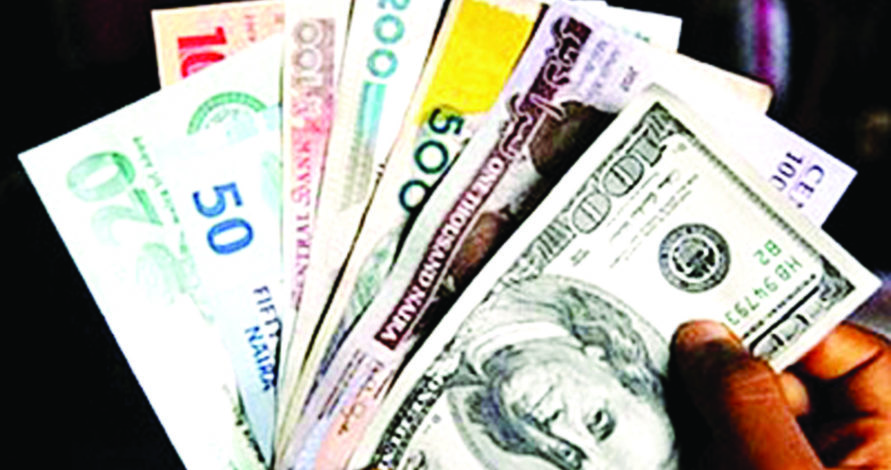
For the 11th straight trading session, the Naira closed lower against the United States Dollar in the Nigerian Autonomous Foreign Exchange Market (NAFEX) on Wednesday, March 4.
At the official market, it lost N2.80 or 0.2 per cent against the greenback to close at N1,387.09/$1, i contrast to the N1,384.29/$1 it was traded a day earlier.
It also depreciated against the Pound Sterling in the same market window at midweek by N12.88 to quote at N1,855.10/£1 versus Tuesday’s rate of N1,842.22/£1, and weakened against the Euro by N9.08 to N1,615.27/€1 from N1,606.19/€1.
The Nigerian Naira depreciated against the US Dollar yesterday at the GTBank forex counter by N12 to sell for N1,385/$1 compared with the previous day’s N1,373/$1, and tumbled by N5 in the parallel market to close at N1,390/$1 compared with the preceding day’s N1,385/$1.
The exchange rate has been trending downward for almost two weeks, though it has been resistant to being in panic mode because it is still within its projected N1,350 to N1,450 per Dollar band.
Nigeria’s gross external reserves climbed to $49.693 billion from $49.604 billion, based on the latest data from the Central Bank of Nigeria (CBN).
Meanwhile, the cryptocurrency market recovered after weeks of consolidation, but traders remain divided over whether the move marks a genuine breakout or another trap for late buyers.
Analysts have pointed to heavy overhead supply and positioning in derivatives markets as potential risks, with some suggesting a rally could only attract sellers rather than confirm a sustained recovery.
Dogecoin (DOGE) gained 8.3 per cent to trade at $0.0962, Ethereum (ETH) appreciated by 7.9 per cent to $2,122.87, Bitcoin (BTC) added 6.3 per cent to sell for $72,438.50, Solana (SOL) improved by 6.2 per cent to $90.37, and Cardano (ADA) jumped 5.1 per cent to $0.2733.
Further, Ripple (XRP) rose by 4.9 per cent to $1.41, Binance Coin (BNB) soared by 3.2 per cent to $652.64, and Litecoin (LTC) surged by 2.7 per cent to $56.09, while the US Dollar Tether (USDT) and the US Dollar Coin (USDC) traded flat at $1.00 each.
By Adedapo Adesanya
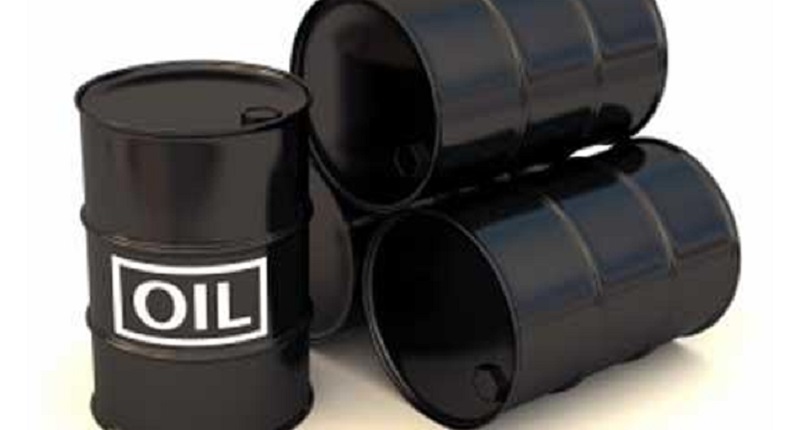
Crude oil prices were largely unchanged on Wednesday as escalating US and Israel strikes against Iran widened regional tensions and halted shipping through the Strait of Hormuz.
Brent crude was at $81.40 per barrel, while the US West Texas Intermediate (WTI) crude gained 10 cents or 0.1 per cent to trade at $74.66 per barrel.
Despite not much movement in midweek, analysts say prices remain elevated as markets grapple with the prospect of a prolonged war and lingering supply disruptions.
The US government has signalled a four- to five-week campaign, but Iran is seeking to regionalise the conflict, and the crucial Strait of Hormuz chokepoint is effectively shut.
The New York Times reported that operatives from Iran’s Ministry of Intelligence signalled openness to the US Central Intelligence Agency to talks on ending the war.
On Wednesday, US Defence Secretary Pete Hegseth said America was winning the war against Iran and that the US military could fight as long as needed.
While all other options are being explored, forces from both the US and Israel have struck targets across Iran, prompting Iranian retaliatory strikes against energy infrastructure in a region that accounts for just under a third of global oil production.
Iraq, the second-largest crude producer in the Organisation of the Petroleum Exporting Countries (OPEC), has cut output by nearly 1.5 million barrels a day due to storage limits and the lack of an export route.
The US said it was working on plans to secure the Strait of Hormuz to ensure safety for oil tankers amid the war with Iran.
President Donald Trump on Tuesday said the country’s Navy could begin escorting oil tankers through the strait if necessary. He added that he had ordered the US International Development Finance Corporation to provide political risk insurance and financial guarantees for maritime trade in the Gulf.
Meanwhile, countries and companies have begun seeking alternative routes and supplies of crude. India and Indonesia said they were looking for other supplies, while some Chinese refineries were shutting or moving up maintenance plans.
The Energy Information Administration (EIA) said on Wednesday that crude stocks rose by 3.5 million barrels in the last week to their highest in three and a half years.










-
 Feature/OPED6 years ago
Davos was Different this year
-
Travel/Tourism10 years ago
Lagos Seals Western Lodge Hotel In Ikorodu
-

 Showbiz3 years ago
Estranged Lover Releases Videos of Empress Njamah Bathing
-
 Banking8 years ago
Sort Codes of GTBank Branches in Nigeria
-

 Economy3 years ago
Subsidy Removal: CNG at N130 Per Litre Cheaper Than Petrol—IPMAN
-

 Banking3 years ago
Sort Codes of UBA Branches in Nigeria
-

 Banking3 years ago
First Bank Announces Planned Downtime
-

 Sports3 years ago
Highest Paid Nigerian Footballer – How Much Do Nigerian Footballers Earn