Connect with us

Economy

Nigeria Sells Treasury Bills to Investors at 19% After Spike in Demand

Published

on

treasury bills yields

By Dipo Olowookere

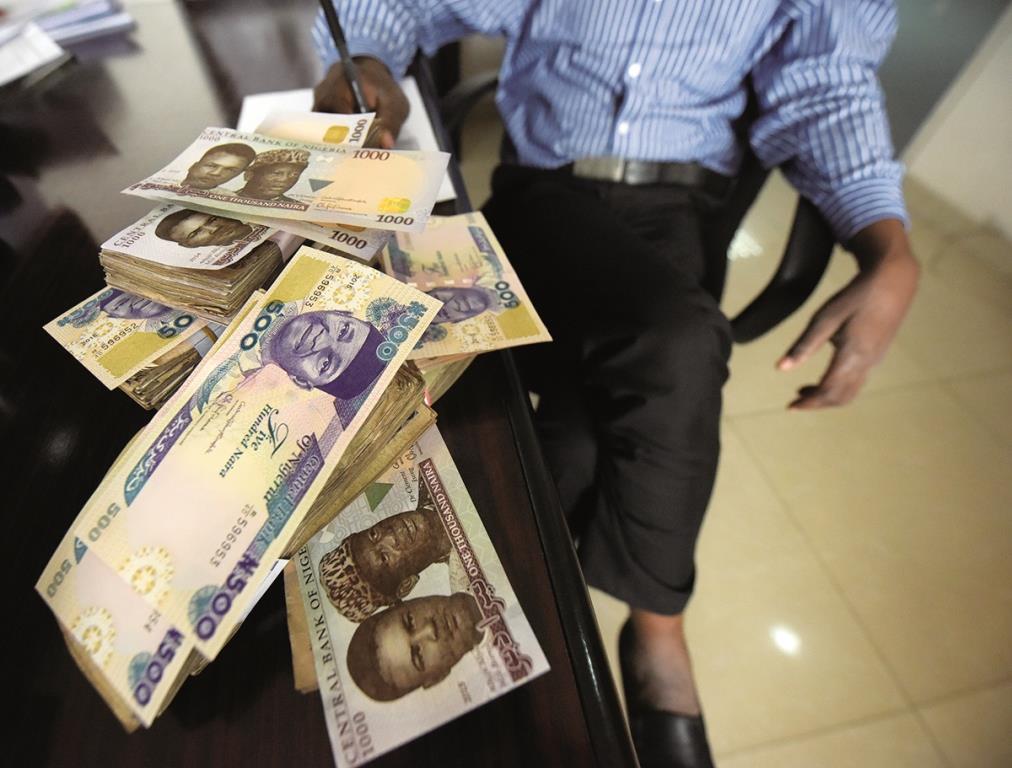
Investors purchased Nigerian treasury bills at 19.00 per cent at the primary market on Wednesday, details from the exercise obtained by Business Post have revealed, indicating that the benchmark interest rate could be raised from the current 18.75 per cent when the Monetary Policy Committee (MPC) meeting is held later this month.

The Central Bank of Nigeria (CBN), on behalf of the federal government, through the Debt Management Office (DMO) auctioned T-bills at the primary market yesterday.

The debt instruments came in their usual three tenors on Wednesday, with N1 trillion on offer, this newspaper gathered.

The worth of the 91-day bill offered for sale was N200 billion; the same for the 182-day bill, while the 364-day bill was N600 billion.

However, the short- and mid-dated instruments were undersubscribed by investors, while the long-dated paper witnessed a strong demand.

According to the results of the exercise, traders stake N1.9 trillion on the one-year treasury bill at the PMA, with the range of bids between 13.00 per cent and 29.94 per cent. However, about N908.8 billion was allotted by the central bank to successful bidders at 19.00 per cent, higher than the 11.54 per cent it cleared at the preceding PMA by 7.46 per cent.

A look at the result of the six-month bill showed that investors offered N76.8 billion with a range of bids between 4.00 per cent and 19.98 per cent, but only N51.4 billion was allotted at 18.00 per cent, which is 10.85 per cent higher than the 7.15 per cent it cleared at the previous exercise.

The three-month instrument received subscriptions valued at N39.9 billion during the sales and a range of bids between 7.00 per cent and 17.20 per cent. However, N39.9 billion was sold at 17.24 per cent versus the 5.00 per cent it was offered by the central bank at the last auction, indicating a 12.24 per cent hike.

Analysis of the exercise showed that the apex sold slightly above the N1 trillion it offered for sale yesterday by N100 million after getting bids valued at N1.983 trillion.


Economy

Naira Appreciates to N1,441/$1 as FX Pressure Eases

Published

on

Naira-Denominated Assets

By Adedapo Adesanya

Recent foreign exchange (FX) pressure on the Naira eased on Thursday as its against the US Dollar closed stronger in the Nigerian Autonomous Foreign Exchange Market (NAFEM) by N1.64 or 0.11 per cent to N1,441.44/$1 from the N1,443.08/$1 it was exchanged a day earlier.

Equally, the Nigerian Naira improved its value against the Pound Sterling in the official market by N2.44 to sell for N1,898.96/£1 versus the previous day’s N1,901.40/£1. However, it depreciated against the Euro by 99 Kobo to close at N1,674.96/€1, in contrast to Wednesday’s closing price of N1,673.97/€1.

At the GTBank forex counter, the domestic depreciated against the Dollar yesterday by N3 to settle at N1,450/$1 versus the preceding session’s rate of N1,447/$1, and in the black market, the exchange rate of the Naira to the Dollar remained unchanged at N1,455/$1.

The local currency is trying to claw back some losses recorded this week as unmet demand from thin US dollar supply has invited pressure across key segments.

However, positive signals like Nigeria’s gross external reserves rising by more than $30 million day on day to close at $43.427 billion as of November 11, 2025, gives the Central Bank of Nigeria (CBN) enough power to make significant intervention.

In recent weeks, the apex bank FX injection has been minimal and erratic due to increasing FX inflows from foreign portfolio investors and exporters. FX inflow into currency market has fallen from peaked of $1.37 billion to $899 million.

In the cryptocurrency market, there were significant declines on Thursday as short and long-term investors liquidated their positions. More than $1 billion in leveraged crypto positions were wiped out over 24 hours, with roughly $887 million coming from longs.

Ethereum (ETH) slumped by 10.9 per cent to $3,160.25, Solana (SOL) went south by 10.3 per cent to $140.65, Cardano (ADA) depreciated by 9.6 per cent to $0.5146, Ripple (XRP) fell by 9.2 per cent to $2.27, Dogecoin (DOGE) slipped by 8.2 per cent to $0.1620, Bitcoin (BTC) dropped 6.9 per cent to $96,351.91, Binance Coin (BNB) shrank by 6.1 per cent to $909.83, and Litecoin (LTC) went down by 5.4 per cent to $95.57, while the US Dollar Tether (USDT) and the US Dollar Coin (USDC) remained unchanged at $1.00 apiece.

Continue Reading

Economy

Oil Rises Amid Global Oversupply Concerns, Lukoil Sanctions

Published

on

OPEC Global Oil Demand

By Adedapo Adesanya

Oil gained on Thursday as investors weighed concerns about global oversupply with looming sanctions against Russia’s Lukoil.

The price of the Brent crude grade chalked up 30 cents or 0.5 per cent to $63.01 a barrel, and the US West Texas Intermediate (WTI) crude increased by 20 cents or 0.3 per cent to $58.69 a barrel.

The US has imposed sanctions on Lukoil as part of its efforts to bring the Russian government to peace talks with Ukraine. The sanctions prohibit transactions with the Russian company after November 21.

According to JPMorgan, nearly a third of Russia’s current seaborne oil export potential is now stuck in tankers as the US sanctions upend crude flows and Russia’s top buyers, China and India, are still struggling to assess the implications of the sanctions.

“Russia’s oil exports are entering a new phase of disruption as sanctions targeting Rosneft and Lukoil are set to take effect, prompting its two largest customers — India and China — to sharply reduce their December purchases,” the Wall Street bank said in a note.

JPMorgan estimates that as many as 1.4 million barrels per day of Russian crude oil or nearly a third of its exporting potential are on tankers at present, amid re-routing and slowed unloading as buyers are hesitant following the US sanctions on Russia’s top oil producers and exporters, Rosneft and Lukoil.

Also, the US Energy Information Administration (EIA) showed a larger-than-expected rise in US crude stocks, while gasoline and distillate inventories fell less than expected last week. Crude inventories rose by 6.4 million barrels to 427.6 million barrels in the week ended November 7, the EIA said.

The Organisation of the Petroleum Exporting Countries (OPEC) said global oil supplies would slightly exceed demand in 2026, a further shift from the group’s earlier projections of a deficit.

It also said it expected the supply surplus next year because of wider production increases by OPEC+, a group of producers that includes OPEC members and allies like Russia.

The International Energy Agency (EIA) raised its global oil supply growth forecasts for this year and next in its monthly oil market report on Thursday, signaling a bigger surplus in 2026.

The US EIA also said in its Short-Term Energy Outlook on Wednesday that U.S. oil production is expected to set a larger record this year than previously forecast.

Global oil inventories will grow through 2026 as production increases faster than demand for petroleum fuels, adding to pressure on oil prices, the EIA added.

Continue Reading

Economy

Nigerian Exchange Rallies 1.08%

Published

on

Nigerian Exchange

By Dipo Olowookere

The bulls tightened their grip on the local bourse by 1.08 per cent on Thursday as investors mopped up shares selling at attractive prices.

On Wednesday, the Nigerian Exchange (NGX) rebounded after enduring a series of losses due to a special interest of the United States in the incessant attacks on Christians in the country by some alleged Islamic terrorists.

However, clarity in the implementation of the controversial capital gains tax (CGT) by the Minister of Finance, Mr Wale Edun, on Tuesday, triggered a fresh round of buying pressure.

Yesterday, apart from the industrial goods space, which lost 0.09 per cent and the commodity index, which closed flat, every other sector ended in green.

The insurance counter appreciated by 4.58 per cent, the banking industry improved by 3.80 per cent, the consumer goods space rose by 1.73 per cent, and the energy sector grew by 0.65 per cent.

Consequently, the All-Share Index (ASI) went up by 1,577.34 points to 146,981.17 points from 145,403.83 points and the market capitalisation soared by N1.003 trillion to N93.481 trillion from N92.478 trillion.

Linkage Assurance advanced by 10.00 per cent to N1.76, Custodian Investment also surged by 10.00 per cent to N38.50, Oando increased by 9.97 per cent to N43.55, Legend Internet expanded by 9.96 per cent to N5.74, and NAHCO jumped by 9.96 per cent to N106.55.

Conversely, Austin Laz lost 9.96 per cent to sell for N2.35, Union Dicon declined by 9.68 per cent to N7.00, Sterling Holdings shed 5.81 per cent to N7.30, NGX Group crashed by 5.31 per cent to N52.60, and Guinness Nigeria depleted by 5.14 per cent to N166.00.

Business Post reports that 55 equities ended on the advancers’ chart and 10 equities finished on the decliners’ table, indicating a positive market breadth index and strong investor sentiment.

However, the level of activity was lower than the preceding session as the trading volume, value, and number of deals went down by 25.63 per cent, 53.32 per cent and 3.40 per cent, respectively.

This was because traders transacted 599.7 million shares worth N22.7 billion in 23,675 deals during the trading day versus the 806.4 million shares valued at N50.8 billion traded in 24,509 deals at midweek.

Wema Bank was the busiest yesterday with 98.4 million units sold for N2.0 billion, UBA transacted 53.0 million units worth N2.2 billion, Access Holdings exchanged 50.9 million units valued at N1.2 billion, Fidelity Bank traded 41.2 million units for N784.0 million, and Zenith Bank transacted 40.8 million units valued at N2.6 billion.

Continue Reading

Trending