Connect with us

Economy

Joint Military Task Force Vows to Go After Oil Thieves

Published

on

crude oil theft

By Adedapo Adesanya

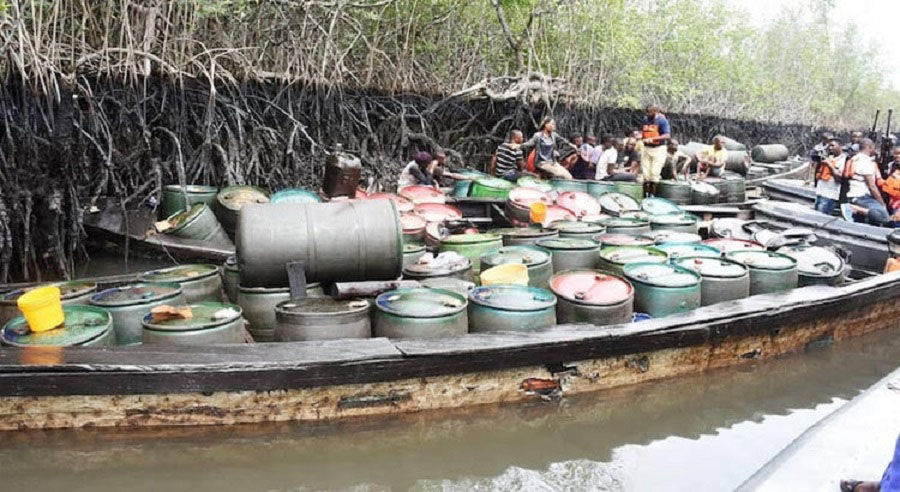
The joint military task force operating in the Niger Delta region with the codename Operation Delta Safe has affirmed its commitment to eliminate crude oil theft, illegal refining and illegal oil bunkering activities in the country, in line with the directive of President Bola Tinubu.

The Commander of Operation Delta Safe, Rear Admiral Olusegun Ferreira, affirmed this in Port Harcourt, Rivers State, on Wednesday, during his maiden visit and familiarization tour to units under OPDS.

Mr Ferreira said the visit was imperative to assess the operational tempo of the joint task force in line with its mandate from the Defence Headquarters to protect oil and gas infrastructure within the Niger Delta region, geared towards ensuring the continuous thriving of economic activities in the country.

According to him, OPDS has attained a very high level of operational success, and the environment has largely been sanitized, as the soot pollution.

He said, “If you recall back in the day, you will find black soot in Port Harcourt and environs but that has gone down. Naturally, these criminal elements will try to sustain their criminal acts all geared towards illicit sources of funds, but they have forgotten that the environment is our common heritage which we all must get to protect.

“Nonetheless, OPDS will continue to pursue and implement all necessary operations that will continue to eliminate these acts of these criminals.

“We will leave no stone unturned; we will continue to detect their actions as much as possible.

“We are going to ride on the directive of the President to eliminate complete destruction of illegal refineries and eliminate crude oil theft in general.”

The OPDS boss further urged perpetrators of oil theft to desist forthwith, warning that Operation will not rest on its oars in eliminating all forms of criminalities and oil theft in the country.

“The onus is on them (oil thieves) to desist from this crime and turn away from their nefarious ways and embrace the non-kinetic opportunities which the government has emplaced so that we rid this environment of oil theft.”

During his first week of office (Thursday, June 1), President Tinubu directed Service Chiefs and heads of security and intelligence agencies to “crush” perpetrators of oil theft, saying his administration would not tolerate the menace.

Mr Tinubu also said on his watch insecurity would not bring Nigeria to her knees while other countries record achievements in key sectors of their economies.

The President gave the directive during his maiden official meeting with Service Chiefs and intelligence heads, led by the Chief of Defence Staff, Gen. Lucky Irabor, at the Presidential Villa, Abuja.


Adedapo Adesanya is a journalist, polymath, and connoisseur of everything art. When he is not writing, he has his nose buried in one of the many books or articles he has bookmarked or simply listening to good music with a bottle of beer or wine. He supports the greatest club in the world, Manchester United F.C.

Click to comment

Leave a Reply

Your email address will not be published. Required fields are marked *

Economy

Naira Firms to N1,380/$ as FX Market Rally Continues

Published

on

print Naira massively

By Adedapo Adesanya

The Naira appreciated against the US Dollar in the Nigerian Autonomous Foreign Exchange Market (NAFEX) on Friday, July 17, by N1.35 or 0.07 per cent to N1,380.18/$1 from N1,381.53/$1.

It also improved its value against the Pound Sterling in the same market segment during the session by N11.75 to trade at N1,854.42/£1 compared with the previous day’s N1,866.17/£1, and gained N5.69 against the Euro to sell at N1,576.99/€1 versus Thursday’s closing price of N1,582.68/€1.

In the same vein, the Naira chalked up N1 against the United States currency yesterday at the GTBank forex desk to quote at N1,388/$1, in contrast to the preceding day’s N1,389/$1, but closed flat at the black market at N1,405/$1.

The appreciation of the Nigerian currency on Friday came amid fresh signals that Nigeria is building its external reserves for protection against shocks and excessive currency volatility.

The Governor of the Central Bank of Nigeria (CBN), Mr Yemi Cardoso, said the country’s gross reserves had risen above approximately $52 billion by 15 July, while net reserves had increased from about $3 billion when the current CBN leadership took office to more than $40 billion.

Mr Cardoso linked the increase in reserves to reforms that had restored greater confidence in the foreign exchange system. He also pointed to efforts to diversify foreign currency inflows, including policies designed to increase remittances through official channels.

He noted that monthly diaspora remittances had risen above $600 million and the CBN expected them to reach approximately $1 billion by the end of 2026. The target is part of a broader effort to grow reserves through recurring inflows rather than temporary measures.

The improvement, he argued, had strengthened Nigeria’s capacity to respond when unexpected events threatened market stability.

The apex bank has also launched a new digital platform that will track every foreign exchange transaction involving Bureau De Change (BDC) operators, marking a major step in its efforts to improve transparency and strengthen oversight of Nigeria’s retail forex market.

As for the crypto market, prices were up as markets overlooked geopolitical developments and macro forces weighing on the whole market ecosystem rather than anything crypto-specific, with Cardano (ADA) up by 4.6 per cent to $0.1661.

Bitcoin (BTC) jumped by 1.8 per cent to $63,968.32, Ethereum (ETH) improved by 0.9 per cent to $1,843.88, Dogecoin (DOGE) also rose by 0.9 per cent to $0.0723, Solana (SOL) soared by 0.6 per cent to $74.90, Ripple (XRP) also appreciated by 0.6 per cent to $1.08, and Binance Coin (BNB) advanced by 0.1 per cent to $567.32.

However, TRON (TRX) depreciated by 0.2 per cent to close at $0.3218, while the US Dollar Tether (USDT) and the US Dollar Coin (USDC) remained unchanged at $1.00 each.

Continue Reading

Economy

Brent Climbs to $88 as Middle East Conflict Fuels Supply Fears

Published

on

Brent Price

By Adedapo Adesanya

The prices of the crude oil grades rose Friday, as fighting between the US and Iran continued in the Middle East, leading to further attacks in Bahrain, Jordan, Kuwait, Oman, Qatar and Syria.

Brent crude futures advanced by about 4.6 per cent to $88.10 per barrel, while the US West Texas Intermediate (WTI) futures gained about 4.5 per cent to settle at $82.49 per barrel.

US forces stepped up attacks on Iranian sites, reportedly striking key bridges, railways, and an airport, prompting retaliatory action by Iran.

US Central Command said that it had completed its sixth consecutive night of strikes against Iran, hitting dozens of military targets such as military logistics infrastructure and maritime capabilities.

Centcom said more than 50,000 service members were operating across the Middle East, adding that they “remain vigilant, lethal, and ready.”

Iran said it attacked the US targets in Bahrain, Jordan, Kuwait, Oman, Qatar and Syria in retaliation for the latest round of strikes by the Americans.

Kuwait said Iran attacked a power and water desalination plant as fighting escalated in the Persian Gulf, saying that the attack damaged the facility that sparked a fire that affected a large number of its electricity-generating units, according to The Kuwait Times.

Kuwait is heavily dependent on desalination plants for potable water. Analysts have long feared that Iran would strike infrastructure that is critical to supporting civilian life in the Middle East.

A tanker was hit by a projectile off the coast of Oman, causing minor damage, the United Kingdom Maritime Trade Operations Centre said in an incident report Friday. Iran has repeatedly attacked tankers over the past week as it tries to force civilian ships to transit the Strait of Hormuz through its waters.

The escalating fighting comes as the fragile truce reached last month has collapsed, once again disrupting energy flows through the strategically vital Strait of Hormuz, which typically handles around 20% of the world’s oil traffic.

Earlier in the week, President Donald Trump said American forces would target Iran’s infrastructure next week unless the two sides reached a diplomatic breakthrough.

Iran has asked Yemen’s Houthis to close the Red Sea oil route if the US targets Iranian power infrastructure.

Market analysts noted that Iran and the US still have strong economic incentives to avoid a complete breakdown in talks, with the US seeking lower oil prices ahead of the November midterm elections and Iran reluctant to forgo economic incentives.

Continue Reading

Economy

Rising Food Prices Not Good for Nigeria’s Inflation Gains—CPPE

Published

on

Prices of Food

By Adedapo Adesanya

Despite signs that Nigeria’s headline inflation is easing, rising food prices continue to threaten the country’s inflation outlook, the chief executive of the Centre for the Promotion of Private Enterprise (CPPE), Mr Muda Yusuf, has warned.

He noted that structural inflationary pressures in the real economy remain pronounced despite improving macroeconomic stability.

In a policy brief released following the inflation report, he noted that headline inflation eased marginally, while month-on-month change moderated from 1.75 per cent to 1.66 per cent, indicating that headline inflation has largely plateaued.

According to him, the dominant concern in the latest inflation report is the renewed acceleration in food inflation.

This growth, he said, suggested that food prices have resumed an upward trajectory after a brief period of moderation.

Warning that a renewed increase in food inflation has significant economic and social implications, he stressed that food inflation remained the biggest driver of Nigeria’s cost-of-living crisis, stressing that rising food prices continue to erode household purchasing power, worsen poverty and food insecurity while weakening the inclusiveness of the current reform programme.

He maintained that sustained moderation in food prices is critical to improving citizens’ welfare and strengthening public confidence in the ongoing economic reforms.

Acknowledging the easing of core inflation as encouraging, he drew attention to the persistence of urban inflation.

At 16.08 per cent, urban inflation exceeded the national headline inflation rate of 15.91 per cent, while month-on-month urban inflation increased from 1.99 per cent to 2.13 per cent.

According to Mr Yusuf, the figures indicated that inflationary pressures remained particularly intense across urban centres.

He attributed the rising urban inflation partly to increasing population displacement from rural communities affected by insecurity, expressing worry that as more households migrate to urban areas, demand for housing, transportation, utilities and other essential services would increase, adding to inflationary pressures and creating additional urbanisation challenges.

Addressing insecurity in farming communities, he said, was important not only for protecting lives and property and boosting agricultural output but also for easing cost pressures in urban centres, adding that the June CPI data reinforced the view that Nigeria’s inflation challenge is predominantly structural rather than monetary.

On the monetary policy outlook, he said the data do not justify further monetary tightening, arguing that headline inflation has largely stabilised.

The CPPE chief expected the Monetary Policy Committee (MPC) to retain the current monetary policy rate at its next meeting, adding that the priority is for monetary and fiscal authorities to work together to accelerate structural reforms to expand food supply, improve logistics, reduce energy and production costs, lower debt service costs, as well as strengthen domestic value chains.

Continue Reading