Connect with us

Economy

Lagos to Float N100b Bond for Bus Reform Initiative

Published

on

By Modupe Gbadeyanka

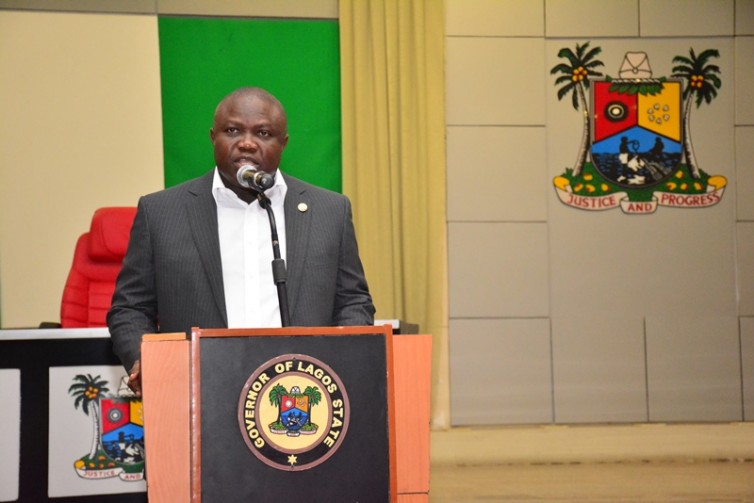
Governor Akinwunmi Ambode of Lagos State has disclosed that his administration would launch a public transportation infrastructure bond of N100 billion that would span between seven to 10 years.

This, he said at the weekend, would drive the implementation of his integrated public transportation system tagged the Bus Reform Initiative that would kick start this year with a sinking fund of N30 billion.

Addressing newsmen, Mr Ambode said his administration had identified the challenges Lagosians go through on a daily basis commuting via public transportation, saying the reform was aimed at providing a viable alternative.

He said the Bus Reform Initiative is a three-year plan aimed at introducing over 5000 air-conditioned buses to replace the yellow commercial buses, popularly called Danfo, which according to him, was no longer befitting for the state’s mega city status.

Hear him: “We decided that the best thing is to allow the yellow buses go and so the Bus Reform Initiative itself is a three-year plan of 2017 to 2019 in which it intends to bring in new buses of 5,000 units in the three-year plan.

“The bigger size buses will take 70 people and then the medium range buses will take 30 people. We believe that the middle range buses will be supplied up to 70 per cent of the total volume which will amount to about 3,600 units and then the longer range in that direction.”

“You are aware that the Federal Government paid the refund of the Paris Club Loan last December and this is a money belonging to the state governments due to the refund and so Lagos State decided not to touch its share of the Paris Club refund.

“Right now, we have a sinking fund of N14.5 billion that is already put in place to drive this public transportation bond.

“We refused to touch our money and we believe that the second batch of the refund should be paid next month and eventually that will be N29 billion that we will have. I will add another N1 billion to it making it N30 billion to kick start this initiative.

“By the time we have N30 billion as sinking fund to drive the bus initiative against the bond of N100 billion that we want to put into the market, there will be that credibility and credence that the bond will drive itself and that is the whole idea,” Governor Ambode added.

He said aside the bond, his administration also intends to give out franchise to interested stakeholders in multiple of 50 buses each, 100 buses, 200 buses and above, explaining that what is required is a down payment of 25 percent of the buses.

“So, these are bankable projects as we have a sinking fund and so our exposure as a government is just technically 75 percent. So, from the kind of machinery we want to use to run the buses, there are no cash takings, everything is automated and obviously, whoever has a franchise, whoever drives, they have the recourse to take part of the money while part of the intake also goes to the repayment of the facility and so it is a comprehensive template,” he said.

However, Mr Ambode pointed out that the state government expects the Danfo drivers, who would be absorbed into the new initiative to adapt accordingly, saying that the transport unions would be expected to take ownership to ensure sustainability.

“This is just a paradigm shift where Danfo drivers move from being addressed as Danfo drivers but as professional drivers. So, we will buy back the Danfos from them and it becomes the seed money to become eventual owners of those buses in the years the facility is spread.

“It is something we have been working on in the last one year and we don’t come out to say we are going to do anything without working properly on it. It is process and now we are at the advocacy process.

“We intend to start to go to the bus parks and all that to educate people and the integral part of these buses is what you see us trying to provide bus terminals, Laybys, bus stops. They are coming in pieces but they will become a complete cup of delivering this particularly product when we put them together,” he explained.


Modupe Gbadeyanka is a fast-rising journalist with Business Post Nigeria. Her passion for journalism is amazing. She is willing to learn more with a view to becoming one of the best pen-pushers in Nigeria. Her role models are the duo of CNN's Richard Quest and Christiane Amanpour.

Economy

Crude Oil Slightly Rises as Iran Allows Safe Passage for Ships

Published

on

Brazilian Crude Oil

By Adedapo Adesanya

Crude oil marginally appreciated on Thursday after it was reported that about 30 vessels had crossed the Strait of Hormuz, with Brent crude oil futures gaining 9 cents or 0.09 per cent to trade at $105.72 a barrel, and the US West Texas Intermediate (WTI) futures expanding by 15 cents or 0.15 per cent to $101.17 a barrel.

Iranian state media reported that about 30 Chinese vessels were allowed safe passage by Iran through the Strait, which has been largely shut since the Iran war broke out at the end ​of February.

Before the report, a Chinese supertanker carrying 2 million barrels of Iraqi crude sailed through the contested waterway on Wednesday after being stranded in the Gulf for more than two months, while a Panama-flagged crude oil tanker managed by Japanese refining group Eneos had also passed.

Bloomberg also reported that the vessels were allowed to pass the Strait of Hormuz with the coordination of the Iranian authorities and Islamic Revolutionary Guard Corps’ navy, however, it added that it is yet unknown or unclear whether the US Navy side of the de facto blockade will also let them pass.

The move also follows formal requests by China’s foreign minister as well as its ambassador to Iran, with Iran reportedly agreeing based on safeguarding the two allies’ strategic partnership.

It also comes as President Donald Trump’s ongoing state visit to China, where he and President Xi Jinping agreed that the ‌Strait of ‌Hormuz must be open for ‌the free flow of energy.

President Xi expressed interest in purchasing more US oil to reduce China’s dependence on the Strait of Hormuz, according to the White House. China, the world’s largest oil importer, is not a big buyer of US crude and has not imported any since May 2025 due to a 20 per cent import tariff imposed during the trade war.

Iran, a member of the Organisation of the Petroleum Exporting Countries (OPEC), ​also appears to have tightened control over the strait, cutting deals with Iraq and Pakistan to ship oil and liquefied natural gas from the region.

The International Monetary Fund (IMF) said the global economy is clearly moving into a middle “adverse scenario,” which would see global real GDP growth falling to 2.5 per cent this year from 3.4 per cent growth in 2025, citing the Iran war as the cause.

Continue Reading

Economy

Run From Any Unregistered Online Investment Platform—SEC Warns Nigerians

Published

on

SEC Nigeria

By Aduragbemi Omiyale

For the umpteenth time, the Securities and Exchange Commission (SEC) has run to the rooftop to warn Nigerians against putting their hard-earned money in online investment platforms not authorised to operate in the nation’s capital market.

SEC is the apex regulatory agency in the Nigerian capital market. It issues licences to companies operating in the ecosystem.

In a statement on Thursday, the organisation expressed concerns over the rising “promotion of unregistered online investment schemes on social media applications and websites, including WhatsApp, Instagram, Telegram, Facebook, TikTok and other digital platforms.

In the notice, the SEC emphasised that, “Many of these investment schemes exhibit characteristics of Ponzi or Prohibited investment schemes, while some operators of such schemes also provide unauthorised investment services to members of the public.”

In view of these, the commission advised members of the public “to refrain from investing or participating in any unregistered online investment platform or scheme promising unrealistic or guaranteed returns.”

“Members of the public are further advised not to rely on investment advisories circulated through online platforms by persons or entities not registered by the commission, as reliance on such advisories may expose investors to significant financial losses and fraudulent schemes,” it noted.

“The public is reminded that, under the provisions of the Investments and Securities Act, 2025, only entities registered by the commission are authorised to promote investment services, provide investment advisory services or solicit funds from the public in the Nigerian capital market,” another part of the circular signed by the management noted.

The regulator urged the investing public to verify the registration status of any platform, company, or entity offering investment opportunities on its dedicated portal: https://sec.gov.ng/fintech-and-innovation- hub-finport/registered-fintech-operators/ or https://www.sec.gov.ng/cmos before transacting or investing with them.

Continue Reading

Economy

Dangote Rejects NNPC Bid to Raise Stake in Soon-to-Be Listed Refinery

Published

on

NNPC vs Dangote refinery

By Adedapo Adesanya

Nigerian businessman, Mr Aliko Dangote, has disclosed that he rejected requests by the Nigerian National Petroleum Company (NNPC) Limited to increase its 7.25 per cent stake in the Dangote Petroleum Refinery.

Mr Dangote stated this in a podcast with the Chief Executive Officer of the Norwegian Sovereign Wealth Fund, Mr Nicolai Tangen.

In the podcast interview, the billionaire revealed that the state oil company offered to increase its current 7.25 per cent stake in the 650,000 barrels per day plant.

However, this was rejected because the company is planning to go public and give other Nigerians the opportunity to own shares in the plant.

Recall that the refinery is planning a multi-exchange listing and targeting a valuation of $50 billion. It has appointed a consortium of three financial advisers to manage the offering. Stanbic IBTC Capital to handle international book-building process and lead engagement with foreign portfolio investors; Vetiva Capital Management to manage retail investor distribution within Nigeria; and FirstCap to focus on placements with Nigerian institutional investors, particularly pension funds.

It was reported in 2021 that the NNPC acquired the 7.25 per cent stake in the refinery for $1 billion, with an option to acquire the remaining 12.75 per cent stake by June 2024.

However, the national oil firm reneged on its decision.

During the interview with the Norwegian Sovereign Wealth Fund CEO, Mr Dangote revealed that the state oil company had made attempts to acquire more stakes in the refinery, but this was turned down.

The revelation came while he was responding to questions about what could be the biggest risks to his businesses.

“Actually, if there are civil wars, which is not in the offing at all.

“The other biggest risk is government inconsistencies in policies, and we are addressing that one because if you look at our refinery, the national oil company already owns 7.25 per cent, and they are trying to buy more. We are the ones that said no; we want to now spread it and have everybody be part of it.”

In 2024, Mr Dangote revealed that under the former Group Chief Executive Officer, Mr Mele Kyari, the NNPC reduced its stake in the refinery from 20 per cent to 7.25 per cent. He disclosed that the NNPC had only a 7.2 per cent stake in the refinery and not 20 per cent as many Nigerians believed.

“The agreement was actually 20 per cent, which we had with NNPC, and they did not pay the balance of the money up until last year; then we gave them another extension up until June (2024), and they said that they would remain where they had already paid, which is 7.2 per cent. So NNPC owns only 7.2 per cent, not 20 per cent,” Mr Dangote stated at the time.

Continue Reading

Trending