Economy
Naira Appreciates to N763 Per Dollar at Official Market
By Adedapo Adesanya
It was a positive outcome for the Nigerian Naira against the US Dollar in the Investors and Exporters (I&E) arm of the foreign exchange (FX) market on Tuesday, June 27.
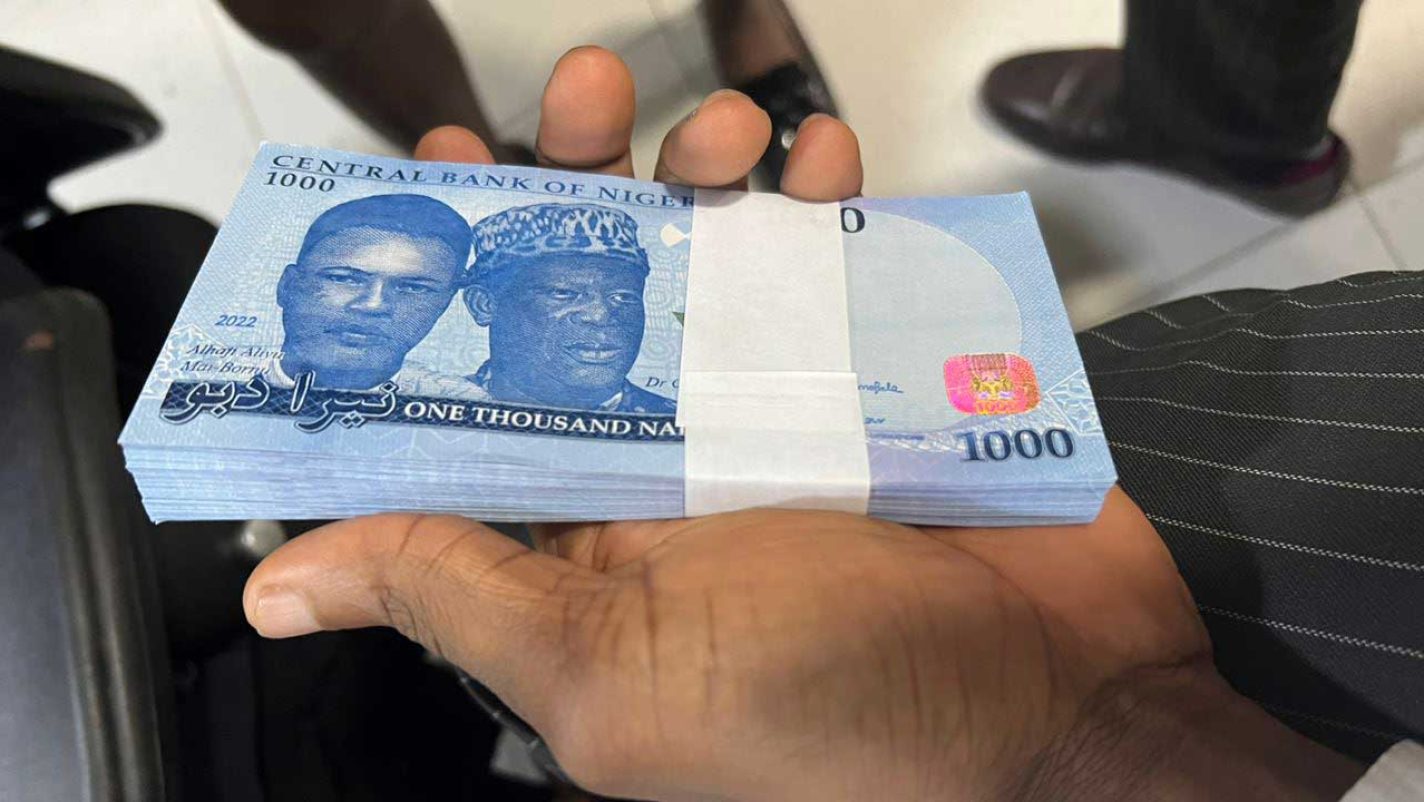
Amid renewed faith in the forex operations after the new Nigerian government unified the exchange rates in less than one month in office, the Naira gained 0.67 per cent or N5.17 against the greenback yesterday in the official market or the spot market, selling at N763.00/$1 compared with the preceding day’s rate of N768.17/$1, according to data obtained from FMDQ Securities Exchange.
It was observed that the Naira had the strength to withstand the forex demand pressure it came under during the trading session, as the turnover ballooned by 23.9 per cent or $47.52 million to $245.65 million from the $198.13 million recorded on Monday.
In the parallel market, the local currency maintained stability against the United States currency on Tuesday, trading flat at N768/$1, according to data harvested by Business Post.
However, in the Peer-2-Peer (P2P) window, the domestic currency depreciated against the Dollar by N1 during the session to quote at N780/$1, in contrast to the previous day’s rate of N779/$1.
Equally, the local currency was down against the Pound Sterling in the spot market yesterday by N13.72 to close at N958.56/£1 compared with Monday’s value of N944.84/£1 and lost N13.28 against the Euro to sell at N822.47/€1 versus the previous session’s N809.19/€1.
The official market will be going on a two-day break as the federal government declared Wednesday and Thursday for the Eid-el-Kabir celebrations.
A look at the digital currency market indicated that the bears had a field day, as most of the tokens monitored by Business Post finished in the red zone, with Bitcoin (BTC) falling below $31,000 after traders seemingly moved to secure gains, with the crypto becoming overbought. The relative strength index (RSI) rose to its highest point since January, prompting bears to reenter the market.
Its value shrank by 0.2 per cent to $30,437.53, as Ethereum (ETH) weakened by 0.3 per cent to $1,865.99, with Solana (SOL) losing 1.2 per cent to trade at $16.28.
Further, Binance Coin (BNB) went south by 1.1 per cent to $235.17, Cardano (ADA) depleted by 0.8 per cent to $0.2793, Litecoin (LTC) slumped by 0.7 per cent to $87.21, and Dogecoin (DOGE) depreciated by 0.3 per cent to sell at $0.0649, while Ripple (XRP) improved by 0.1 per cent to $0.4824.
However, Binance USD (BUSD) and the US Dollar Tether (USDT) retained their previous trading prices of $1.00 each.
Economy
NNPC Sees Deep Offshore Incentive Order Accelerating Investment, Production Growth
By Aduragbemi Omiyale
The Deep Offshore Oil and Gas Projects Incentives (Tax Remission) Order, 2026, approved recently by President Bola Tinubu, has been described as a landmark reform that significantly enhances Nigeria’s competitiveness for deep offshore investment and strengthens the nation’s pathway towards achieving its 3 million barrels of oil per day (MMbopd) production ambition by 2030.
The chief executive of the Nigerian National Petroleum Company (NNPC) Limited, Mr Bayo Ojulari, in a statement signed by the Chief Corporate Communications Officer of NNPC, Mr Andy Odeh, said the development is one of the most significant policy interventions for the upstream sector in recent years.
He thanked Mr Tinubu for his relentless leadership and unwavering commitment to creating an enabling environment for investment and sustainable growth in Nigeria’s energy sector through several Presidential Executive Orders which have strengthened the nation’s oil and gas sector.
“This is a transformative reform that sends a strong signal to global investors that Nigeria is committed to providing a stable, competitive and investment-friendly environment for deep offshore development. Fiscal certainty is a critical driver of investment decisions, and this framework provides the additional clarity the industry has long sought,” he said.
“For NNPC, the order aligns directly with our strategy of protecting our existing production base, accelerating near-term growth, and attracting new investment into high-value assets. It strengthens our confidence in achieving our strategic production ambition of 3 MMbopd while creating greater value for our shareholders and the Nigerian economy,” the NNPC chief added.
Mr Ojulari noted that recent reforms across the petroleum sector have already stimulated more than $34 billion in new investment commitments, stating that the Deep Offshore Incentives Order is expected to build on that momentum by enabling timely FIDs on strategic offshore developments.
The new order establishes a transparent, predictable and globally competitive fiscal framework for qualifying greenfield deep offshore developments. It provides the certainty required to unlock long-term capital, accelerate Final Investment Decisions (FIDs), and maximise value from Nigeria’s offshore resources.
The framework, which reinforces Nigeria’s position as one of the world’s attractive destinations for deep offshore oil and gas development, is expected to unlock over $50 billion in new investments, including major projects starting with Bonga South-West, which was approved in March 2026, and the Zabazaba and Owowo Deep Offshore projects. Bonga South West is expected to be the first FID on a Nigeria deepwater Production Sharing Contract asset since 2008.
Economy
Geregu Acknowledges Concerns Over N40bn Bond Repayment Default
By Aduragbemi Omiyale
The board of Geregu Power Plc has acknowledged the concerns raised by shareholders, stakeholders, as well as regulators over the inability of the company to pay bondholders for their investment in its N40 billion bond sale.
There were reports that the power-generating organisation defaulted in repaying investors who bought its debt instrument.
In 2022, the company issued a seven-year paper to investors at a coupon of 14.5 per cent to be paid semi-annually. The note is expected to mature in July 2029. But data from the FMDQ Securities Exchange showed that there have been defaults in the 8th coupon payment and the 4th bullet principal repayment.
Reacting to the issue on Thursday, Geregu said it is actively having talks with advisers and others on ways to iron things out.
“Geregu remains actively engaged with relevant stakeholders and advisers regarding the resolution of the various challenges and is committed to achieving an orderly and mutually beneficial outcome.
“Discussions and engagements are ongoing, and the Company will continue to act in good faith in fulfilling its responsibilities,” part of the statement signed by its scribe, The Structure HQ, stated.
The firm explained that since assuming responsibility for its affairs, the current board and management have undertaken a comprehensive review and reconciliation of its transactions, liabilities, operational commitments, financing arrangements, financial obligations and related corporate documentation.
It stressed that this action was to ensure transparency, accuracy and prudent financial management, adding that it remains committed to transparency, responsible corporate governance and constructive engagement with all stakeholders.
The majority stake of Geregu Power was controlled by Mr Femi Otedola. He divested his stake in the energy firm in 2025, with the sale of 95 per cent of his shares in Amperion to MA”AM Energy.
Earlier in 2023, he sold N399 million shares of Geregu to another investor. Before then, he sold his stake in Forte Oil to invest in Geregu Power, which now has the former Governor of Zamfara State, Mr Abdulaziz Yari, as its chairman.
Economy
Ex-NAICOM Boss Warns FG Against Post-Recapitalisation Intervention
By Adedapo Adesanya
A former Commissioner for Insurance of the National Insurance Commission (NAICOM), Mr Mohamed Kari, has warned the federal government to reduce its intervention in the sector’s post-recapitalisation process.
He charged the Minister of Finance and Coordinating Minister of the Economy, Mr Taiwo Oyedele, to ignore calls for regulatory concessions in the just-concluded insurance industry recapitalisation exercise in the country.
The call, he said, was critical, especially when the companies clamouring for such concessions were chronic defaulters whose failure or strict regulatory discipline poses absolutely zero systemic risk to the Nigerian financial system or the broader economy.
Recall that NAICOM had requested insurance companies, as part of the recapitalisation process, to transfer their entire recapitalisation funds into an escrow account with the Central Bank of Nigeria (CBN). However, NICON Insurance and Nigeria Re, in a recent petition, had petitioned NAICOM over what they described as unlawful fees and regulatory demands arising from the implementation of the Nigerian Insurance Industry Reform Act (NIIRA) 2025.
Mr Kari, who was also a former chief executive of NICON Insurance and Nigeria Re, said it was globally accepted that a government may occasionally intervene to rescue or support a consequential player in the financial sector, strictly where its distress poses a genuine ‘too big to fail’ systemic risk whose collapse would trigger a wider economic catastrophe.
“However, one must examine the reality of the two institutions in question today. These are no longer the market giants they once were decades ago,” he said.
He warned that having suffered years of steep decline, loss of market share, and severe operational shrinkage, their current market footprint is virtually insignificant.
“Their failure or strict regulatory discipline poses absolutely zero systemic risk to the Nigerian financial system or the broader economy. Why then should government intervene to shield operators whose distress carries no systemic consequence whatsoever?
“Rescuing or granting regulatory concessions to insignificant, chronic defaulters cannot be justified under any sound macroeconomic policy,” he added.
“When political intervention steps in to shield such non-systemic entities from standard regulatory checks, the equilibrium of the market breaks down as it creates unfair advantage.
“Operators that meet compliance targets carry the full cost of regulatory fidelity, while non-compliant firms that secure political exemptions operate with an artificial cost advantage.
“It disincentivises real capacity building: When political lobbying becomes an alternative to recapitalisation, companies are discouraged from making the hard structural choices necessary to refine their balance sheets and operations.”
He noted that if such a concession is granted to both insurance industry players in the defunct, it “distorts investor confidence: Both domestic and international investors look for predictable, transparent environments. A playing field where rules can be bent for select players frightens away patient capital. It weakens policyholder protection.”