Connect with us

Economy

Naira Appreciates to N773/$1 Amid Devaluation Fears, FX Scarcity

Published

on

stop dispensing old Naira notes

By Adedapo Adesanya

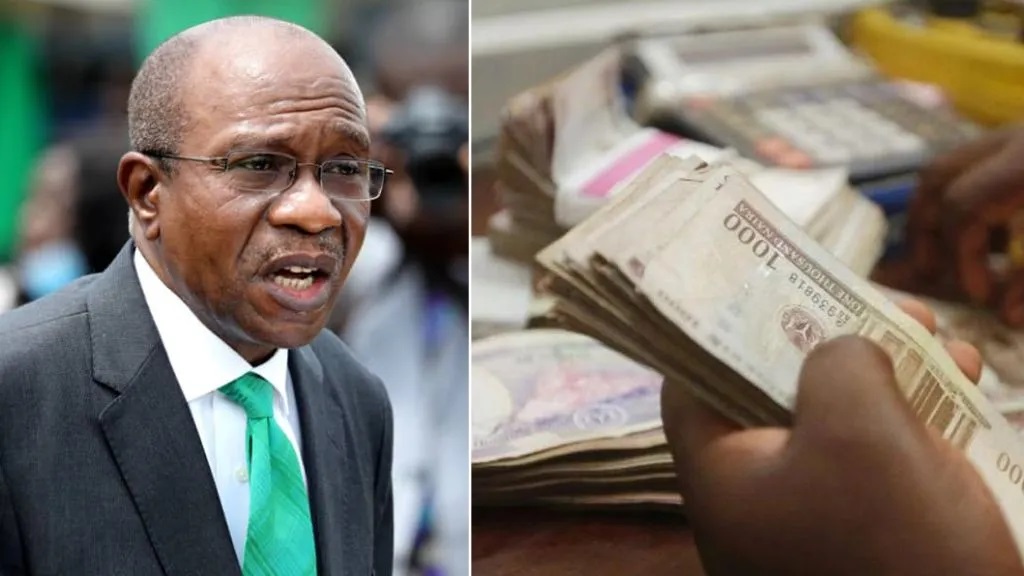
The Naira appreciated against the Dollar at the Peer-2-Peer (P2P) segment of the foreign exchange (FX) market on Friday, May 19, amid headwinds, including forex scarcity and news of another devaluation of the local currency by the Central Bank of Nigeria (CBN).

This was spurred by the weakening of the Nigerian Naira to N465/$1 on Wednesday in the Investors and Exporters (I&E) window of the FX market, though it appreciated the next day to N463.00/$1.

Yesterday, the domestic currency maintained stability against the greenback in the official market as its value remained at N463.00/$1 at the close of business, amid a decline in the forex turnover for the trading session by 43.6 per cent or $70.99 million to $91.81 million from the preceding session’s $162.80 million.

Back to the P2P market, the local currency was strengthened against the US Dollar on Friday by N5 to sell at N773/$1 compared to the preceding day’s value of N778/$1.

However, in the black market, the Naira depreciated against the American Dollar yesterday by N7 to trade at N758/$1, in contrast to Thursday’s closing price of N751/$1.

In the interbank segment, the Naira closed flat against the British Pound Sterling and the Euro during the session at N574.09/£1 and N498.94/€1, respectively.

Meanwhile, the cryptocurrency market treaded upward on Friday as markets reacted to a halt in the conversation about raising the world’s largest economy, the US debt ceiling.

Without a deal, the US could default on its $31.4 trillion debt, an unprecedented development that would mean the government could not borrow any more money or pay all of its bills.

The US Treasury Department has warned that a default could begin on June 1.

Bitcoin (BTC) fell by 0.2 per cent to sell at $26,860.42, Cardano (ADA) lost 1.7 per cent to trade at $0.3646, Litecoin (LTC) went down by 1.6 per cent to $90.87, and Solana (SOL) slumped by 1.2 per cent to $20.17.

Further, Binance Coin (BNB) recorded a 0.5 per cent fall to sell at $308.30, Dogecoin (DOGE) depreciated by 0.3 per cent to trade at $0.0734, and Ripple (XRP) dropped by 0.04 per cent to trade at $0.4638.

But Ethereum (ETH) made a 0.3 per cent appreciation to sell at $1,809.82, while the United States Tether (USDT) and Binance USD (BUSD) closed flat at $1.00 each.


Adedapo Adesanya is a journalist, polymath, and connoisseur of everything art. When he is not writing, he has his nose buried in one of the many books or articles he has bookmarked or simply listening to good music with a bottle of beer or wine. He supports the greatest club in the world, Manchester United F.C.

1 Comment

Leave a Reply

Your email address will not be published. Required fields are marked *

Economy

Investors Lose N3.1bn as NASD Exchange Remains Red

Published

on

NASD OTC stock exchange

By Adedapo Adesanya

The NASD Over-the-Counter (OTC) Securities Exchange entered a third straight day of losses after it fell by 0.12 per cent on Wednesday, June 10.

The depletion trimmed the market capitalisation further by N3.1 billion to N2.590 trillion from N2.593 trillion, and cut the NASD Unlisted Security Index (NSI) by 5.19 points to 4330.12 points from 4,335.31 points.

11 Plc lost N22.21 during the session to finish at N221.00 per share versus the previous day’s N243.21 per share, MRS Oil Plc depreciated by N6.90 to N158.10 per unit from N165.00 per unit, and Central Securities Clearing System (CSCS) Plc decreased by N2.81 to N78.32 per share from N81.13 per share.

On the flip side, FrieslandCampina Wamco Nigeria Plc went up by N9.27 to N183.08 per unit from N173.81 per unit, Nitrox Industrial Gases Plc added N1.92 to its value to close at N23.80 per share compared with the preceding day’s N21.88 per share, and Food Concepts Plc gained 10 Kobo to exchange at N2.58 per unit, in contrast to Tuesday’s closing price of N2.48 per unit.

At the close of business, the volume of securities traded by investors contracted by 92.6 per cent to 117,374 units from 1.6 million units, and the value of securities moderated by 80.5 per cent to N12.2 million from N62.3 million, while the number of deals increased by 4.9 per cent to 43 deals from 41 deals.

Great Nigeria Insurance (GNI) Plc finished the day as the most traded stock by value on a year-to-date basis with 3.4 billion units worth N8.4 billion, followed by Infrastructure Credit Guarantee (Infracredit) Plc with 2.3 billion units traded for N6.5 billion, and CSCS Plc with 65.2 million units exchanged for N4.4 billion.

GNI Plc also closed the session as the most traded stock by volume on a year-to-date basis with 3.4 billion units valued at N8.4 billion, followed by Infracredit Plc with 2.3 billion units transacted for N6.5 billion, and Resourcery Plc with 1.1 billion units sold for N415.7 million

Continue Reading

Economy

Naira Crashes to N1,362.05/$1 at Official Window After N1.50 Loss

Published

on

deposit old Naira notes

By Adedapo Adesanya

The Naira fell against the United States Dollar by N1.50 or 0.11 per cent in the Nigerian Autonomous Foreign Exchange Market (NAFEX) to sell at N1,362.05/$1 on Wednesday, June 10, compared with the N1,360.55/$1 it traded on Tuesday.

Also, the local currency lost N4.33 against the Pound Sterling in the official window yesterday to trade at N1,827.33/£1 versus the preceding day’s N1,823.00/£1, and depreciated against the Euro by N1.74 to quote at N1,575.35/€1, in contrast to N1,573.61/€1 of the previous session.

However, at the GTBank forex desk, the Naira gained N3 against the US Dollar to sell at N1,370/$1 versus N1,373/$1, and at the parallel market, it remained unchanged at N1,380/$1.

Updated data from the Central Bank of Nigeria (CBN) showed that foreign reserves surged further due to additional inflows from various sources. Nigeria’s gross external reserves increased to $50.439 billion, its highest level since March 2026, reflecting sustained inflows from oil revenue and other FX sources.

Also, the International Monetary Fund (IMF) has said increased confidence in the Naira, supported by lower and more stable inflation, would encourage households, businesses and investors to hold more local currency assets and reduce reliance on foreign currencies.

The global lender, in a recent assessment, stressed the importance of strengthening the CBN’s operational framework and aligning liquidity management operations more closely with monetary policy objectives.

In the cryptocurrency market, there were recoveries from recent losses as US headline inflation rose an expected 0.5 per cent in May, but the beat on the core rate — which cuts out food and energy costs — pleased markets. The core rate, though, rose just 0.2 per cent in May against forecasts for 0.3 per cent.

The print reinforces the view that the US Federal Reserve will keep interest rates at 350-375 basis points at its June 17 meeting, but is likely to increase rates by 25 basis points by the end of the year.

Cardano (ADA) went up by 2.4 per cent to $0.1647, Bitcoin (BTC) rose by 2.3 per cent to $62,794.09, Binance Coin (BNB) jumped 1.8 per cent to $596.23, Ethereum (ETH) grew by 1.7 per cent to $1,658.12, and Solana (SOL) also soared by 1.7 per cent to $65.23.

Further, Dogecoin (DOGE) appreciated by 1.5 per cent to $0.0849, Ripple (XRP) expanded by 0.4 per cent to $1.11, and TRON (TRX) increased by 0.05 per cent to $0.3218, while the US Dollar Tether (USDT) lost 0.10 per cent to close at $0.9989, and the US Dollar Coin (USDC) declined by 0.01 per cent to $0.9997.

Continue Reading

Economy

Oil Prices Jump as Iran Shuts Down Strait of Hormuz

Published

on

oil prices driving up Trump

By Adedapo Adesanya

Oil prices jumped early on Thursday as Iran declared the critical energy chokepoint, the Strait of Hormuz, closed ‌after the US launched additional strikes against the Middle East oil producer.

Brent futures rose $1.48 or 1.59 per cent to $94.58 per barrel, and the US West Texas Intermediate (WTI) crude climbed $1.71 or 1.90 per cent to $91.74 a barrel.

Iran’s top joint military command announced the closure of the ​Strait of Hormuz on Thursday, including oil tankers and commercial ships, saying any vessel attempting ⁠passage will be shot at.

Market analysts noted that the renewed ​escalation in fighting prompted oil prices to rally in early morning trading.

On Wednesday, the US military said on X that commercial ships continue to transit in and out of the strait. It also said no US warships have been struck in the strait, after ​Iran’s state media reported US ships near the waterway were targeted by missiles and drones.

US forces began launching ​additional strikes against multiple targets in Iran on Wednesday, the latest in an escalating exchange of attacks that threaten ‌to ⁠reignite a full-scale war, which was paused in early April when the two sides agreed to a fragile ceasefire.

Defence Secretary Pete Hegseth held a press briefing announcing further attacks on Iran, saying, “If we need to negotiate with bombs, we’ll negotiate with bombs.” US Central Command later described those attacks as targeting “Iranian military surveillance capabilities, communication systems, and air defence sites across Iran.”

In response to the attacks, Iran’s top joint military command then announced that the Strait was closed to all shipping.

President Donald Trump said the strikes would stop shortly, but that they would continue if Iran’s leaders did not sign an agreement with the US immediately.

Iran’s months-long ​blockade of the strait, which ​normally carries a fifth ⁠of global oil and gas shipments, has kept oil prices elevated.

The latest exchange of strikes between the US and Iran marks the most significant escalation in the conflict since both countries agreed to a fragile ceasefire in April. Since then, oil inventories have drained dramatically, and no tangible breakthroughs have been announced.

Crude oil inventories in the US decreased by 7.2 million barrels during the week ending June 5, according to new data from the Energy Information Administration (EIA).  The EIA’s data release follows figures that were released by the American Petroleum Institute (API) a day earlier, which reported that crude oil inventories saw a draw of 9.119 million barrels in the period.

Continue Reading

Trending