Connect with us

Economy

Naira Crashes to N1,099.05/$1 at Official Market

Published

on

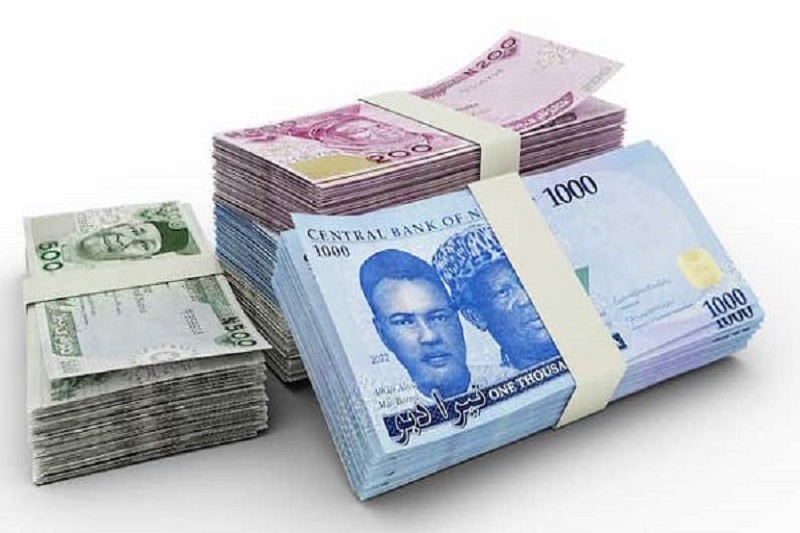
old Naira notes

By Adedapo Adesanya

The Nigerian Naira weakened to a new low on the American Dollar at the Nigerian Autonomous Foreign Exchange Market (NAFEM) on Friday, December 8, amid speculations that the Central Bank of Nigeria (CBN) has again devalued the local currency.

In the previous trading session, there were reports that the exchange rate for clearing cargoes has been raised to N952/$1, sparking rumours that domestic currency would hit N1,000/$1 in the spot market.

On the last trading session of the week, the Naira lost N255.98 or 30.4 per cent of its value on the greenback to trade at N1,099.05/$1 in the official market compared with the previous rate of N843.07/$1.

At NAFEM yesterday, the FX turnover was $137.35 million, $0.1 million lower than the $137.25 million quoted on Thursday, according to data from the FMDQ Securities Exchange.

In the peer-to-peer (P2P) segment, the Nigerian currency depreciated against the American currency by N9 to close at N1,188/$1 compared with the previous day’s value of N1,179/$1.

In the parallel market window, the local currency crashed against the US Dollar on Friday by N20 to settle at N1,200/$1, in contrast to Thursday’s closing price of N1,180/$1.

However, the Naira appreciated against the Pound Sterling in the spot market on Friday by N1.78 to close at N1,115.24/£1 versus the preceding day’s N1,117.02/£1 and gained N62 Kobo against the Euro to quote at N956.89/€1 versus N957.51/€1.

In the cryptocurrency market, Bitcoin (BTC) depreciated by 1.2 per cent to $43,356.56 as Ripple (XRP) recorded a 0.2 per cent loss to trade at $0.6433.

However, Solana (SOL) gained 14.4 per cent to sell at $72.66, Cardano (ADA) added 7.1 per cent to finish at $0.4798, and Ethereum (ETH) grew by 4.9 per cent to $2,372.49, Litecoin (LTC) went up by 1.3 per cent to $74.71, Binance Coin (BNB) appreciated by 0.5 per cent to sell for $234.50, and  Dogecoin (DOGE) made a 0.3 per cent appreciation to sell at $0.0971, while the US Dollar Tether (USDt) and US Dollar Coin (USDC) both traded flat at $1.00 each.


Adedapo Adesanya is a journalist, polymath, and connoisseur of everything art. When he is not writing, he has his nose buried in one of the many books or articles he has bookmarked or simply listening to good music with a bottle of beer or wine. He supports the greatest club in the world, Manchester United F.C.

Economy

Oil Market Mixed Amid Supply Disruptions, US–Iran Peace Talk Prospects

Published

on

crude oil market

By Adedapo Adesanya

The oil market was mixed on Friday as traders weighed supply disruptions against the potential restart of peace talks between the US and Iran that could help limit those shortfalls.

Brent crude futures settled at $105.33 a barrel after rising by 26 cents or 0.3 per cent, while the US West Texas Intermediate (WTI) crude futures traded at $94.40 ​a barrel after falling by $1.45 or 1.5 per cent. For the week, Brent gained about 16 per cent and WTI rose nearly 13 per cent.

Reuters reported that Iranian Foreign Minister Abbas Araqchi was expected to arrive ⁠in Islamabad late on Friday to discuss proposals for resuming peace talks with the U.S. after talks collapsed earlier this ​week.

Also, CNN reported that US President Donald Trump was sending special envoy Steve Witkoff and Jared Kushner to ​Pakistan for talks with Iran’s foreign minister.

The American President also told Reuters on Friday that Iran plans to make an offer aimed at satisfying US demands. On Thursday, he said Iran may have loaded up its weaponry “a little bit” during a two-week ceasefire, but added that the US military could eliminate it in a single day. ​On Wednesday, he said he would indefinitely extend the ceasefire to allow for further peace ​talks.

Meanwhile, navigation through the Strait of Hormuz, which before the war carried about a fifth of global oil output, remains effectively blocked.

Iran’s Islamic Revolutionary Guard Corps seized two container ships – MSC Francesca and Epaminondas – following the US’ seizure of the Iranian cargo ship Touska, putting a drastic halt to attempts to pass through the Strait of Hormuz by non-oil tankers.

The head of the International Energy Agency (IEA), Mr Fatih Birol, said that the Iran war has permanently changed the fossil fuel industry, adding that the damage to confidence in fossil fuel security is permanent, and that countries exposed to the Strait of Hormuz disruption will rethink how much geopolitical risk they are willing to embed in their energy systems.

Analysts from JPMorgan argued that prices may need to rise further to force additional demand destruction. Goldman Sachs estimates Gulf oil production is down 57 per cent from pre-war levels, which are shortage signals, not evidence of a fossil fuel system in retreat.

Continue Reading

Economy

Nigerian Equity Market Surpasses N145trn After 1.30% Expansion

Published

on

Nigerian equity market

By Dipo Olowookere

The Nigerian equity market showed no signs of slowing down, as it further appreciated by 1.30 per cent on Friday on the back of sustained buying pressure.

Unlike the preceding sessions, investor sentiment was bullish yesterday after the Nigerian Exchange (NGX) Limited ended with 43 price gainers and 26 price losers, implying a positive market breadth index, the first this week.

UPDC gained 10.00 per cent to close at N4.40, Academy Press also appreciated by 10.00 per cent to quote at N7.70, Haldane McCall improved by 9.97 per cent to N3.97, Zichis soared by 9.94 per cent to N15.60, and Wema Bank added 9.84 per cent to settle at N31.25.

Conversely, Meyer lost 9.92 per cent to sell for N16.80, Trans-Nationwide Express also crashed by 9.92 per cent to end at N7.90, C&I Leasing slipped by 8.53 per cent to N5.90, Omatek dipped by 7.34 per cent to N2.02, and eTranzact decreased by 5.28 per cent to N17.05.

When the bourse closed its doors to business, the All-Share Index (ASI) rose by 2,884.81 points to 225,722.49 points from 222,837.68 points, and the market capitalisation grew by N1.858 trillion to N145.335 trillion from N143.477 trillion.

A look at the activity chart showed that market participants transacted 627.6 million shares worth N44.5 billion in 55,232 deals during the trading day compared with the 667.9 million shares valued at N38.1 billion traded in 53,062 deals a day earlier.

This indicated that the volume of transactions went down by 6.03 per cent, the value of trades went up by 16.80 per cent, and the number of deals jumped by 4.09 per cent.

Access Holdings closed the session as investors’ toast, with a turnover of 75.6 million units worth N2.4 billion. UBA transacted 43.1 million units valued at N2.3 billion, Wema Bank exchanged 41.5 million units for N1.3 billion, Zenith Bank traded 38.4 million units valued at N5.2 billion, and Universal Insurance sold 29.5 million units for N35.9 million.

Continue Reading

Economy

Oyedele Eyes Fiscal Discipline, Investor-friendly Environment, Fair Taxation

Published

on

taiwo oyedele wale edun

By Aduragbemi Omiyale

Mr Taiwo Oyedele has set some goals he intends to achieve as Nigeria’s Minister of Finance and Coordinating Minister of the Economy.

While taking over from his predecessor, Mr Wale Edun, on Thursday, the tax expert assured that he has no plans to overturn some of the reforms already put in place by the former occupier of the seat.

In a message on Friday, he emphasised that, “Our immediate task is to consolidate these gains, deepen ongoing reforms, and ensure they translate into tangible benefits for all Nigerians.”

He promised to ensure fiscal discipline by embracing transparent and prudent management of public resources, while also harmonising revenue administration, broadening the tax base, reducing the burden on the vulnerable population, and supporting economic growth.

Mr Oyedele further said his other strategic priorities include creating a predictable and investor-friendly environment anchored on policy coherence, consistency, and clarity; and aligning efforts across all tiers and institutions to maximise policy impact.

He also said efforts would be made to deepen collaboration with the private sector and other key stakeholders for data-driven policy design, co-implementation, and feedback for continuous improvement.

According to him, “Good policy design alone is not enough; success will be defined by execution. We are committed to disciplined implementation, accountability, and measurable results.”

“I look forward to working with colleagues across government, the private sector, and all Nigerians as we move from reform to result, accelerate growth and build a more stable, inclusive, and prosperous economy,” he stated.

Continue Reading

Trending