Economy
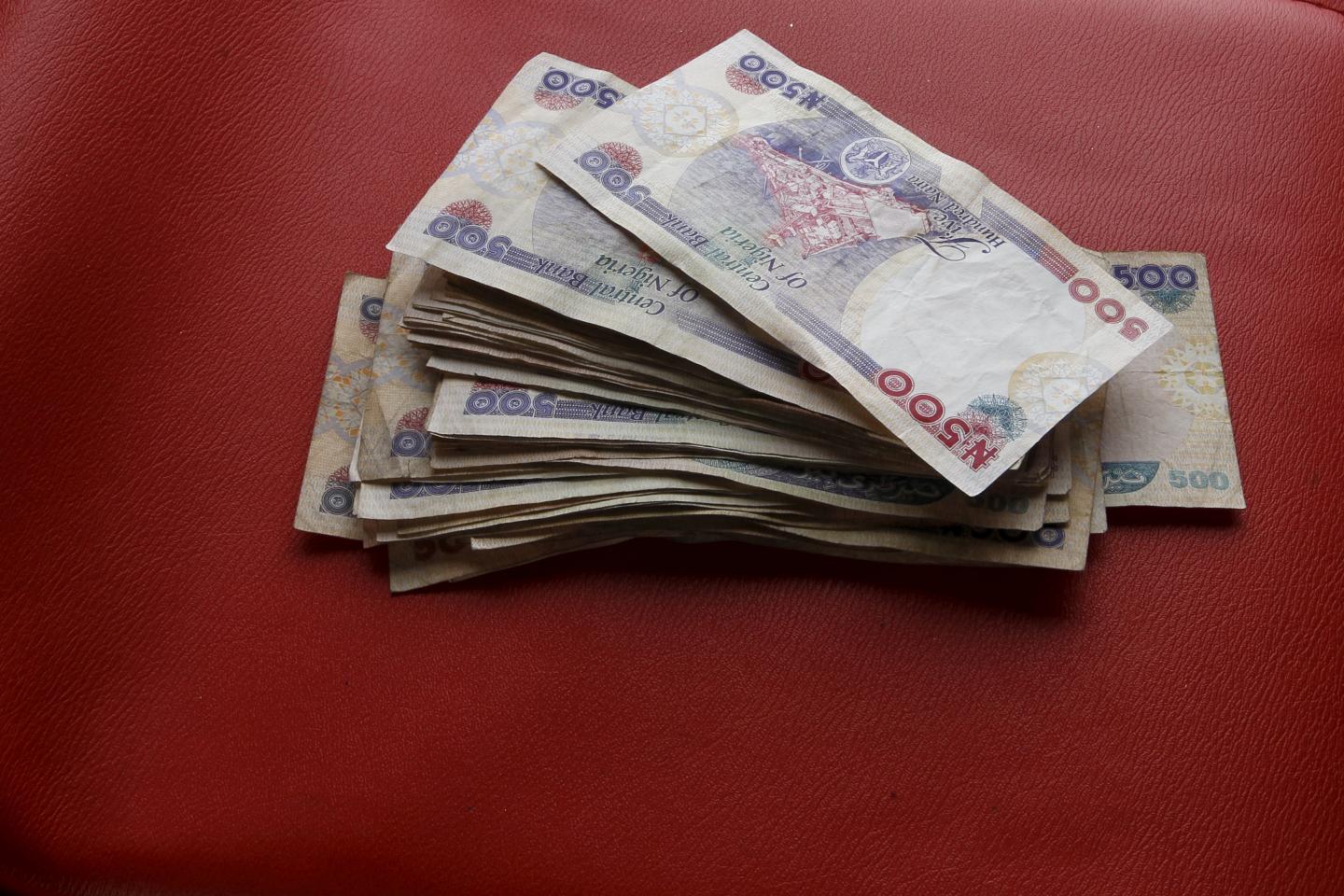
Naira Loses N31 Against Dollar at Parallel Market in Two Weeks
By Adedapo Adesanya
On July 27, the Governor of the Central Bank of Nigeria (CBN), Mr Godwin Emefiele, in his customary fashion of black suit and a lemon tie announced that the bank will be stopping the sale of foreign exchange (FX) to Bureaux De Change (BDCs).
This wasn’t unprecedented as such action had been carried out on two previous occasions under his tenure, but one thing was sure, the Naira was set for uncharted territory.
The local currency, which stood at 526/$1 at the end of last month, fell to 557/$1 at the parallel market on Tuesday, September 14. This means that within two weeks, it has lost 5.9 per cent or N31 of its value against the United States Dollar.
This is particularly a telling sight as forex affects everything Nigerians use with a corresponding rise expected in goods and services.
“We are concerned that BDCs have allowed themselves to be used for graft,” Mr Emefiele had said when he announced the decision at the end of the two-day Monetary Policy Committee (MPC) meeting in Abuja.
He had accused the BDC operators of sabotaging the financial system and refused to sell the forex at a small margin different from the official Investors and Exporters (I&E) window.
Although the central bank says the black market is an illegal channel for sourcing FX, many Nigerians are left without a choice than to approach the unregulated market to meet their needs since they have been shut out of the official channels, especially importers of items on the FX restriction list.
In addition, those who are allowed to access forex at the I&E segment through the commercials are limited to a certain amount per quarter like the PTAs and BTAs, where the quarterly allocation is $4,000 and $5,000 respectively.
This situation is forcing many forex end-users to the parallel market, causing BDC operators to jerk the exchange rate higher, further widening the disparity between the rate at the official channels and the unofficial window.
Although Mr Emefiele has been mute despite several calls from different quarters, requesting him to take an action to save the Naira from total collapse, the Director of Monetary Policy at the CBN, Mr Hassan Mahmud, while speaking at a virtual investor conference last week said the major concern of the CBN, for now, was boosting Dollar supply to the market windows and not the valuation of the local currency.
He said the apex bank was worried about the supply side of the FX market and the confidence in the system, noting that the level of the Naira was expected to adjust based on demand.
No indication has shown that the Naira will stop its continued downward trajectory anytime soon with many calling for the resignation of the CBN Governor.
A member of the House of Representatives, Mr Tajudeen Adefisoye, had alleged that Mr Emefiele has failed to heed the multiple calls of the National Assembly to appear before it to explain his forex policies and others.
Economy
Six Price Losers Handicap NASD Exchange by 0.86%
By Adedapo Adesanya
The NASD Over-the-Counter (OTC) Securities Exchange was depleted by 0.86 per cent on Friday, November 14, after the price of six securities on the platform closed lower.
This reduced the NASD Unlisted Security Index (NSI) by 31.38 points to 3,613.23 points from the 3,644.61 points recorded a day earlier, as the market capitalisation lost N18.77 billion to end the week at N2.161 trillion compared with the N2.180 trillion it finished a day earlier.
During the session, NASD Plc fell by N4.00 to close at N55.00 per share compared with the preceding session’s N59.00 per share, FrieslandCampina Wamco Plc crashed by N3.00 to end at N51.00 per unit versus the previous day’s N54.00 per unit, Central Securities Clearing System (CSCS) Plc depreciated by N1.60 to close at N40.40 per share versus N42.00 per share, Lagos Building Investment Company (LBIC) Plc went down by 35 Kobo to settle at N3.13 per unit compared with the N3.48 per unit it ended on Thursday, UBN Property Plc decreased by 26 Kobo to quote at N2.33 per share versus the preceding day’s N2.59 per share and Industrial and General Insurance (IGI) Plc crumbled by 1 Kobo to close at 41 Kobo per unit versus 42 Kobo per unit.
Yesterday, the volume of securities traded by market participants increased by 99.5 per cent to 2.2 million units from the previous day’s 119,329 units, the value of securities ballooned by 4,185.1 per cent to N82.9 million from N1.9 million, and the number of deals expanded by 50 per cent to 21 deals, from 14 deals.
When the market ended for the session, Infrastructure Credit Guarantee Company (InfraCredit) Plc remained the most traded stock by value with a year-to-date sale of 5.8 billion units valued at N16.4 billion, trailed by Okitipupa Plc with 170.3 million units traded for N8.0 billion, and Air Liquide Plc with 507.4 million units sold for N4.2 billion.
InfraCredit Plc also ended as the most traded stock by volume on a year-to-date basis with 5.8 billion units worth N16.4 billion, followed by IGI Plc with 1.2 billion units transacted for N419.7 million, and Impresit Bakolori Plc with 536.9 million units valued at N524.9 million.
Economy
Naira Slips to N1,442/$ at Official Market
By Adedapo Adesanya
The Naira weakened against the US Dollar in the Nigerian Autonomous Foreign Exchange Market (NAFEM) on Friday, November 14 on fresh forex demand pressure associated with this period.
During the session, the domestic currency depreciated against the greenback by 99 Kobo or 0.07 per cent to trade at N1,442.43/$1, in contrast to the N1,441.44/$1 it traded on Thursday.
In the same official market window, the local currency closed flat against the Pound Sterling at N1,898.96/£1, but further declined against the Euro by N3.60 to close at N1,678.56/€1 versus the previous day’s N1,674.96/€1.
However, at the GTBank FX counter, the Naira appreciated against the Dollar yesterday by N2 to settle at N1,448/$1 versus the preceding session’s rate of N1,448/$1, and in the parallel market, it maintained stability at N1,455/$1.
Increased demand for Dollars above the supply level has impacted price swing, but in the last two sessions, the pressure have been minimal.
In recent weeks, the apex bank FX injection has been minimal and erratic due to increasing FX inflows from foreign portfolio investors and exporters. FX inflow into currency market has fallen from peaked of $1.37 billion to $899 million.
While the Naira came under renewed strain, Nigeria’s foreign reserves continued their upward trajectory, climbing to $43.5 billion, up from $43.32 billion the week before.
This steady improvement in external reserves may be attributed to stronger crude oil receipts, improved non-oil inflows, and tightened FX management policies by the Central Bank of Nigeria (CBN).
As for the cryptocurrency market, investors tried to claw back some gains after many liquidated positions in the recent sessions largely driven by a lack of clarity on key US economic conditions and subsequent monetary policy direction.
That data blackout was due to the longest US government shutdown that lasted from October 1 until Thursday, that suspended government inflation and jobs data releases, with Litecoin (LTC) growing by 8.5 per cent to $104.14.
Further, Binance Coin (BNB) rose by 2.3 per cent to sell for $932.27, Solana (SOL) went up by 0.9 per cent to $142.71, Ethereum (ETH) jumped by 0.3 per cent to $3,175.02, and Dogecoin (DOGE) also appreciated by 0.3 per cent to $0.1633.
But Cardano (ADA) depreciated by 0.8 per cent to $0.5130, Ripple (XRP) fell by 0.3 per cent to $2.28, and Bitcoin (BTC) dropped 0.2 per cent to finish at $96,193.83, while the US Dollar Tether (USDT) and the US Dollar Coin (USDC) remained unchanged at $1.00 each.
Economy
Oil Market Jumps 2% as Russia Halts Export from Key Port
By Adedapo Adesanya
The oil market was up by more than 2 per cent on Friday as a key Russian port suspended oil exports after Ukraine attacked the facility, raising concerns about supply.
Brent crude futures increased by $1.38 or 2.19 per cent to trade at $64.39 a barrel and the US West Texas Intermediate (WTI) crude futures grew by $1.40 or 2.39 per cent to close at $60.09 a barrel. Brent rose 1.2 per cent on the week, and WTI posted a weekly gain of 0.6 per cent.
Russia’s port of Novorossiisk halted oil exports following a Ukrainian drone attack that hit an oil depot in the Russian energy hub, stoking supply concerns.
The port, a key export outlet of crude from Russia and Kazakhstan, and a major wheat export hub, paused oil exports, equivalent to 2.2 million barrels per day, or 2 per cent of global supply.
According to reports, the attacks damaged a ship, nearby apartment buildings, and an oil depot, injuring three crew members aboard the vessel. This comes as Ukrainian forces have increasingly targeted Russian oil-refining, storage, and export infrastructure using drones and missiles.
In addition, Russia’s pipeline company Transneft suspended crude oil supply to the facilities at the port.
Ukraine on Friday said it separately struck an oil refinery in Russia’s Saratov region and a fuel storage facility in nearby Engels overnight.
Market analysts noted that in recent month, Ukraine has made a shift in strategy from smaller-scale strikes on storage tanks to targeting hard-to-replace refinery equipment, like cracking units, much of it western-made and subject to sanctions.
Britain on Friday issued a special licence allowing businesses to continue working with two Bulgarian subsidiaries of sanctioned Russian oil firm Lukoil, as the Bulgarian government seized control of the assets.
The US imposed sanctions banning deals with Russian oil companies Lukoil and Rosneft after November 21 as part of efforts to stop the war which commenced with Russia attacking Ukraine in February 2022.
While geopolitical tensions and the end of the US government shutdown offered fleeting support this week, the market remained focused on rising global inventories, shifting supply-demand expectations from the Organisation of the Petroleum Exporting Countries (OPEC) and the International Energy Agency (IEA) and a broader sense that supply continues to outpace demand.
-
Feature/OPED6 years agoDavos was Different this year
-
Travel/Tourism9 years ago
Lagos Seals Western Lodge Hotel In Ikorodu
-
Showbiz3 years agoEstranged Lover Releases Videos of Empress Njamah Bathing
-
Banking7 years agoSort Codes of GTBank Branches in Nigeria
-
Economy2 years agoSubsidy Removal: CNG at N130 Per Litre Cheaper Than Petrol—IPMAN
-
Banking3 years agoFirst Bank Announces Planned Downtime
-
Sports3 years agoHighest Paid Nigerian Footballer – How Much Do Nigerian Footballers Earn
-
Banking3 years agoSort Codes of UBA Branches in Nigeria