
Economy
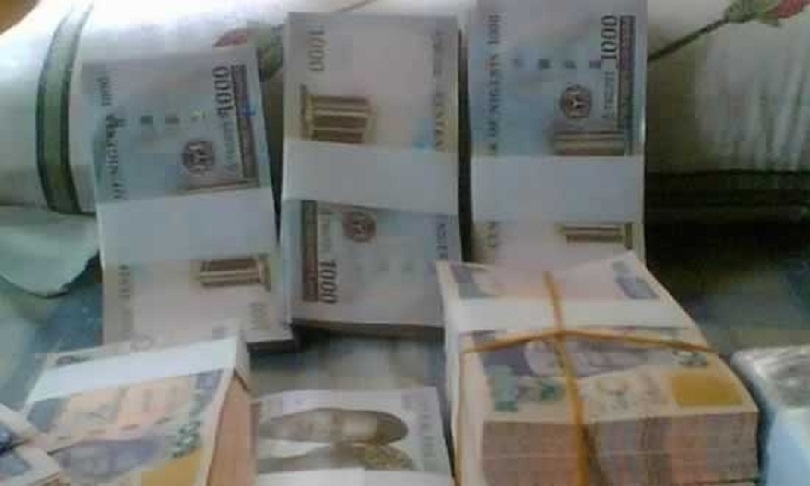
Naira Loses N33 to Trade at N1,615/$1 at Official Market

By Dipo Olowookere
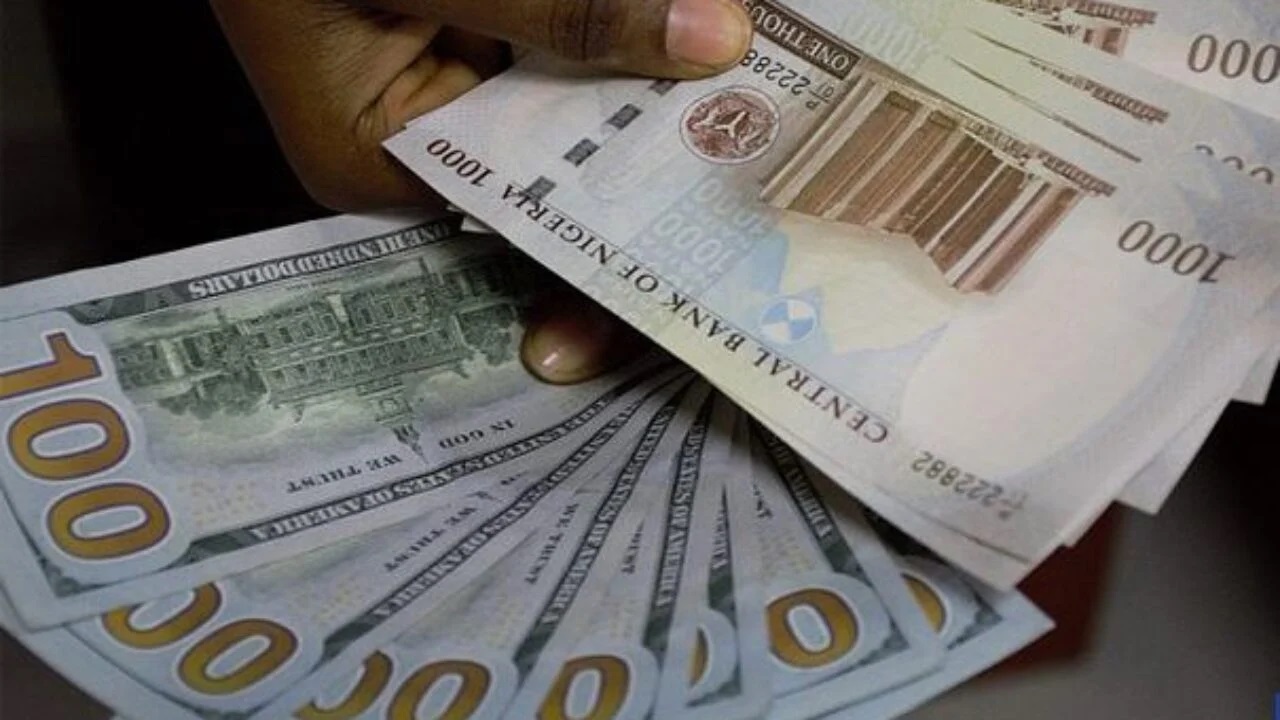
It was a bad day for the Naira in the official market, the Nigerian Autonomous Foreign Exchange Market (NAFEM), on Tuesday as its value weakened by N33.00 or 2.09 per cent against the United States Dollar to sell at N1,615.94/$1 compared with the previous day’s N1,582.94/$1.
This came on a day the Governor of the Central Bank of Nigeria (CBN), Mr Yemi Cardoso, reemphasised that the Nigerian currency was grossly undervalued.
While briefing newsmen yesterday on the outcome of the Monetary Policy Committee (MPC) meeting, Mr Cardoso stressed that the current rate was not the true value of the local currency at the FX market.
Data obtained by Business Post from the FMDQ Securities Exchange showed that the forex turnover for the trading session remained unchanged at $154.16 million as the central bank makes efforts to make the market wet with Dollars to boost the value of the domestic currency.
Also, in the parallel market, the Nigerian Naira depreciated against the Dollar yesterday by N80 to quote at N1,600/$1, in contrast to the preceding day’s value of N1,520/$1, as forex traders on the streets transact business in fear due to the recent clampdown on them by security officials led by the Economic and Financial Crimes Commission (EFCC).
The peer-to-peer (P2P) segment of the FX market was also not spared by attempts by the federal government to prohibit trading, particularly through a well-known cryptocurrency exchange platform, Binance.
At the P2P window on Tuesday, the local currency lost N16 against the greenback to trade at N1,659/$1 versus the 1,643/$1 it was transacted a day earlier.
Mr Cardoso, during his chat with journalists on Tuesday in Abuja, claimed that about $26 billion passed through Binance in one year from unidentified sources, expressing deep concerns over the effect of this on the nation’s FX market and economy.
“We are concerned that certain practices go on that indicate illicit flows, going through a number of these entities and suspicious flows.
“In the case of Binance, in the last year, $26 billion has passed through Binance Nigeria from sources and users who we cannot adequately identify,” he said.
This may be an indication that the Nigerian government will ban crypto trading again just a few months after it lifted an embargo on the market.






By Adedapo Adesanya
The Federation Account Allocation Committee (FAAC) at its March 2026 meeting, chaired by the Minister of Finance, Mr Wale Edun, shared the sum of N1.894 trillion from the N2.230 trillion earned in February to the three tiers of government.
From the stated amount, the federal government received N675.086 billion, the states got N651.525 billion, the local government councils were given N456.467 billion, while the oil-producing states shared N110.949 billion as 13 per cent of mineral revenue, with N77.302 billion taken for the cost of collection, and N259.078 billion for transfers, intervention and refunds (TIR).
In a communique issued by FAAC at the end of the meeting, Mr Edun disclosed that the gross revenue available from the Value Added Tax (VAT) for the month was N668.450 billion compared with N1.083 trillion distributed in the preceding month.
From this, N26.738 billion was used as the cost of collection, and N22.593 billion was deducted for TIR. The balance of N619.119 billion was distributed to the three tiers of government, with N61.912 billion going to the federal government, N340.515 billion to the state governments, and N216.692 billion to the councils.
It was disclosed that the gross statutory revenue for the month under review was N1.561 trillion, lower than N1.957 trillion received a month earlier by N395.138 trillion.
From the stated amount, N50.564 billion was allocated for the cost of collection and a total of N236.485 billion for TIR, while the remaining balance of N1.274 trillion was distributed as follows to the three tiers of government: federal government got N613.174 billion, the states received N311.010 billion, the local councils got N239.776 billion, and N110.949 billion was given to the oil-producting states.
Last month, oil and gas royalty and excise duty increased significantly, while Petroleum Profit Tax (PPT), Hydrocarbon Tax (HT), Companies Income Tax and VAT decreased substantially. Import Duty and CET levies increased marginally.

By Adedapo Adesanya
Nigeria’s first indigenous broadband company to be listed on the Nigerian Exchange (NGX) Limited, Legend Internet Plc, has commenced talks with Spectranet for a possible merger deal before the end of June 2026.
In a notice on Monday, Legend Internet said the proposed merger aligns with its long-term strategy to expand broadband infrastructure and strengthen its position within Nigeria’s telecommunications sector.
The Abuja-based Nigerian technology company, founded in 2021, specialises in fibre-to-the-home (FTTH) broadband, fintech, and digital services. The company operates a high-speed, 1Gbps-capable fibre network, focusing on premium digital.
The transaction is expected to deliver significant strategic and financial benefits, including enhanced network capacity through the integration of fibre and wireless infrastructure, improved operational efficiency, and expanded coverage across key urban markets.
The firm’s board believes the transaction will create sustainable long-term value for shareholders by strengthening its competitive position, supporting revenue growth, and improving earnings capacity through operational synergies and increased scale. The deal is expected to be value accretive to shareholders over the medium to long term.
However, it is subject to the approval of relevant regulatory authorities, including the Federal Competition and Consumer Protection Commission (FCCPC) and the Nigerian Communications Commission (FCCPC). Subject to obtaining the required approvals, completion is anticipated in Q2 2026.
Legend assured stakeholders in the capital market that it remains committed to maintaining transparency and will continue to keep NGX and the investing public informed of any material developments in respect of the transaction.
Spectranet was awarded a License from the Nigerian Communications Commission in 2009 to promote Internet services across Nigeria. Spectranet was the first Internet Service Provider to launch 4G LTE internet service in Nigeria and aims to be a leader in the Internet Services space.
By Adedapo Adesanya
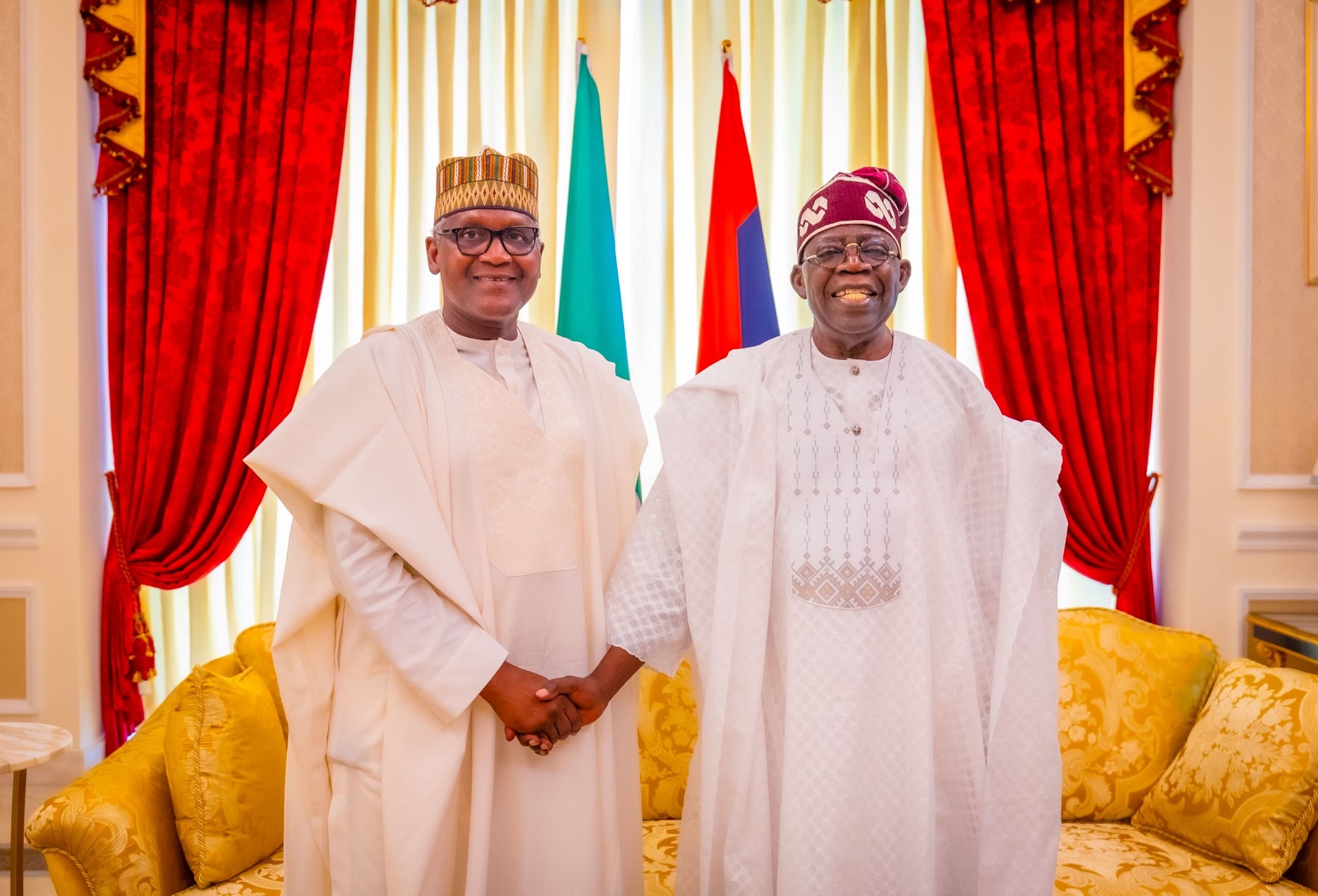
The president of the Dangote Group, Mr Aliko Dangote, met with President Bola Tinubu on Monday to discuss and address concerns about the growing volatility in the global oil market and its impact on Nigerians.
Petrol prices have jumped to as high as N1,400 per litre amid the continuous rise in prices of crude oil in the global market as a result of the Middle East war. Brent crude rose above $100 per barrel due to compounding supply constraints, though it closed below the mark yesterday.
Mr Dangote, whose company controlled about 60 per cent of Nigeria’s domestic supply pre-war, speaking after the meeting, said that although Nigeria is not directly involved in the war, the ripple effects of global oil price fluctuations would inevitably be felt.
“It means quite a lot. We don’t have much to do with it, but I know the world is a global village. And it definitely will affect us, unfortunately, but we pray this situation will be sorted out,” he said after his visit to President Tinubu in Lagos yesterday.
He warned that a prolonged crisis could further destabilise economies, particularly in Africa, where fiscal buffers are limited, and debt pressures remain high.
“If it doesn’t de-escalate, we’ll end up paying high prices, like what I said earlier on CNN. Africa is very busy paying debt, and putting this again on top of us is going to add a lot of hardship on people, on the government, on the people, on everybody, for something that we have no involvement in.”
He stressed that energy costs are central to nearly all sectors of the economy, meaning sustained increases would have widespread and cascading effects on livelihoods and production.
He explained that governments could face mounting fiscal strain as subsidies rise and revenues fluctuate under unstable global oil market conditions.
Mr Dangote added that Africa’s rising debt burden could worsen under prolonged instability, further limiting fiscal space and weakening economic resilience.
“Africa is already grappling with debt, and additional shocks will only compound hardship for governments and the people,” he said.
He said escalating energy costs would disrupt nearly every sector, including small enterprises, manufacturing chains, logistics operations and household consumption patterns.
The business mogul noted that some countries were already adopting coping strategies such as reduced workdays, energy rationing and remote working arrangements.
Mr Dangote said such measures, while necessary, could reduce productivity, slow economic output and affect livelihoods, particularly among vulnerable populations.
He urged global leaders to prioritise de-escalation, stressing that many Africans rely on daily earnings and remain highly exposed to economic shocks.








-
 Feature/OPED6 years ago
Davos was Different this year
-
Travel/Tourism10 years ago
Lagos Seals Western Lodge Hotel In Ikorodu
-

 Showbiz3 years ago
Estranged Lover Releases Videos of Empress Njamah Bathing
-
 Banking8 years ago
Sort Codes of GTBank Branches in Nigeria
-

 Economy3 years ago
Subsidy Removal: CNG at N130 Per Litre Cheaper Than Petrol—IPMAN
-

 Banking3 years ago
Sort Codes of UBA Branches in Nigeria
-

 Banking3 years ago
First Bank Announces Planned Downtime
-

 Sports3 years ago
Highest Paid Nigerian Footballer – How Much Do Nigerian Footballers Earn