Connect with us

Economy

Naira Loses N5 After Unveiling of Redesigned Notes by Buhari

Published

on

New Naira Notes

By Dipo Olowookere

The parallel market segment of the foreign exchange (forex) market in Nigeria has reacted negatively to the unveiling of the redesigned Naira notes by President Muhammadu Buhari on Wednesday.

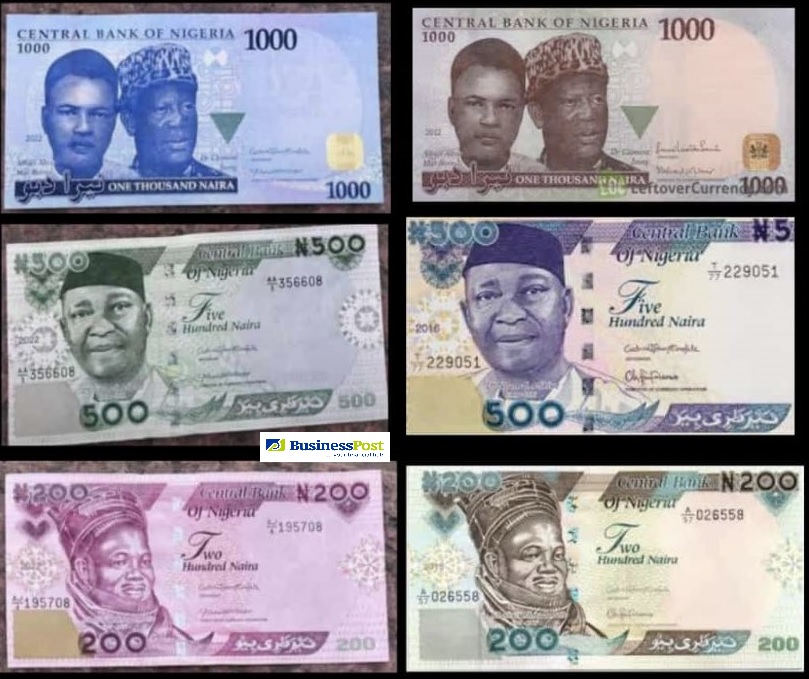
This morning, Mr Buhari revealed the new N200, N500, N1,000 notes at the weekly Federal Executive Council (FEC) meeting held at the Presidential Villa in Abuja.

This has started to generate mixed reactions from Nigerians, with some expressing disappointment at the development, claiming that it was purely a change in the colour of the banknotes.

Business Post reports that at the black market this afternoon, the value of the Naira to its United States counterpart depreciated by N5 to trade at N780/$1 compared with the N775/$1 it was traded on Tuesday.

The country has still been unable to overcome its FX liquidity problems, which have put the local currency under pressure as the supply has not been able to meet demand.

Recall that the Nigerian currency went into a free-fall for a few weeks after the Central Bank of Nigeria (CBN) said on October 26, 2022, that it was redesigning the domestic currency.

It had said the new notes would be in circulation from December 15 and that the old banknotes would seize to be legal tender in Nigeria from February 1, 2023.

There were calls for an extension but yesterday, after the Monetary Policy Committee (MPC) meeting in Abuja, the Governor of the CBN, Mr Godwin Emefiele, said there would not be an extension to the January 31, 2023, deadline for the exchange of the old notes for the new notes.

Yesterday, the Naira appreciated against the Dollar in the black market by N5 to N775/$1 from N780/$1, but the gains have evaporated after the latest development.

It is not certain if these will be recovered in the coming day, but some financial experts, including Mr Sakiru Adediran, have said it is too early to say for now.

“It is too early to judge the effect of the new Naira notes on its value at the black market, but I do not see it strengthening the value of the Naira,” he said when contacted by this newspaper for his expert opinion.


Dipo Olowookere is a journalist based in Nigeria that has passion for reporting business news stories. At his leisure time, he watches football and supports 3SC of Ibadan. Mr Olowookere can be reached via [email protected]

Click to comment

Leave a Reply

Your email address will not be published. Required fields are marked *

Economy

Claims of PMS Export, Re-importation Not True—Dangote Refinery

Published

on

Fifth Crude Cargo Dangote Refinery

By Aduragbemi Omiyale

Dangote Petroleum Refinery and Petrochemicals has refuted allegations that its premium motor spirit (PMS), otherwise known as petrol, exported to other countries, is being re-imported into Nigeria.

It was claimed that the private crude oil refiner sells PMS to other African nations, especially Togo, at a lower price to the extent that when re-imported into the country, it is still cheaper than what Dangote Refinery sells to Nigerian marketers.

Reacting via a statement on Tuesday night, the management described the allegations as “baseless and unsubstantiated” because they are not “supported by verifiable trade data, commercial logic, or the operational realities of Dangote Refinery.”

The company noted that its core mandate is to strengthen domestic supply and remains a leading provider of petroleum products in Nigeria.

“Any practice that enables imports to compete directly with its own production clearly contradicts this objective,” it stated.

Dangote Refinery said “all sales contracts and tender agreements expressly prohibit the resale or re-importation of Dangote Refinery products into Nigeria,” emphasising that “the economics of the purported trade route are fundamentally flawed.”

The organisation stated that estimated logistics costs for transporting products from the refinery to Lomé and back into Nigeria range between $82–90 per metric ton. Such additional costs would significantly erode margins and render the transaction commercially unviable.

“Dangote Refinery does not provide export discounts sufficient to offset these costs or create arbitrage opportunities between export and domestic markets. Simply put, no rational producer would incur additional shipping, storage, financing, and handling costs only for products to re-enter and compete in its primary market,” it pointed out.

The management also highlighted that the refinery maintains stringent product traceability protocols, including detailed records of lifting points, nominated vessels, counterparties, and declared destinations. These measures ensure full visibility and accountability across the supply chain.

The statement insisted that any “claim suggesting that the refinery facilitates or tolerates re-importation is inconsistent with its contractual safeguards and established compliance standards.”

The refinery said it has consistently advocated for reducing Nigeria’s dependence on imported petroleum products, underscoring that encouraging or enabling re-importation would undermine local refining efforts, strain foreign exchange reserves, and weaken national industrial growth, positions that are contrary to its core objectives.

Dangote Refinery reiterated that there is no strategic, economic, or operational basis for the claim that it exports products for re-importation into Nigeria, stressing that the allegation is entirely unfounded and does not withstand scrutiny when measured against market logic, contractual frameworks, and industry practices.

The statement concluded that “Dangote Refinery remains focused on its mission to enhance energy security, support local refining, and contribute meaningfully to Africa’s industrial development.”

Continue Reading

Economy

Customs Street Rallies 1.06% on Improved Market Activity, Investor Sentiment

Published

on

Customs Street

By Dipo Olowookere

The Nigerian Exchange (NGX) Limited rallied by 1.06 per cent on renewed investor confidence after surviving a run of losing streaks.

Yesterday, some performance indicators were better compared with the previous session, with the All-Share Index (ASI) chalking up 2,540.08 points to settle at 240,743.19 points versus Monday’s 238,203.11 points, and the market capitalisation gained N1.649 trillion to close at N154.484 trillion, in contrast to the preceding day’s N152.835 trillion.

As for the sectoral performance, the energy sector was down by 0.09 per cent, but the loss was offset by the gains recorded by the others.

The insurance counter grew by 2.84 per cent, the banking and the consumer goods indices rose by 0.18 per cent each, and the industrial goods segment expanded by 0.07 per cent.

Unlike on Monday, the market breadth index was positive on Tuesday, with Customs Street closing with 33 price gainers and 23 price losers, indicating bullish investor sentiment.

Guinea Insurance improved by 10.00 per cent to N1.10, International Energy Insurance advanced by 9.89 per cent to N6.11, Tripple Gee soared by 9.82 per cent to N3.69, Cornerstone Insurance climbed 9.76 per cent to N6.75, and Sovereign Trust Insurance surged by 8.63 per cent to N2.14.

On the flip side, Red Star Express dropped 9.96 per cent to trade at N24.85, Premier Paints depreciated by 9.93 per cent to N6.43, Trans-Nationwide Express declined by 9.82 per cent to N4.04, Royal Exchange shrank by 9.38 per cent to N1.45, and Abbey Mortgage Bank crashed by 9.29 per cent to N28.12.

Market activity improved during the trading day, with market participants transacting 564.9 million shares valued at N39.4 billion in 49,230 deals compared with the 475.8 million shares worth N36.5 billion traded in 63,567 deals a day earlier, implying a shortfall in the number of deals by 22.55 per cent, and a rise in the trading volume and value by 18.73 per cent and 7.95 per cent, respectively.

Fidelity Bank led the activity chart after a turnover of 59.4 million units worth N1.1 billion, Zenith Bank traded 49.5 million units valued at N5.9 billion, Dangote Sugar exchanged 43.1 million units for N3.1 billion, Chams sold 39.5 million units worth N156.5 million, and Access Holdings transacted 30.7 million units valued at N703.6 million.

Continue Reading

Economy

Brent, WTI Further Loses as Middle East Tensions Ease

Published

on

West Texas Intermediate WTI

By Adedapo Adesanya

The prices of the two major crude oil grades further declined on Tuesday as investors kept a close watch on crude flows through the Strait of Hormuz following signs of ​progress in US-Iran peace talks.

Brent futures lost 82 cents or 1.1 per cent to trade at $77.08 per barrel, while the US West Texas Intermediate (WTI) futures gave up 65 ‌cents or 0.9 per cent to sell for $73.21 a barrel.

The market continued to edge lower after the US granted Iran a 60-day sanctions waiver following initial peace talks, while hostilities in Lebanon eased under a broader agreement.

Investors are cautiously watching how quickly Middle Eastern producers can resume oil production and exports following damage from the war, and whether more ships will enter the region.

After US Vice President JD Vance left Switzerland on June 22 after a round of talks over the weekend, President Donald Trump issued a warning to Iran that “I will do what I have to do” if it does not stick to its agreement with the US.

Mr Vance had noted movement on a framework toward reaching a final peace deal within 60 days, including the guarantee of safe passage through the Strait of Hormuz, an end to fighting in Lebanon, and Iran’s acceptance of visits by international nuclear inspectors.

On Tuesday, Oman and Iran agreed to press on with discussions about ​the future administration of navigation in the Strait of Hormuz, through which 20 per cent of crude and liquified natural gas (LNG) passes.

US Secretary of State Marco Rubio said on Tuesday that Iran would not be ​able to charge tolls in the key waterway as part of any final agreement with the United States, saying such ⁠an arrangement would violate international law.

According to the International Energy Agency (IEA), the world has lost millions of barrels of oil and gas supply since the Iran war closed the strait, putting the shut-in data at more than 14 million barrels per day of oil output or about 14 per cent of world demand.

Meanwhile, President Trump claimed that 19 million barrels of oil flowed out of the strait on Monday, and pointed to falling oil prices in a social media post on Tuesday.

The American Petroleum Institute (API) estimated that crude oil inventories in the US fell by 765,000 barrels in the week ending June 19. Official data from the US Energy Information Administration (EIA) will be released later on Wednesday.

Continue Reading

Trending