Connect with us

Economy

Naira Woes Continue at Black Market, Sheds N2

Published

on

naira depreciate

By Modupe Gbadeyanka

The poor performance of the Nigerian Naira against major foreign currencies at the forex market continued on Thursday.

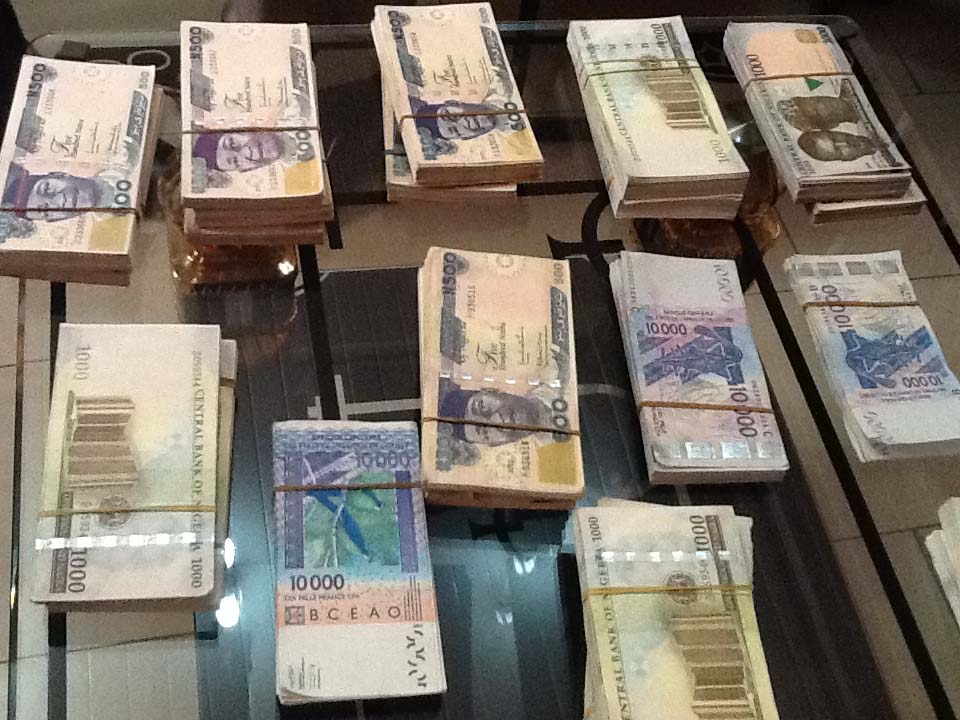
The local currency further depreciated at the black market yesterday, going down by N2 against both the Dollar and Pound Sterling.

However, it traded flat against the Euro at the same segment of the forex market on Thursday.

Business Post reports that the Naira was sold for N364 to a Dollar at the parallel market yesterday in contrast to N363 it went for the previous, while it was exchanged for N483 to the Pound against N482 it was traded on Wednesday.

As earlier stated, the local currency traded flat against the Euro at the black market on Thursday, closing at N426.

As at Friday morning, while filing this report, the Naira was another N2 against the Dollar and Pound Sterling.

It was being exchanged for N365 per Dollar and N484 to a Pound at the parallel market, but still trading at N426 to the Euro.


Modupe Gbadeyanka is a fast-rising journalist with Business Post Nigeria. Her passion for journalism is amazing. She is willing to learn more with a view to becoming one of the best pen-pushers in Nigeria. Her role models are the duo of CNN's Richard Quest and Christiane Amanpour.

Click to comment

Leave a Reply

Your email address will not be published. Required fields are marked *

Economy

Oil Climbs 1% as US-Iran Deal Hopes Fade, Hormuz Closure Persists

Published

on

OPEC Global Oil Demand

By Adedapo Adesanya

Oil was up by 1 per cent on Tuesday as doubts about a potential United States-Iran peace deal fueled concerns that Middle East supply disruptions would persist.

As a result, Brent futures rose by $1.19 or 1.4 per cent ‌to $88.91 a barrel, while the US West Texas Intermediate (WTI) futures expanded by $1.07 or 1.3 per cent to $83.20 per barrel.

Both contracts had jumped about 5 per cent on Monday as hopes for a peace deal between the US and Iran started to fade.

It looked worse on Tuesday when Iran said the Strait of Hormuz will remain closed unless the US ends the war and meets Iran’s conditions, raising the bar for a deal that would restore more oil traffic through the key waterway. About 20 per cent of global oil supply passed through the strait before the start of ⁠the Iran war on February 28.

Mr Mohsen Rezaei, secretary of Iran’s Supreme National Security Council, said it has also delivered additional conditions to the US through mediators.

US officials had suggested last week that negotiations involving Iran and Oman were making progress toward allowing more vessels through Hormuz.

Shipping traffic through the Strait of Hormuz fell sharply on Monday as tensions continued to disrupt maritime activity across the Middle East.

Shipping data showed that only six vessels passed through the strategic waterway on Monday, below the 10-day average of about 11 vessels. Before the conflict, daily traffic through the strait averaged between 125 and 140 vessels.

The disruption comes amid heightened security concerns across key regional shipping routes.

In the Bab el-Mandeb, Yemen’s Iran-aligned Houthis attacked a Saudi vessel carrying military equipment, according to the Houthi-run Saba news agency.

Separately, Reuters reported a missile attack on a container ship off Pakistan in what was suspected to be a US strike, further underscoring the security risks facing commercial shipping in the region.

The disruption to regional maritime traffic has also raised concerns about the recovery of oil production in the Middle East.

The US Energy Information Administration (EIA) said on Tuesday that some oil producers in the region could struggle to restore output to pre-conflict levels by the end of 2027, even if shipping and trade patterns return to normal by early next year.

The outlook highlights the potential for prolonged disruptions to global oil supplies despite a possible normalisation of trade flows in the coming months.

In Libya, a member of the Organisation of the Petroleum Exporting Countries (OPEC), renewed violence in the strategic city of Zawiya has disrupted the oil industry, with state oil firm the National Oil Corporation saying it could declare force majeure if drone attacks on energy assets in the city continued.

In Europe, the Ukrainian military said ⁠on Tuesday it attacked an oil refinery in the Russian city of Orsk, the second-largest city in the Orenburg region and an important industrial hub.

The combination of Ukraine’s attacks on Russian energy infrastructure and the Iran war has limited global supplies and ​boosted global energy prices.

Continue Reading

Economy

Tanzania Tasks Africa to Prioritise Economic Integration Through Industrialisation

Published

on

Dangote Tanzania

By Aduragbemi Omiyale

African leaders have been advised to focus on economic integration through industrialisation, as this would make the continent a formidable force in the global market.

This charge was given by the Minister of State in the Tanzanian President’s Office responsible for Planning and Investment, Prof. Kitila A. Mkumbo, during a visit to the Dangote Petroleum Refinery and Petrochemicals in Lagos.

“Africa now needs economic liberation, and that can only come through industrialisation,” he said, describing Mr Aliko Dangote as Africa’s leading industrialist whose investments are increasingly extending beyond Nigeria to support development across the continent.

He added that Tanzania looks forward to working with Dangote Group as part of a broader vision of accelerating Pan-African industrialisation and strengthening regional manufacturing capacity.

The Minister also highlighted the importance of local refining capacity in improving Africa’s energy security, particularly in light of recent disruptions in global oil markets.

Referring to the impact of tensions around the Strait of Hormuz on global fuel prices, he said increased refining capacity from facilities such as the Dangote Petroleum Refinery would help cushion African economies against external shocks.

According to him, affordable and reliable energy remains one of the most important drivers of economic development, noting that expanded refining capacity across the continent would contribute significantly to lowering energy costs and improving the quality of life for millions of Africans.

The Tanzanian delegation was in Nigeria to follow up on discussions held earlier this year between President Samia Suluhu Hassan and Mr Dangote regarding the expansion of Dangote Group’s investment footprint in Tanzania.

The East African nation reaffirmed its commitment to deepening economic cooperation with Dangote Group, expressing strong interest in attracting new investments in fertiliser production, energy and industrial infrastructure to support the country’s long-term development agenda.

“We have come here to make a follow-up on what they deliberated with our President in terms of further Dangote investments in Tanzania,” Mr Mkumbo said.

Continue Reading

Economy

Champion Breweries to Strengthen Market Position

Published

on

champion breweries uyo

By Aduragbemi Omiyale

One of the leading brewers and beverage companies listed on the Nigerian Exchange (NGX) Limited, Champion Breweries Plc, has expressed its commitment to strengthening its market position.

The beer maker gave this assurance while reacting to its financial performance for the first half of 2026, which was strong, driven by solid commercial performance, improved operational efficiencies, and the successful expansion of its business portfolio following the acquisition of EnjoyBev B.V.

In the period under review, the organisation boosted its growth platform through strategic investment, delivered resilient operating performance, and successfully transitioned to a new group structure.

Its revenue reached N35.73 billion, while second-quarter revenue amounted to N21.37 billion. Operating profit stood at N6.17 billion, and profit after tax attributable to the group was N2.65 billion, with second-quarter profit after tax of N1.76 billion.

The firm also successfully completed the acquisition of an 80 per cent equity interest in EnjoyBev B.V., strengthened its capital base through a successful capital raising programme that increased shareholders’ equity to N69.08 billion, and maintained full compliance with NGX free float requirements, with free float increasing to 25.72 per cent as of June 30, 2026.

“The first half of 2026 marks a defining chapter in Champion Breweries’ journey. We have not only delivered a strong operating performance but also successfully transformed our business into a broader beverage group with an expanded platform for sustainable growth.

“While higher finance costs associated with our strategic investment programme impacted profitability during the period, our underlying business remains strong.

“The combination of disciplined commercial execution, continued investment in our brands and route-to-market capabilities and improving operational efficiency positions us well for future growth.

“We remain focused on creating long-term value for shareholders, strengthening our market position, and capturing the opportunities presented by our expanded business platform,” the acting chief executive of Champion Breweries, Mr Rasheed Adebiyi, said.

Continue Reading