Economy
NASD Begins Classification of Listed Stocks April 27
By Modupe Gbadeyanka
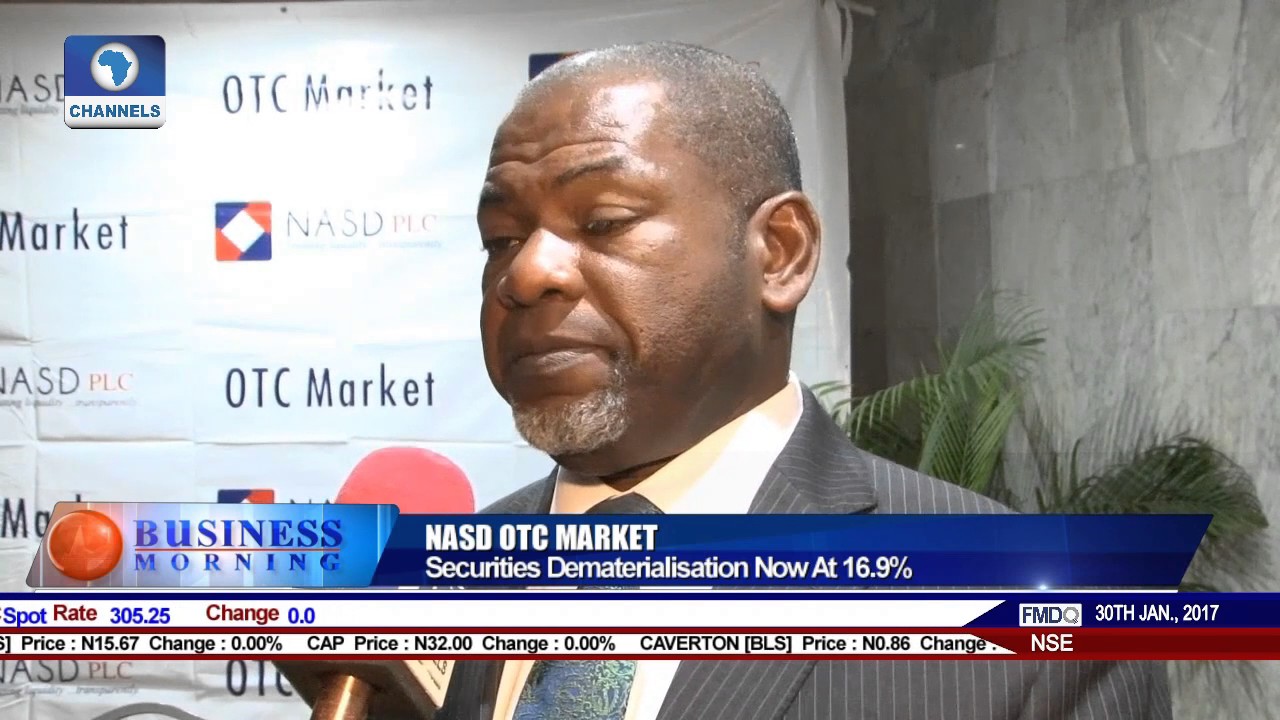
The management of NASD OTC Market has disclosed that it would commence the first review of securities listed on its platform.
Last year, the market started a classification of NASD OTC admitted securities into categories that reflect the level of financial disclosure, adherence to corporate governance standards, dematerialisation of shares and liquidity of the 36 securities trading on the OTC Market.
At the end of this exercise, 12 securities were ranked in the Blue Category, eight in the Pink Category, and 15 were in the Red Category.
In a statement issued last Friday, NASD noted that in line with its efforts to promote transparency, it would conduct a first review of all securities on the OTC Market on Friday, April 27, 2018.
“This review will update the categorisation rankings in response to changes in compliance levels,” it said.
“We believe that this service will enhance transparency on the inherent value in such companies, improve levels of investor confidence and also, improve activities on the OTC Market,” the statement added.
Economy
Naira Closes Weaker at N1,379/$1 in Official Market
By Adedapo Adesanya
The Naira performed poorly against the United States Dollar in the Nigerian Autonomous Foreign Exchange Market (NAFEX) on Friday, July 10, losing N1.19 or 0.09 per cent to close at N1,379.62/$1, in contrast to Thursday’s exchange rate of N1,378.43/$1.
It also depreciated against the Pound Sterling in the official market during the trading session by N3.80 to trade at N1,850.62/£1 compared with the previous day’s N1,846.82/£1, but gained 43 Kobo on the Euro to sell at N1,575.66/€1 versus the preceding day’s N1,576.09/€1.
At the GTBank FX desk, the Naira weakened against the Dollar yesterday by N1 to quote at N1,386/$1 compared with the previous session’s N1,835/$1, and maintained stability in the black market at N1.400/$1.
Data showed that interbank FX turnover fell by about 10 per cent on Friday to $71.044 million from $78.708 million the previous day. Also, interbank forex market deals reduced to 87 from 106 trades executed at the window on Thursday.
The total forex inflows into the Nigerian foreign exchange market have been fluctuating, with about $1 billion in total inflows reported last week.
Total FX inflows settled at $0.99 billion last week, according to the research subsidiary of Coronation Merchant Bank, with Foreign Portfolio Investors (FPIs) accounting for the largest share at 35.81 per cent, or $0.35 billion.
Exporters accounted for 28.72 per cent or $0.28 billion, while the CBN contributed 11.15 per cent or $0.11 billion. Non-Bank Corporations also made up a notable 10.92 per cent of total inflows, reflecting continued support from both market-driven and official sources.
In the cryptocurrency market, Bitcoin rose above $64,100, retesting the price level that rejected it on Monday, with a clean break above, opening the path toward the June 15 high of $67,250. It gained 0.3 per cent to sell at $64,114.16.
Ethereum (ETH) appreciated by 1.6 per cent to $1,798.81, Dogecoin (DOGE) grew by 0.6 per cent to $0.0742, Binance Coin (BNB) added 0.6 per cent to sell for $576.47, Cardano (ADA) also grew by 0.6 per cent to $0.1674, and Ripple (XRP) jumped by 0.4 per cent to $1.10.
But Solana (SOL) lost 1.1 per cent to settle at $77.95, and TRON (TRX) declined by 0.2 per cent to $0.3296, while the US Dollar Tether (USDT) and the US Dollar Coin (USDC) remained unchanged at $1.00 apiece.
Economy
Crude Oil Market Slips as Strait of Hormuz Shipping Outlook Improves
By Adedapo Adesanya
The crude oil market fell on Friday after the latest round of US-Iran fighting as traders grew hopeful that shipping would eventually resume in the Strait of Hormuz.
Brent futures settled at $76.01 a barrel, down 29 cents or 0.38 per cent, while the US West Texas Intermediate (WTI) crude finished at $71,41 a barrel, down 67 cents or 0.93 per cent. However, for the week, Brent gained about 5.50 per cent and WTI nearly 4 per cent.
With the end of tit-for-tat air strikes and the promise of renewed talks between the US and Iran next week, traders looked forward to the Strait of Hormuz reopening.
Market analysts noted that oil prices are coming down after a spike near $76 a barrel, even as the Strait of Hormuz was effectively shut down once again, mainly on confidence that the US’ military strength will not allow the Strait of Hormuz to be shut down for an extended period of time.
On Thursday, Iranian armed forces launched attacks on US military infrastructure in Gulf states after U.S. strikes on Iran’s southern coastal and eastern provinces. However, prices eased after it was reported that Qatari negotiators were in Iran to meet with officials in an effort to de-escalate tensions and create conditions for broader negotiations to continue.
Separately, Iranian media reported multiple explosions across southern Iran. The area included Bushehr, where one of the country’s nuclear plants is located.
The recent escalation in hostilities between the US and Iran could upend the International Energy Agency’s forecast of a significant oil market surplus next year, the agency said. The developments have delayed a full reopening of the Strait of Hormuz, which carried about 20 per cent of daily global oil and gas supplies before the start of the war on February 28.
However, the lack of any new US strikes on Iran overnight is probably weighing on oil prices, though a drop in flows through the Strait of Hormuz is limiting the downside.
The IEA also downgraded its projections on Russian oil production because of Ukrainian attacks on the country’s energy infrastructure.
Traders added a larger risk premium to crude prices as renewed geopolitical tensions in the Middle East raised questions about the security of oil shipments through the Strait of Hormuz. Those concerns outweighed bearish pressure from another production increase by the Organisation of the Petroleum Exporting Countries (OPEC) and an unexpected build in US crude inventories.
Economy
Stanbic IBTC Capital Emerges Best Investment Bank in Nigeria
By Aduragbemi Omiyale
The Global Banking and Finance Review has named Stanbic IBTC Capital, a subsidiary of Stanbic IBTC Holdings, as the Best Investment Bank in Nigeria for 2026.
The leading financial publication picked Stanbic IBTC Capital for the honour in recognition of its commitment to leadership and excellence in Nigeria’s investment banking sector.
The selection process involves an extensive evaluation of performance across critical metrics, including innovation, client service, financial health, and industry advancement.
Stanbic IBTC Capital’s accolade reflects its strong dedication to delivering capital markets and financial advisory solutions for clients in both the public and private sectors.
The firm has made significant strides in facilitating groundbreaking transactions, offering market-leading expertise in equity, debt, and structured finance, while nurturing the growth ambitions of businesses and institutions across Nigeria.
“We are truly pleased to be acknowledged for our relentless pursuit of excellence in the investment banking arena.
“This honour reflects our commitment to hard work and further establishes the deep trust our clients have in our expertise and service.
“It further motivates us to maintain our dedication to exceptional service, cultivate impactful partnerships, and continue delivering innovative financial solutions that meet our clients’ aspirations,” the chief executive of Stanbic IBTC Capital, Mr Oladele Sotubo, stated.
The Executive Director of Corporate and Transaction Banking at Stanbic IBTC Bank, Mr Eric Fajemisin, on his part, said, “Receiving this esteemed acknowledgement from the Global Banking and Finance Review Awards underscores our commitment to driving innovation and excellence within Nigeria’s investment banking landscape.
“This accolade highlights the significant role our skilled team plays in fostering economic growth and stability.
“We are dedicated to delivering exceptional value to our clients, which not only supports their financial success but also contributes to the broader development of the nation’s financial ecosystem.”
The Global Banking and Finance Review annually celebrates institutions that demonstrate quality, innovation, and contributions to the advancement of banking and financial services worldwide.
Now in its 16th edition, the awards honour organisations that uphold outstanding service standards, strategic execution, and industry leadership.