Connect with us

Economy

NGX Index Grows 1.10% as MTN, Airtel, Nestle Witness Cross Deals

Published

on

Cross Deals

By Dipo Olowookere

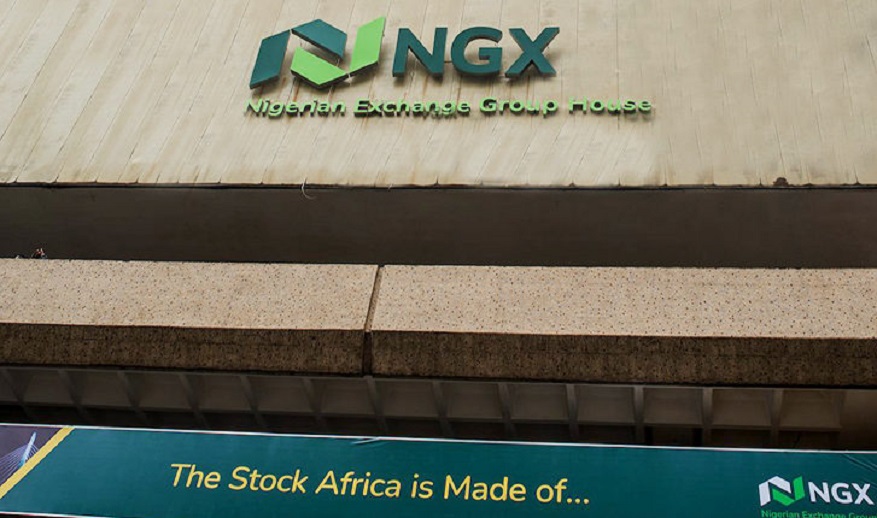
The Nigerian Exchange (NGX) Limited finished strong on Thursday as it appreciated by 1.10 per cent on the back of sustained bargain hunting by investors.

Consequently, the All-Share Index (ASI) went up by 454.40 points to 41,704.11 points from 41,249.71 points, while the market capitalisation rose by N238 billion to N21.764 trillion from N21.526 trillion it finished on Wednesday.

Business Post reports that the activity chart was weak yesterday as a total of 216.2 million shares worth N3.4 billion were traded in 4,272 deals as against the 499.5 million shares worth N5.1 billion transacted in 5,998 deals a day earlier.

This indicated that the volume of shares bought and sold at the session depreciated by 56.72 per cent, the value of the stocks went down by 33.43 per cent and the number of deals fell by 28.78 per cent.

Like in the previous trading day, FBN Holdings was the most traded stock with the sale of 51.9 million units valued at N628.3 million as Ecobank traded 20.0 million units worth N143.7 million.

Transcorp exchanged 14.7 million equities valued at N15.0 million, Access Bank transacted 13.0 million stocks worth N124.2 million, while Fidelity Bank sold 12.5 million shares for N34.2 million.

It was observed that on Thursday, three cross deals were recorded with MTN opening the market with the exchange of about 2 million units of its stocks at N172.00 each, while Airtel Africa witnessed the transfer of over 900,000 units at N770.00 each, with about 100,000 units of Nestle Nigeria’s shares crossed at N1,405.00 each.

A cross deal is the practice of the exchange of stocks between a buyer and a seller through a broker at an agreed price on the exchange.

A total of 23 equities were on the gainers’ chart yesterday with Cutix leading after its value went higher by the maximum rise of 10.00 per cent to settle at N5.50.

NGX Group rose by 9.79 per cent to N23.55, Consolidated Hallmark Insurance grew by 9.09 per cent to 60 kobo, Nigerian Breweries appreciated by 7.41 per cent to N51.45, while BUA Cement gained 6.12 per cent to sell for N72.00.

Conversely, 19 stocks finished on the losers’ log led by the Initiates, which fell by 8.51 per cent to trade at 43 kobo, followed by Neimeth, which lost 4.86 per cent to quote at N1.76.

Furthermore, Universal Insurance depreciated by 4.76 per cent to close at 20 kobo, NAHCO depleted by 3.61 per cent to N3.47, while Unity Bank went down by 3.51 per cent to 55 kobo.

In terms of the performance of the sectors, the energy space was down by 0.36 per cent while the industrial goods, insurance, consumer goods and banking counters appreciated by 2.16 per cent, 1.56 per cent, 1.45 per cent and 0.17 per cent respectively.


Dipo Olowookere is a journalist based in Nigeria that has passion for reporting business news stories. At his leisure time, he watches football and supports 3SC of Ibadan. Mr Olowookere can be reached via [email protected]

2 Comments

Leave a Reply

Your email address will not be published. Required fields are marked *

Economy

Cautious Trading, Profit-taking Weaken Nigeria’s Stock Exchange by 0.66%

Published

on

Nigeria's stock exchange

By Dipo Olowookere

The last trading session of this week on the floor of the Nigerian Exchange (NGX) Limited ended on a negative note, with a 0.66 per cent loss on Friday.

This was influenced by sustained selling pressure and cautious trading, which forced investors into profit-taking.

Data obtained by Business Post showed that the energy sector fell by 4.66 per cent, the insurance counter dipped by 2.23 per cent, the consumer goods index depreciated by 0.96 per cent, and the banking segment shed 0.28 per cent, while the industrial goods space remained unchanged.

At the close of business, the All-Share Index (ASI) of Nigeria’s stock exchange went down by 1,531.81 points to 232,049.02 points from 233,580.83 points, and the market capitalisation dropped N983 billion to settle at N148.905 trillion compared with Thursday’s N149.888 trillion.

Aradel was the worst-performing equity after it lost 10.00 per cent to close at N1,417.50. International Energy Insurance slipped by 9.95 per cent to N5.79, Trans-Nationwide Express depreciated by 9.89 per cent to N3.28, eTranzact crashed by 9.79 per cent to N14.75, and UPDC slumped by 9.72 per cent to N28.12.

The best-performing equity for the day was Universal Insurance, which gained 6.32 per cent to close at N1.01, McNichols grew by 5.52 per cent to N8.60, Linkage Assurance expanded by 4.67 per cent to N1.57, NGX Group appreciated by 4.35 per cent to N120.00, and Transcorp increased by 3.62 per cent to N41.50.

As look at the activity level indicated that investors traded 388.7 million stocks worth N18.4 billion in 44,631 deals compared with the 393.7 million stocks valued at N19.2 billion executed in 45,813 deals a day earlier, representing a decline in the trading volume, value, and number of deals by 1.27 per cent, 4.17 per cent, and 2.58 per cent, respectively.

Continue Reading

Economy

Official FX Market Sees Naira Dip to N1,380.93/$1

Published

on

naira official market

By Adedapo Adesanya

The Naira recorded a loss of 82 Kobo or 0.06 per cent against the United States Dollar in the Nigerian Autonomous Foreign Exchange Market (NAFEX) on Friday, June 26, exchanging at N1,380.93/$1, in contrast to the previous day’s rate of N1,380.11/$1.

Equally, the domestic currency further weakened against the Pound Sterling in the official FX market yesterday by N6.06 to settle at N1,824.90/£1 versus the preceding session’s N1,818.84/£1, and lost N10.74 on the Euro to sell at N1,577 .58/€1 versus N1,566.84/€1.

At the GTBank forex counter, the Naira depreciated against the greenback during the session by N4 to close at N1,387/$1, in contrast to Thursday’s value of N1,383/$1, and at the parallel market, it was unchanged at N1,395/$1.

Interbank FX activity among financial institutions has fluctuated amid a sharp slowdown in forex market interventions by the Central Bank of Nigeria (CBN), as it allows demand and supply to move the market.

Also, a stronger greenback has generally put significant pressure on emerging-market currencies.

Nigeria has accessed the first tranche of a proposed $5 billion derivatives financing arrangement with First Abu Dhabi Bank PJSC, the largest lender in the United Arab Emirates (UAE).

The $5 billion facility, approved by the National Assembly earlier this year, is part of the federal government’s plan to diversify external financing sources and reduce borrowing costs. Structured as a Total Return Swap with First Abu Dhabi Bank, proceeds are earmarked for refinancing debt and supporting infrastructure financing.

If the proceeds are brought into the country through the official FX market, the transaction will increase the currency reserves or Dollar liquidity.

At the cryptocurrency market, Solana (SOL) grew by 2.2 per cent to $71.92, Cardano (ADA) gained 1.1 per cent to trade at $0.1474, Ripple (XRP) also appreciated by 1.1 per cent to $1.05, Dogecoin (DOGE) expanded by 0.9 per cent to $0.0755, and Ethereum (ETH) improved by 0.4 per cent to $1,578.84.

On the flip side, TRON (TRX) slid 0.6 per cent to $0.3203, Binance Coin (BNB) slumped by 0.3 per cent to $564.33, and Bitcoin fell by 0.2 per cent to $60,219.37, while the US Dollar Tether (USDT) and the US Dollar Coin (USDC) traded flat at $1.00 each.

Continue Reading

Economy

Brent Falls Below $72 as Hormuz Shipping Reassures Oil Markets

Published

on

brent crude oil

By Adedapo Adesanya

Crude ​prices fell by more than 3 per cent on Friday as oil tankers kept exiting the ‌Strait of Hormuz, easing supply concerns the day after a cargo vessel was hit near Oman.

Brent crude futures settled at $71.99 a barrel, down $3.27 or 4.34 per cent, while the US West Texas Intermediate (WTI) finished at $69.23 a barrel, down $2.69 or 3.74 per cent. Week-on-week, the Brent benchmark fell 10.86 per cent while the US WTI fell 9.62 per cent.

Prior to ⁠the agreement on a 60-day ceasefire, markets worried supplies would fall short of demand, but those fears seem to be ​passing.

Crude transits through the Strait of Hormuz rose to the highest weekly tally since the onset of the US-Iran conflict this week, with more than 16 million barrels passing through the waterway this Wednesday-Thursday, raising hopes of a full, gradual reopening.

This happened despite Iran firing at a Taiwanese cargo ship, raising fears that Hormuz transit could be choked off again. Iran’s IRG fired several drones at the Taiwan-owned Ever Lovely cargo ship, reportedly attempting to cross the Hormuz through “unauthorised routes,” damaging the vessel’s bridge some 7 miles off the Omani coast on Thursday.

The attack on the ship prompted the United Nations’ shipping agency to pause its voluntary evacuation scheme ⁠to enable ​hundreds of stranded ships and thousands of seafarers to sail out of the Gulf through the strait.

On Friday, Iran reasserted its right to control shipping through the Strait of Hormuz and warned Gulf states against siding ​with the US.

Many ships have been switching on their public automatic identification system (AIS) ​tracking transponders, but some may have gone undetected due in part to major disruption of AIS signals, as well as ships not showing their movements through the strait. ​That makes it difficult to estimate the complete volume of shipments.

Chinese crude oil imports this month are on course to book an even weaker month than May, according to Kpler data, which sees the daily average at just 6.4 million barrels.

According to media reports, Iraq has considered leaving the Organisation of the Petroleum Exporting Countries (OPEC) if the oil group does not allow it to significantly increase its crude production quotas, currently at 4.378 million barrels per day, a claim which the Iraqi Oil Ministry subsequently denied and called ‘premature’.

Continue Reading

Trending