Economy
Nigeria to Auction N150bn FGN Bonds Wednesday
By Dipo Olowookere
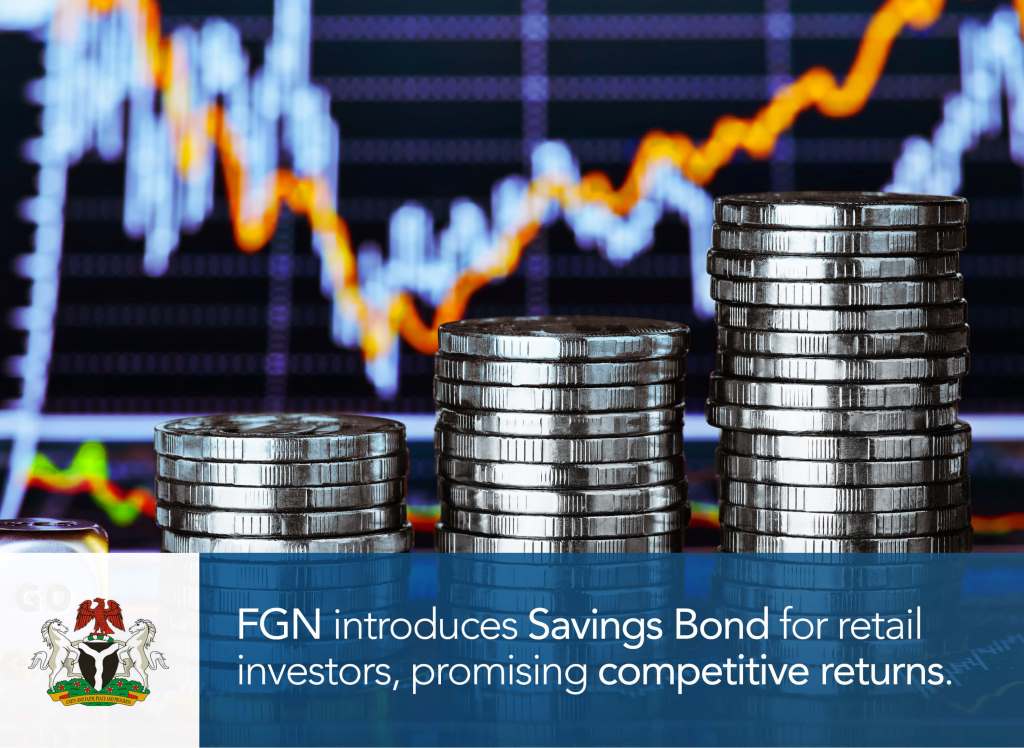
On Wednesday, June 17, 2020, the Nigerian government will auction its bonds worth N150 billion to diverse investors at the local debt market.
The exercise is the monthly FGN bond sale usually conducted and tomorrow, the auction would be carried out by the Central Bank of Nigeria (CBN) for the Debt Management Office (DMO).
The apex bank will be selling N40 billion worth of the 5-year notes maturing in 2023 with a coupon rate of 12.75 percent, N50 billion worth of the 15-year papers maturing in 2035 with a coupon rate of 12.50 percent, and N60 billion worth of the 30-year instruments maturing in 2050 with a coupon rate of 12.98 percent.
Business Post reports that all the tenors are re-opening and the settlement date fixed for Friday, June 19, 2020.
According to the circular released by the DMO, subscribers would be expected to pay N1,000 per unit subject to a minimum subscription of N10,000 and in multiples of N1,000 thereafter.
For the interest rate, especially for the re-openings of previously issued bonds, (where the coupon is already set), successful bidders will pay a price corresponding to the yield-to-maturity bid that clears the volume being auctioned, plus accrued interest from the original issue date.
The debt office further said the interest would be paid semi-annually to holders of the notes, while the full-face value of the papers acquired by investors would be paid on the maturity date.
The FGN bonds qualify as securities in which trustees can invest under the Trustee Investment Act. They also qualify as government securities within the meaning of Company Income Tax Act (CITA) and Personal Income Tax Act (PITA) for Tax Exemption for Pension Funds amongst other investors.
After issuance, the papers will be listed on the trading platform of the Nigerian Stock Exchange (NSE), while all FGN Bonds qualify as liquid assets for liquidity ratio calculation for banks.
The FGN Bonds are backed by the full faith and credit of the Federal Government of Nigeria and are charged upon the general assets of Nigeria.
According to the DMO, interested investors should get in touch with the underlisted primary dealer market makers;
Access Bank Plc, First Bank of Nigeria Ltd, Standard Chartered Bank Nigeria Ltd, Citibank Nigeria Ltd, First City Monument Bank Plc, United Bank for Africa Plc, Coronation Merchant Bank Ltd, FSDH Merchant Bank Ltd, Zenith Bank Plc, Ecobank Nigeria Ltd, Guaranty Trust Bank Plc, FBNQuest Merchant Bank Ltd and Stanbic IBTC Bank Plc.
Economy
Cadbury Nigeria, Others Shrink Equity Market by 1.41%
By Dipo Olowookere
The refusal of the bears to give the bulls a chance further depleted the Nigerian Exchange (NGX) Limited by 1.41 per cent on Thursday.
Persistent selling pressure left the equity market depressed at the close of business yesterday, with profit-taking still witnessed in the financial services sector.
The All-Share Index (ASI) decreased by 3,397.80 points to 237,404.92 points from 240,802.72 points, and the market capitalisation shrank by N2.179 trillion to N152.266 trillion from N154.445 trillion.
Africa Prudential dropped 10.00 per cent to trade at N11.70, Cadbury Nigeria lost 10.00 per cent to finish at N62.10, Tripple Gee crashed by 10.00 per cent to N3.60, John Holt depreciated by 9.93 per cent to N12.25, and McNichols stumbled by 9.33 per cent to N6.80.
On the other side, Legend Internet grew by 9.52 per cent to N5.75, NPF Microfinance Bank gained 9.18 per cent to settle at N5.35, Transcorp advanced by 7.32 per cent to N44.00, Neimeth improved by 7.03 per cent to N9.90, and DAAR Communications added 5.29 per cent to trade at N1.79.
Analysis of the price movement log indicated that the mood remained bearish, as Customs Street ended with 15 price gainers and 39 price losers, representing a negative market breadth index.
The activity level went up yesterday after investors bought and sold 691.6 million stocks worth N116.9 billion in 50,025 deals, in contrast to the 663.0 million stocks valued at N40.0 billion transacted in 51,143 deals on Wednesday. This showed that the trading volume increased by 4.31 per cent, the trading value surged by 192.25 per cent, and the number of deals decreased by 2.19 per cent.
First Holdco was the busiest equity during the trading day, with a turnover of 115.8 million units valued at N7.1 billion. Access Holdings traded 109.7 million units for N2.5 billion, Dangote Cement exchanged 71.5 million units for N83.4 billion, Japaul transacted 26.0 million units worth N83.6 million, and FCMB sold 25.9 million units valued at N285.9 million.
Economy
Brent Nears $80 on Fresh Doubt About US-Iran Ceasefire
By Adedapo Adesanya
Oil prices rose on Thursday after American Vice President JD Vance warned Israel against further attacks on Iran-backed Hezbollah in Lebanon, raising doubts about the durability of the US-Iran ceasefire agreement.
Brent crude futures settled at $79.85 a barrel after chalking up 30 cents or 0.38 per cent, while the US West Texas Intermediate (WTI) crude futures gained 19 cents or 0.25 per cent to finish at $76.60 a barrel.
US Vice President JD Vance on Thursday issued an extraordinary rebuke to Israeli critics of the Iran deal, warning them not to alienate their “only powerful ally” left in the world.
The deal gives negotiators 60 days to reach an agreement on the status of Iran’s nuclear programme and set up a $300 billion reconstruction fund for Iran and other financial incentives.
Mr Vance told members of Israeli Prime Minister Benjamin Netanyahu’s cabinet to “wake up and smell the reality,” amid growing tensions between Netanyahu and US President Donald Trump.
Market analysts noted that the statements about Israel may have put things back on edge, as the two countries jointly launched the war on Iran on February 28.
Ultimately, oil markets will be focused on what happens in the Strait of Hormuz, through which 20 per cent of the world’s oil flowed before the start of the war.
Analysts expect a gradual recovery in flows through the Strait of Hormuz, while industry experts have cautioned that prices may not plummet as demand recovers and inventories are refilled.
Investment bank Goldman Sachs expects Gulf exports to normalise to pre-war levels by the end of July, with crude production recovering by October. The bank estimates that a normalisation in exports to pre-war levels might be achieved with a 13 million barrel-per-day increase in Hormuz flows from current levels to around 70 per cent of pre-war levels.
Markets will be watching closely in the coming week to see exactly how much oil begins to flow, especially Iranian oil, which will no longer be sanctioned thanks to the latest ceasefire agreement.
China, the world’s second-largest oil consumer, is forecast to consume 753 million metric tons of petrol in 2026, down 4.9 per cent from 2025 amid a pivot to new energy and high oil prices.
Economy
FG Releases Transition Guidelines for Tax Acts 2025
By Modupe Gbadeyanka
The transition guidelines on the Tax Acts 2025 to provide direction to taxpayers, tax practitioners, revenue authorities and other stakeholders on how to address various issues arising from the old regime to the new framework have been released by the federal government.
The framework was issued on Thursday via a statement signed by the Director of Press Relations in the Federal Ministry of Finance, Efe Ovuakporie.
The guidelines set out the process for transition from the repealed tax laws to the new tax framework effective January 1, 2026.
Under the guidelines, the Tax Acts 2025, comprising the Nigeria Revenue Service (Establishment) Act, the Nigeria Tax Act, the Nigeria Tax Administration Act, and the Joint Revenue Board (Establishment) Act, apply from the respective commencement dates as enacted in each law. In particular, January 1, 2026, for the Nigeria Tax Act, 2025.
Tax liabilities, assessments, audits, investigations, disputes and enforcement actions relating to periods before that date will be treated under the repealed tax laws, the notice stated.
Tax returns relating to accounting periods ending before January 1, 2026, will be filed under the previous tax laws, while returns relating to accounting periods ending from January 1, 2026, onward will be administered under the new tax framework.
The document also covers the treatment of income taxes, transaction taxes, development levies, tax incentives, exemptions, record-keeping obligations and transactions that span both the old and new tax regimes.
Existing tax incentives and exemptions granted under the repealed laws will remain in place until their expiration dates. New applications and pending requests, however, will be considered under the provisions of the Tax Acts 2025.
The Minister of Finance and Coordinating Minister of the Economy, Mr Taiwo Oyedele, described the Tax Acts 2025 as a significant milestone in Nigeria’s tax reform programme, noting that the Guidelines set out how existing obligations, ongoing matters and future transactions will be treated under the new regime.
According to the Minister, the guidelines are anchored on three key principles – clarity, fairness and administrative certainty, adding that they are intended to promote uniform implementation and support effective administration across the Nigeria Revenue Service, State Internal Revenue Services, the FCT Internal Revenue Service, Local Government Revenue Committees, tax practitioners and taxpayers nationwide.
-
Feature/OPED6 years agoDavos was Different this year
-
Travel/Tourism10 years ago
Lagos Seals Western Lodge Hotel In Ikorodu
-
Showbiz3 years agoEstranged Lover Releases Videos of Empress Njamah Bathing
-
Banking8 years agoSort Codes of GTBank Branches in Nigeria
-
Economy3 years agoSubsidy Removal: CNG at N130 Per Litre Cheaper Than Petrol—IPMAN
-
Banking3 years agoSort Codes of UBA Branches in Nigeria
-
Banking3 years agoFirst Bank Announces Planned Downtime
-
Sports3 years agoHighest Paid Nigerian Footballer – How Much Do Nigerian Footballers Earn