Connect with us

Economy

Nigerian Exchange Begins Week With 0.79% Growth

Published

on

Nigerian Exchange 1

By Dipo Olowookere

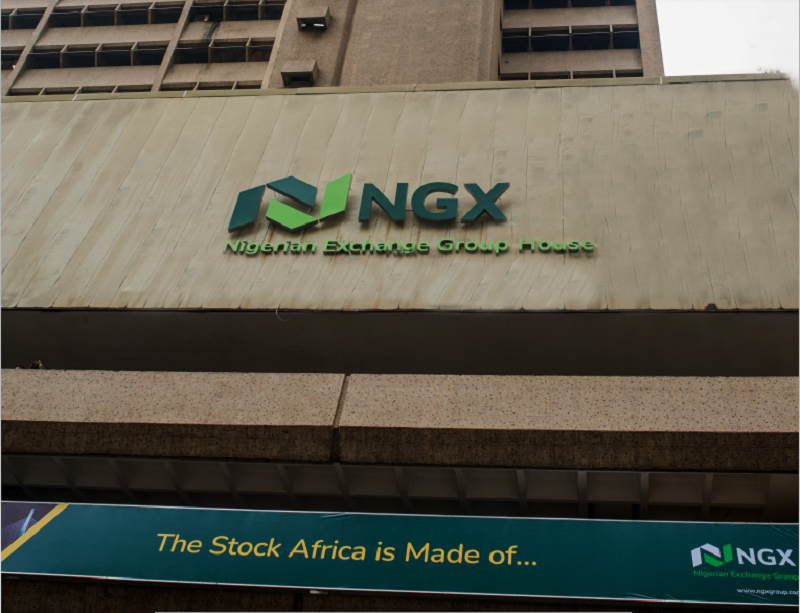
A 0.79 per cent rise was recorded by the Nigerian Exchange (NGX) Limited on Monday as a result of bargain-hunting activities by investors, raising the year-to-date return to 1.45 per cent.

Buying activities in the banking and consumer goods sectors helped the bourse close bullish yesterday as their respectively indices closed higher by 4.71 per cent and 1.74 per cent.

However, the insurance, energy and industrial goods counters depreciated by 0.95 per cent, 0.89 per cent and 0.03 per cent, respectively due to selling pressure.

However, they could not affect the outcome of the stock exchange because the All-Share Index (ASI) increased by 820.49 points to 104,418.95 points from 103,598.46 points and the market capitalisation grew by N795 billion or 1.25 per cent to N64.440 trillion from N63.645 trillion.

Investor sentiment was strong on the first trading day of the week after Customs Street ended with 38 price gainers and 30 price losers, representing a positive market breadth index.

Beta Glass appreciated by 9.98 per cent to N65.00, RT Briscoe jumped by 9.92 per cent to N2.77, Access Holdings improved by 9.88 per cent to N27.80, Chellaram surged by 9.83 per cent to N4.47, and SAHCO gained 9.80 per cent to N36.40.

On the flip side, MRS Oil depleted by 10.00 per cent to N180.90, Transcorp Hotels lost 9.97 per cent to trade at N114.65, Eunisell fell by 9.64 per cent to N11.40, John Holt declined by 9.64 per cent to N7.50, and Caverton crashed by 9.40 per cent to N2.12.

A total of 518.3 million shares worth N13.3 billion exchanged hands in 17,196 deals on Monday versus the 576.4 million shares valued at N9.0 billion transacted in 11,546 deals last Friday, indicating a fall in the trading volume by 10.08 per cent and an improvement in the trading value and number of deals by 47.78 per cent and 48.93 per cent, respectively.

Access Holdings traded 51.1 million equities valued at N1.4 billion, FCMB exchanged 40.3 million stocks worth N471.5 million, Sterling Holdings transacted 38.9 million shares for N232.7 million, Zenith Bank sold 33.2 million shares worth N1.7 billion, and UBA traded 29.4 million equities valued at N1.1 billion.


Dipo Olowookere is a journalist based in Nigeria that has passion for reporting business news stories. At his leisure time, he watches football and supports 3SC of Ibadan. Mr Olowookere can be reached via [email protected]

Click to comment

Leave a Reply

Your email address will not be published. Required fields are marked *

Economy

Profit-taking Crashes NGX All-Share Index by 0.73%

Published

on

NGX All-Share Index

By Dipo Olowookere

The Nigerian Exchange (NGX) Limited tumbled by 0.73 per cent on Tuesday on the back of profit-taking by investors.

The consumer goods counter shed 0.96 per cent, and the banking space crashed by 0.46 per cent due to selling pressure. But the insurance index gained 0.24 per cent, and the energy segment improved by 0.03 per cent, while the industrial goods sector closed flat.

When the bourse closed for the session, the All-Share Index (ASI) gave up 1,806.18 points to 246,723.57 points from 248,529.75 points, and the market capitalisation depreciated by N1.166 trillion to N159.256 trillion from N160.422 trillion.

Thomas Wyatt lost 9.97 per cent to quote at N2.89, AVA Capital declined by 9.60 per cent to N8.95, International Energy Insurance dipped by 6.32 per cent to N4.00, International Breweries dropped 5.98 per cent to close at N11.00, and Guinea Insurance shed 5.13 per cent to 74 Kobo.

On the flip side, UPDC REIT gained 10.00 per cent to end at N14.85, FTN Cocoa appreciated by 9.88 per cent to N8.90, C&I Leasing surged by 8.26 per cent to N5.90, Sovereign Trust Insurance went up by 6.74 per cent to N1.90, and Regency Alliance climbed 6.33 per cent to 84 Kobo.

Yesterday, Fortis Global Insurance was the busiest equity, leading the activity chart with a turnover of 3.3 billion units worth N9.6 billion. Trans-Nationwide Express transacted 84.6 million units for N181.9 million, Access Holdings sold 66.1 million units valued at N1.9 billion, Consolidated Hallmark exchanged 54.3 million units worth N379.4 million, and Fidelity Bank traded 46.9 million units for N1.0 billion.

Investors bought and sold 3.9 billion units worth N32.4 billion in 45,608 deals compared with the 1.1 billion units valued at N27.0 billion traded in 59,185 deals a day earlier. This indicated that the number of deals retreated by 22.94 per cent, the trading volume increased by 254.55 per cent, and the trading value soared by 20.00 per cent.

Continue Reading

Economy

Naira Weakens to N1,364/$1 at NAFEX

Published

on

funds in Naira accounts

By Adedapo Adesanya

The Naira weakened against the United States Dollar by N4.75 or 0.35 per cent to N1,364.89/$1 from N1,360.14/$1 in the Nigerian Autonomous Foreign Exchange Market (NAFEX) on Tuesday, August 11.

In the same vein, the domestic currency slumped against the Pound Sterling in the official market during the session by N4.11 to trade at N1,842.61 compared with the previous day’s N1,838.50/£1, and against the Euro, it lost N4.41 to sell at N1,575.50/€1 versus Monday’s N1,571.09/€1.

But it was a different scenario at the GTBank FX desk, where the Naira gained N4 against the US Dollar yesterday to close at N1,367/$1, in contrast to the previous day’s N1,371/$1, and appreciated by N5 in the parallel market to quote at N1,395/$1 compared with the preceding session’s N1,400/$1.

Interbank FX turnover, according to data from the Central Bank of Nigeria (CBN), fell sharply by 86 per cent to $29.1 million, down more than 86 per cent from $213.9 million a day earlier, with the number of settled interbank deals down to 47 from 182.

The decline in Dollar trading was attributed to weaker bank bids from customers seeking foreign exchange payments, while tight market liquidity continued to weigh on the Naira.

Nigeria’s gross external reserves rose by $83.81 million to $52.14 billion.

Meanwhile, the cryptocurrency market rebounded, with Dogecoin (DOGE) going up by 2.8 per cent to $0.0721 and taking its weekly gain to over 3 per cent, while Bitcoin (BTC) slipped by 0.3 per cent to $63,769.69.

Investors are focused on Thursday’s US Consumer Price Index (CPI) report and Middle East tensions, as lower inflation and a potential Fed pivot could fuel a relief rally in risk assets even as rising oil prices threaten to push inflation higher.

Binance Coin (BNB) grew by 2.2 per cent to $612.49, TRON (TRX) rose by 1.1 per cent to $0.3350, Ripple (XRP) increased by 0.9 per cent to $1.02, Ethereum (ETH) advanced by 0.8 per cent to $1,889.60, and Solana (SOL) jumped by 0.5 per cent to $76.24, while Cardano (ADA) lost 0.6 per cent to end at $0.1867, with the US Dollar Tether (USDT) and the US Dollar Coin (USDC) flat at $1.00 apiece.

Continue Reading

Economy

Oil Climbs 1% as US-Iran Deal Hopes Fade, Hormuz Closure Persists

Published

on

OPEC Global Oil Demand

By Adedapo Adesanya

Oil was up by 1 per cent on Tuesday as doubts about a potential United States-Iran peace deal fueled concerns that Middle East supply disruptions would persist.

As a result, Brent futures rose by $1.19 or 1.4 per cent ‌to $88.91 a barrel, while the US West Texas Intermediate (WTI) futures expanded by $1.07 or 1.3 per cent to $83.20 per barrel.

Both contracts had jumped about 5 per cent on Monday as hopes for a peace deal between the US and Iran started to fade.

It looked worse on Tuesday when Iran said the Strait of Hormuz will remain closed unless the US ends the war and meets Iran’s conditions, raising the bar for a deal that would restore more oil traffic through the key waterway. About 20 per cent of global oil supply passed through the strait before the start of ⁠the Iran war on February 28.

Mr Mohsen Rezaei, secretary of Iran’s Supreme National Security Council, said it has also delivered additional conditions to the US through mediators.

US officials had suggested last week that negotiations involving Iran and Oman were making progress toward allowing more vessels through Hormuz.

Shipping traffic through the Strait of Hormuz fell sharply on Monday as tensions continued to disrupt maritime activity across the Middle East.

Shipping data showed that only six vessels passed through the strategic waterway on Monday, below the 10-day average of about 11 vessels. Before the conflict, daily traffic through the strait averaged between 125 and 140 vessels.

The disruption comes amid heightened security concerns across key regional shipping routes.

In the Bab el-Mandeb, Yemen’s Iran-aligned Houthis attacked a Saudi vessel carrying military equipment, according to the Houthi-run Saba news agency.

Separately, Reuters reported a missile attack on a container ship off Pakistan in what was suspected to be a US strike, further underscoring the security risks facing commercial shipping in the region.

The disruption to regional maritime traffic has also raised concerns about the recovery of oil production in the Middle East.

The US Energy Information Administration (EIA) said on Tuesday that some oil producers in the region could struggle to restore output to pre-conflict levels by the end of 2027, even if shipping and trade patterns return to normal by early next year.

The outlook highlights the potential for prolonged disruptions to global oil supplies despite a possible normalisation of trade flows in the coming months.

In Libya, a member of the Organisation of the Petroleum Exporting Countries (OPEC), renewed violence in the strategic city of Zawiya has disrupted the oil industry, with state oil firm the National Oil Corporation saying it could declare force majeure if drone attacks on energy assets in the city continued.

In Europe, the Ukrainian military said ⁠on Tuesday it attacked an oil refinery in the Russian city of Orsk, the second-largest city in the Orenburg region and an important industrial hub.

The combination of Ukraine’s attacks on Russian energy infrastructure and the Iran war has limited global supplies and ​boosted global energy prices.

Continue Reading