
Economy
Nigerian Exchange Opens New Week 0.25% Weaker

By Dipo Olowookere
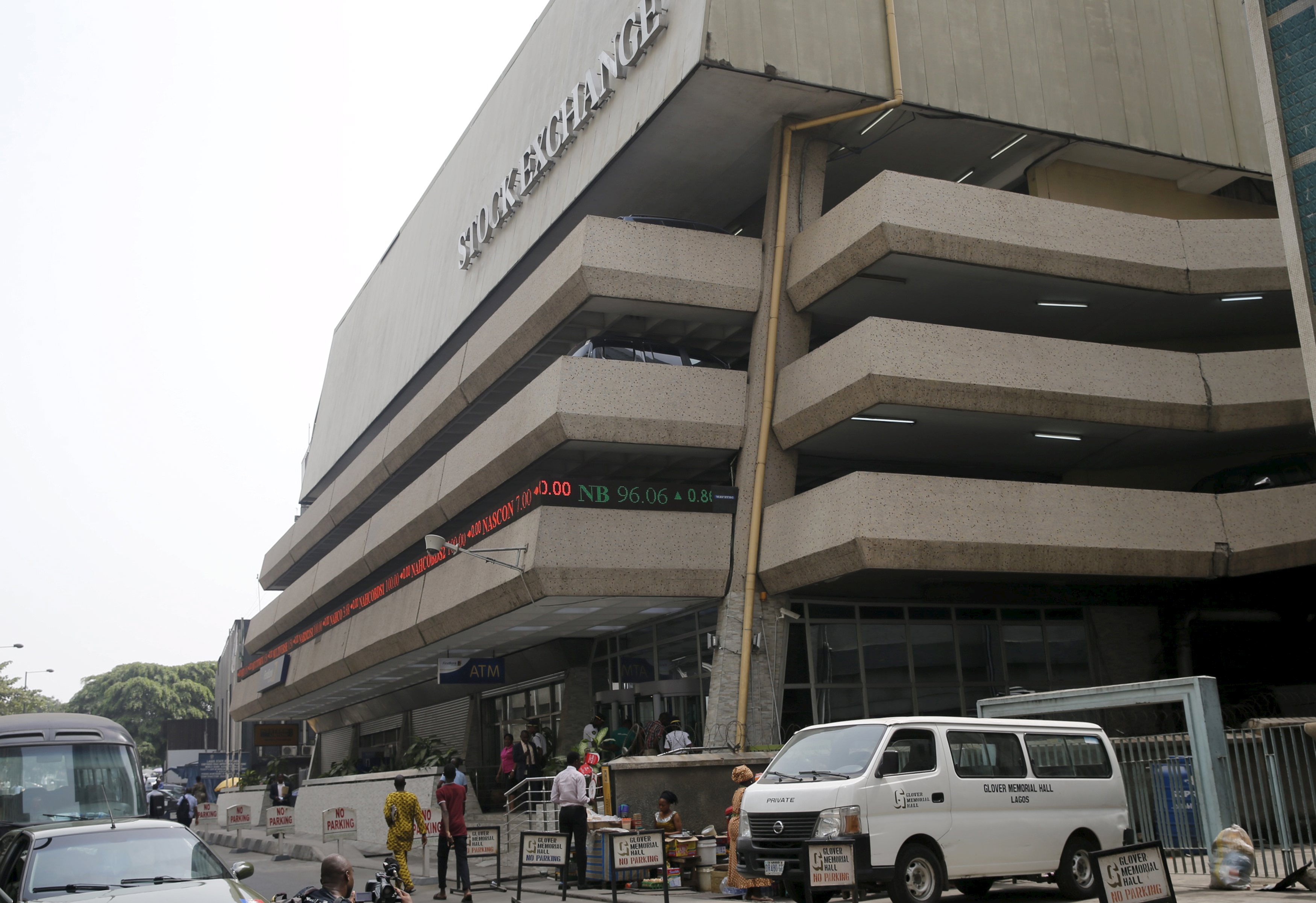
The first trading session of this week on the floor of the Nigerian Exchange (NGX) Limited ended on a negative note on Monday after a 0.25 per cent loss.
This was due to heavy profit-taking in most of the key sectors of the bourse during the trading day, as the 0.49 per cent growth printed by the consumer goods space could not salvage the situation.
Data obtained by Business Post from Customs Street indicated that the energy index was down by 3.94 per cent, the commodity space shrank by 1.85 per cent, the industrial goods counter weakened by 1.48 per cent, and the banking industry slumped by 0.22 per cent, while the industrial goods sector closed flat.
At the close of business, the 387.34 points to 153,739.11 points from 154,126.45 points and the market capitalisation contracted by N246 billion to N97.583 trillion from the N97.829 trillion it ended last Friday.
Honeywell Flour was the worst-performing equity for the day after it lost 10.00 per cent to sell for N18.00, Northern Nigeria Flour Mills depreciated by 9.98 per cent to N84.30, Aradel Holdings gave up 9.21 per cent to close at N710.00, Japaul declined by 7.95 per cent to N2.20, and Ikeja Hotel slipped by 7.71 per cent to N17.35.
The best-performing equity was Union Dicon, which gained 9.93 per cent to finish at N7.75, Omatek appreciated by 9.92 per cent to N1.33, NAHCO expanded by 7.62 per cent to N113.00, International Breweries jumped 6.35 per cent to N13.40, and Champion Breweries rose by 6.33 per cent to N15.95.
It was observed that 38 shares ended on the losers’ table yesterday and 19 shares finished on the gainers’ chart, showing a negative market breadth index and bearish sentiment.
The busiest stock for the session was UBA with 136.8 million units sold for N5.5 billion, Aso Savings traded 109.0 million units valued at N120.4 million, Access Holdings exchanged 68.2 million units worth N1.6 billion, GTCO transacted 49.8 million units for N4.6 billion, and Zenith Bank sold 31.8 million units valued at N2.0 billion.
In all, investors bought and sold 627.5 million shares worth N25.0 billion in 36,425 deals compared with the 5.2 billion shares valued at N45.2 billion transacted in 30,598 deals, representing a decline in the trading volume and value by 87.93 per cent, 44.69 per cent, respectively, and a rise in the number of deals by 19.04 per cent.







By Dipo Olowookere
The Nigerian Exchange (NGX) Limited began the new week bearish after it shed 0.21 per cent on Monday due to profit-taking.
Business Post reports that four of the five key sectors of Customs Street tracked pointed southwards yesterday, as only the energy index gained 0.10 per cent.
The insurance counter lost 1.38 per cent, the banking space depreciated by 0.81 per cent, the industrial goods sector weakened by 0.45 per cent, and the consumer goods segment declined by 0.02 per cent.
As a result, the All-Share Index (ASI) retreated by 428.63 points to 200,484.43 points from 200,913.06 points, and the market capitalisation moderated by N275 billion to N128.694 trillion from N128.969 trillion.
The market breadth index was negative during the session, as there were 27 price gainers and 34 price losers, representing weak investor sentiment.
Secure Electronic Technology depreciated by 10.00 per cent to N1.17, May and Baker slumped by 9.42 per cent to N38.00, Legend Internet tumbled by 8.67 per cent to N6.85, Cutix shrank by 8.29 per cent to N3.21, and Fortis Global Insurance lost 7.97 per cent to trade at N1.27.
On the flip side, Austin Laz appreciated by 9.98 per cent to N4.41, Zichis gained 9.93 per cent to quote at N15.16, Trans Nationwide Express soared by 9.65 per cent to N2.84, The Initiates advanced by 9.60 per cent to N21.70, and Learn Africa improved by 9.41 per cent to N9.30.
The bourse closed with a turnover of 593.3 million shares valued at N25.7 billion executed in 60,311 deals compared with the 595.2 million shares worth N24.5 billion traded in 43,440 deals in the previous trading day.
This showed that the value of transactions went up by 4.90 per cent, the number of deals increased by 38.84 per cent, and the volume of trades decreased by 0.32 per cent.
Access Holdings finished the session as the most active with 86.6 million units sold for N2.3 billion, First Holdco exchanged 84.6 million units worth N4.3 billion, Secure Electronic Technology traded 31.1 million units valued at N37.4 million, Fidelity Bank transacted 26.7 million units worth N512.4 million, and Zenith Bank traded 26.1 million units valued at N2.6 billion.

By Adedapo Adesanya
The first trading session for the Naira in the Nigerian Autonomous Foreign Exchange Market (NAFEX) ended on a negative note, as it lost N3.00 or 0.22 per cent against the Dollar on Monday, March 30, to trade at N1,383.58/$1 compared with last Friday’s closing price of N1,380.58/$1.
The local currency remains under pressure as increased demand for forex for international settlements and import-related obligations continue t0 strain available FX supply.
Last week, the Central Bank of Nigeria (CBN) shed the policy requiring International Oil Companies (IOCs) to keep half of their export proceeds in Nigeria and allowed them to fully access their funds. Market analysts noted that this could reduce the dollar supply, putting pressure on the nation’s legal tender whenever outflows exceed inflows.
The country’s external reserves recorded a marginal decline, falling by 0.7 per cent to $49.48 billion, reflecting a depletion of about $350 million and signalling continued pressure on Nigeria’s FX buffer.
However, the Nigerian currency further appreciated against the Pound Sterling in the official market during the session by N12.05 to N1,824.94/£1 from N1,836.99/£1, and gained N5.80 against the Euro to sell at N1,586.28/€1 versus N1,592.08/€1.
Equally, at the GTBank forex desk, the Naira improved its value against the greenback yesterday by N7 to N1,394/$1 from N1,401/$1, and remained unchanged at the parallel market at N1,410/$1.
As for the cryptocurrency market, it was mixed even as Federal Reserve Chairman Jerome Powell eased any concerns about imminent rate hikes.
The central banker said the lender is inclined to look past the Iran-related energy shock for now and hold rates steady, adding that the US central bank — for the moment — is looking past short-term oil price shocks and focusing on inflation expectations that remain “well anchored.” As a result, bond yields fell, but oil continued its rise, ultimately pressuring the stock market and crypto.
Solana (SOL) gained 1.1 per cent to sell at $82.68, Ethereum (ETH) appreciated by 1.0 per cent to $2,021.66, Cardano (ADA) grew by 1.0 per cent to $0.2431, Ripple (XRP) jumped 0.2 per cent to $1.32, and Bitcoin (BTC) added 0.1 per cent to settle at $66,568.25.
However, TRON (TRX) dipped 1.0 per cent to $0.3199, Dogecoin (DOGE) went down by 0.2 per cent to $0.0909, and Binance Coin (BNB) dropped 0.1 per cent to $609.25, while the US Dollar Tether (USDT) and the US Dollar Coin (USDC) closed flat at $1.00 each.


By Modupe Gbadeyanka
The deadline for filing income tax returns for the 2025 fiscal year has been extended by the Lagos State Internal Revenue Service (LIRS) by two weeks.
The Head of Corporate Communications for LIRS, Mrs Monsurat Amasa-Oyelude, in a statement on Monday, said the new deadline is April 14, 2026, and no longer March 31, 2026.
The tax filing is for individuals living in the metropolis, and they have been charged to give priority to the timely filing of their annual income tax returns, noting that compliance should be embedded as a routine personal practice.
The chairman of LIRS, Mr Ayodele Subair, explained that the statutory deadline for filing individual annual tax returns is March 31 every year, adding that the extension is intended to provide individuals with additional time to complete and submit accurate tax returns.
He also reiterated that electronic filing through the LIRS eTax platform remains the only approved method for submitting annual returns, as manual filings have been completely phased out. Individuals are therefore required to file their returns exclusively through the LIRS eTax portal: https://etax.lirs.net.
Describing the platform as secure, user-friendly, and accessible 24/7, Mr Subair advised individuals to ensure that their TaxID (Tax Identification Number) is correctly captured in their submissions.









-
 Feature/OPED6 years ago
Davos was Different this year
-
Travel/Tourism10 years ago
Lagos Seals Western Lodge Hotel In Ikorodu
-

 Showbiz3 years ago
Estranged Lover Releases Videos of Empress Njamah Bathing
-
 Banking8 years ago
Sort Codes of GTBank Branches in Nigeria
-

 Economy3 years ago
Subsidy Removal: CNG at N130 Per Litre Cheaper Than Petrol—IPMAN
-

 Banking3 years ago
Sort Codes of UBA Branches in Nigeria
-

 Banking3 years ago
First Bank Announces Planned Downtime
-

 Sports3 years ago
Highest Paid Nigerian Footballer – How Much Do Nigerian Footballers Earn