Connect with us

Economy

Nigerian Exchange Opens New Week 0.25% Weaker

Published

on

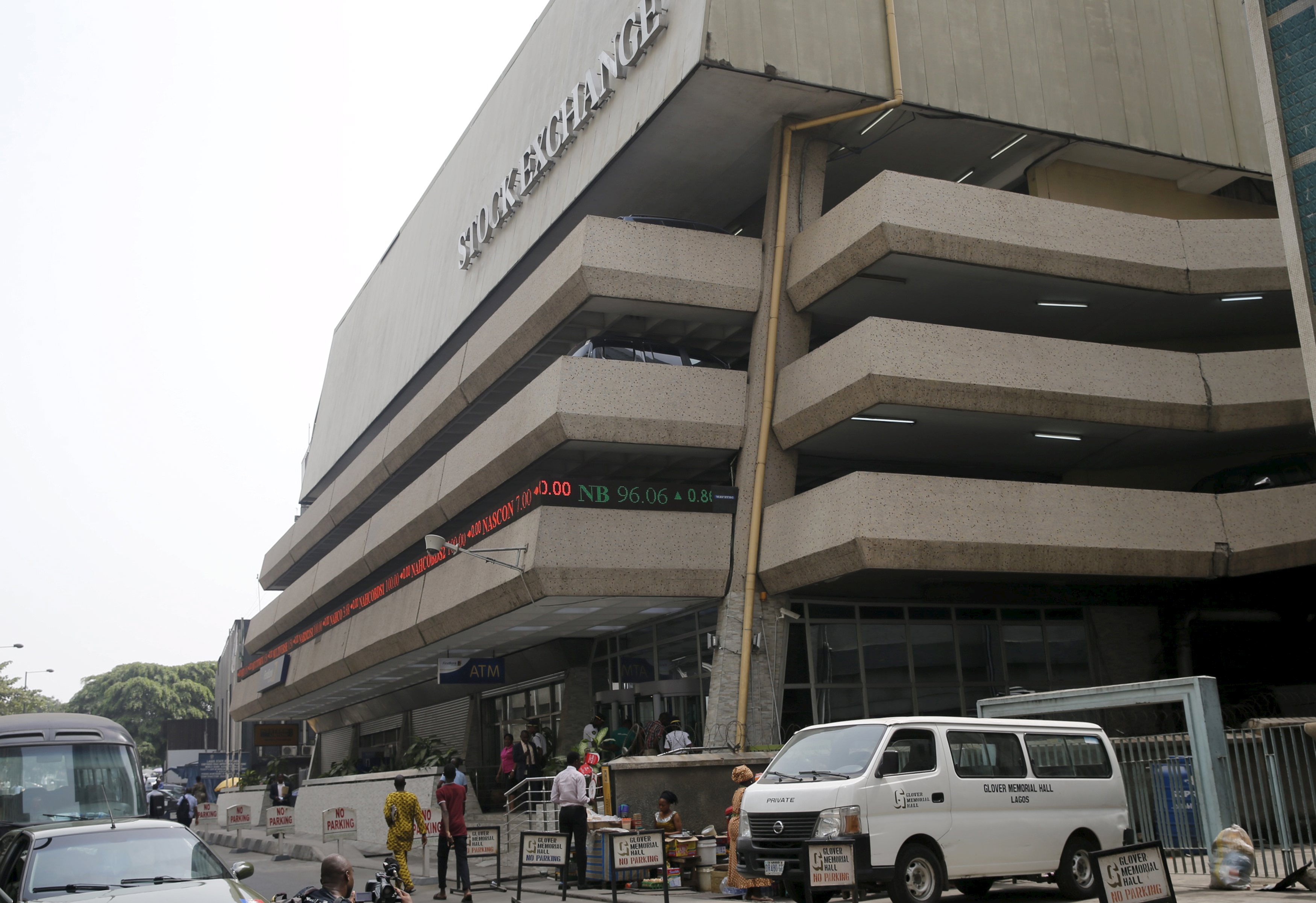
Customs Street Nigerian Stock Exchange

By Dipo Olowookere

The first trading session of this week on the floor of the Nigerian Exchange (NGX) Limited ended on a negative note on Monday after a 0.25 per cent loss.

This was due to heavy profit-taking in most of the key sectors of the bourse during the trading day, as the 0.49 per cent growth printed by the consumer goods space could not salvage the situation.

Data obtained by Business Post from Customs Street indicated that the energy index was down by 3.94 per cent, the commodity space shrank by 1.85 per cent, the industrial goods counter weakened by 1.48 per cent, and the banking industry slumped by 0.22 per cent, while the industrial goods sector closed flat.

At the close of business, the 387.34 points to 153,739.11 points from 154,126.45 points and the market capitalisation contracted by N246 billion to N97.583 trillion from the N97.829 trillion it ended last Friday.

Honeywell Flour was the worst-performing equity for the day after it lost 10.00 per cent to sell for N18.00, Northern Nigeria Flour Mills depreciated by 9.98 per cent to N84.30, Aradel Holdings gave up 9.21 per cent to close at N710.00, Japaul declined by 7.95 per cent to N2.20, and Ikeja Hotel slipped by 7.71 per cent to N17.35.

The best-performing equity was Union Dicon, which gained 9.93 per cent to finish at N7.75, Omatek appreciated by 9.92 per cent to N1.33, NAHCO expanded by 7.62 per cent to N113.00, International Breweries jumped 6.35 per cent to N13.40, and Champion Breweries rose by 6.33 per cent to N15.95.

It was observed that 38 shares ended on the losers’ table yesterday and 19 shares finished on the gainers’ chart, showing a negative market breadth index and bearish sentiment.

The busiest stock for the session was UBA with 136.8 million units sold for N5.5 billion, Aso Savings traded 109.0 million units valued at N120.4 million, Access Holdings exchanged 68.2 million units worth N1.6 billion, GTCO transacted 49.8 million units for N4.6 billion, and Zenith Bank sold 31.8 million units valued at N2.0 billion.

In all, investors bought and sold 627.5 million shares worth N25.0 billion in 36,425 deals compared with the 5.2 billion shares valued at N45.2 billion transacted in 30,598 deals, representing a decline in the trading volume and value by 87.93 per cent, 44.69 per cent, respectively, and a rise in the number of deals by 19.04 per cent.


Dipo Olowookere is a journalist based in Nigeria that has passion for reporting business news stories. At his leisure time, he watches football and supports 3SC of Ibadan. Mr Olowookere can be reached via [email protected]

Economy

OPEC Cuts 2026 Global Oil Demand Forecast Over Iran War

Published

on

opec oil output

By Adedapo Adesanya

The Organisation of the Petroleum Exporting Countries (OPEC) on Wednesday lowered its forecast for global oil demand growth in 2026 due to the Iran war.

According to the cartel, world oil demand will rise by 1.17 ​million barrels per day in 2026, down from the previous 1.38 million barrels per day.

OPEC said consumption would rebound later and raised its demand growth forecast ​for 2027. For next year, it expects oil demand to rise by 1.54 million barrels per day, up 200,000 barrels per day ‌from the ⁠previous forecast.

OPEC joins other forecasters, such as the International Energy Agency (IEA), in cutting expectations due to the war that started in February.

The ​producer group sees a smaller hit to demand than the IEA, which earlier ​on Wednesday increased its estimate of the decline in oil use ⁠this year.

The ​IEA sees demand falling by ⁠420,000 barrels per day this year, compared with a previous forecast of an 80,000 barrels per day drop. Overall, global oil supply will fall by around 3.9 million barrels per day across 2026 due to the war, slashing its previous forecast, which had projected a 1.5 ​million barrels per day drop.

The war has effectively closed the Strait of Hormuz, a key global oil route, ​curbing millions of barrels of Middle East output and sending fuel prices soaring. The surge is hitting consumers and businesses, and prompting government steps to conserve supplies.

“The global economic growth continues to show resilience for this year despite geopolitical tensions, particularly in the Middle East,” OPEC said, leaving its economic growth forecasts unchanged.

Global oil demand is expected to average 104.57 million barrels per day in the second quarter, down from the 105.07 ​million barrels per day forecast last ​month, OPEC said. ⁠The previous report had already cut the second-quarter estimate by 500,000 barrels per day.

The wider OPEC+, which groups the OPEC ​and allies such as Russia, had agreed to resume output increases ​from April, ⁠but the closure of Hormuz has made it impossible to deliver on the deal. The report said output fell further in April.

OPEC+ crude output averaged 33.19 million barrels per day in April, ⁠down ​1.74 million barrels per day from March, the report said, citing ​secondary sources OPEC uses to monitor its production.

The April figure includes the United Arab Emirates (UAE), which left OPEC ​on May 1.

Continue Reading

Economy

We Will Continue to Borrow Responsibly—Tinubu

Published

on

tinubu in kenya

By Adedapo Adesanya

President Bola Tinubu has said that Nigeria would continue to borrow responsibly amid rising concerns about the country’s swelling debt profile.

According to a statement by presidential spokesperson, Mr Bayo Onanuga, President Tinubu made the remarks on Tuesday while leading Nigeria’s government, diplomatic, and business delegation to the Africa Forward Summit at the Kenyatta Convention Centre in Nairobi.

Mr Tinubu noted that the debt to be repaid in the year is nearly half of the projected revenue, at about $11.6 billion.

“Every single dollar that leaves our treasury to pay punitive interest rates is a Dollar that did not go into our steel sector, our textile mills, our agro-processing plants, or our digital industries. It is a dollar that did not train a young Nigerian engineer or provide affordable power for our factories.

“Our industrial base is being starved of the blood it needs — long-term, affordable finance — while creditors and rating agencies treat African sovereigns as permanent high-risk borrowers, regardless of our fiscal performance.

“So, I ask this gathering: how can an African manufacturer compete with a competitor in Europe, Asia, or North America when the cost of borrowing in our nations is five to ten times higher? How can we build cross-border industrial value chains under the African Continental Free Trade Area when our infrastructure projects face a financing gap deepened by the very institutions meant to bridge it? The answer is plain: we cannot. The international financial architecture, as currently constituted, is an instrument of industrial disarmament for Africa.”

He emphasised that Nigeria is not asking for charity, adding that the country will have to borrow, albeit responsibly.

“We are demanding a financial system that intentionally enables Africa to industrialise — to process its own minerals, refine its own crude oil, manufacture its own pharmaceuticals, and compete fairly in global markets.

“We will continue to borrow responsibly, but we insist that our creditworthiness be measured by our economic fundamentals and our industrial potential, not by outdated stereotypes,” he noted.

He called for deeper economic integration across Africa, stressing the need for policies that prioritise the continent’s industrial growth and prosperity.

Mr Tinubu highlighted Nigeria’s blue economy potential as a key driver of Africa’s development, noting that it had long been underutilised due to insecurity and uncertainty.

“Today, I make an explicit commitment: Nigeria will intensify regional coordination by offering our Deep Blue Project’s maritime intelligence infrastructure as a shared data hub for willing Gulf of Guinea states. Interoperable systems, harmonised laws, and seamless joint enforcement must become the daily reality, not an aspiration on paper.

“Let no one misunderstand: maritime sovereignty does not repel investment — it attracts it. Secure sea lanes, predictable regulation, and functional courts are the preconditions that unlock private capital. Governance has de-risked Nigeria’s maritime proposition. We now invite partners to build on these gains as we advance climate-aligned port modernisation and the digital transformation of our maritime sector.

“As we endorse the Nairobi Declaration, Nigeria affirms that maritime sovereignty and ocean governance are the non-negotiable foundations of Africa’s Blue Economy transformation. We will continue to earn that sovereignty — through institutions, through assets, through law, and through iron-clad regional solidarity that turns our waters from a theatre of risk into a story of shared resilience.

“The oceans have no duplicate as a common heritage of mankind. For Africa, moving from sea blindness to ocean sovereignty is not a choice — it is a generational duty. Nigeria is ready, and we invite all present to join us in that duty,” the President stated.

Continue Reading

Economy

Middle East Tensions: Dangote Refinery Exports 1.66 billion Litres of Petroleum Products

Published

on

dangote refinery exports

By Adedapo Adesanya

An estimated 1.66 billion litres of refined petroleum products were exported by Dangote Petroleum Refinery in April 2026, amid continued tensions in the Middle East and fears of possible disruption to global fuel supply routes following the growing conflict involving the United States and Iran.

According to the latest data from the Nigerian Midstream and Downstream Petroleum Regulatory Authority (NMDPRA), the country exported about 513 million litres of Premium Motor Spirit (PMS), popularly called petrol; 534 million litres of Automotive Gas Oil (AGO), also known as diesel; and 615 million litres of aviation fuel within the month under review.

The Dangote refinery is the only major functional refinery in Nigeria that currently produces enough refined petroleum products for both local consumption and export.

This is the first month the refinery has exported such a high volume of petroleum products, especially jet fuel and diesel, indicating the significance of the 650,000-barrel-per-day plant.

The combined export volume translates to approximately 55.4 million litres daily. The development comes as the international oil market faces fresh uncertainty over the security of the Strait of Hormuz, a critical global oil shipping route, following the failure of the United States and Iran to agree on a peace deal.

The NMDPRA document showed that local refineries operated at an average capacity utilisation of 99.12 per cent in April, with the Dangote refinery accounting for the lion’s share of production.

The downstream regulator stated that the refinery achieved 100 per cent capacity utilisation “for most of the days in April.” The report also indicated that domestic refineries received 18.37 million barrels of crude oil in April, up from 13.11 million barrels recorded in March.

Findings further showed that the refinery maintained strong export momentum despite increased domestic supply obligations.

According to the April fact sheet, average daily petrol production stood at 53.6 million litres, while 40.7 million litres were supplied locally and 17.1 million litres were exported daily.

Similarly, diesel production averaged 23.6 million litres daily, with exports accounting for 17.8 million litres per day, more than double the domestic supply volume of 8 million litres daily. For aviation fuel, exports stood at 20.5 million litres daily, compared to the domestic supply of 2.6 million litres per day.

The strong aviation fuel export performance comes weeks after reports emerged that domestic airline operators threatened to shut down over the rising cost of the fuel.

There are reports that Nigeria has become a net petrol exporter for the first time in decades due to rising output from the Dangote refinery. The refinery had earlier exported about 434 million litres of petrol in March after domestic production exceeded local consumption levels.

The latest figures underscore Nigeria’s gradual transition from a major importer of refined petroleum products to an export hub within Africa. It was observed that jet fuel exports may rise further if instability in the Middle East continues to disrupt traditional supply chains serving Europe and other regions.

The Middle East accounts for a substantial share of global aviation fuel exports, with the Strait of Hormuz serving as a strategic transit corridor for crude oil and refined petroleum products. The prolonged disruption in the region has tightened global fuel supply and pushed up prices internationally.

The NMDPRA report also revealed that Nigerians consumed an average of 51.1 million litres of petrol daily in April, slightly above the 50 million litres benchmark estimated by the regulator. Diesel consumption stood at 17.3 million litres daily, while aviation fuel consumption averaged 2.5 million litres per day.

Continue Reading

Trending