Economy
Nigerian Stock Exchange Fines Three Companies N39.2m
Modupe Gbadeyanka
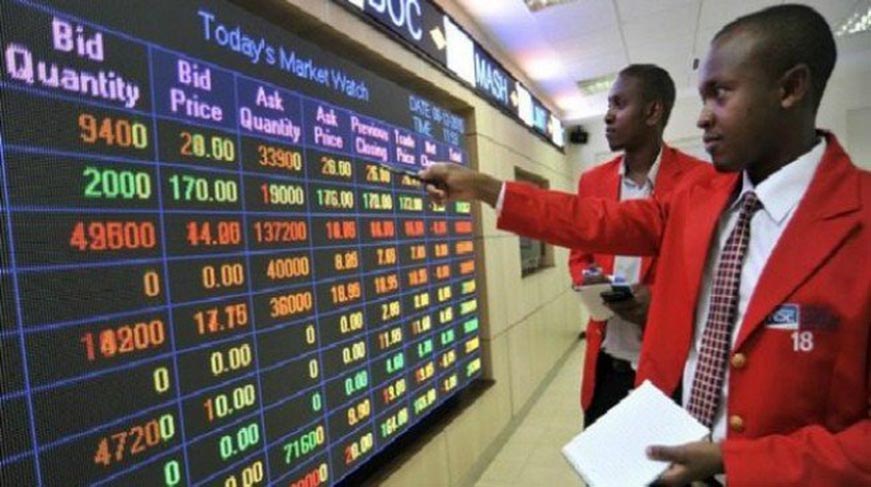
Three companies trading their shares on the Nigerian Stock Exchange (NSE) have been sanctioned for violating a similar rule, Business Post can authoritatively report.
The firms received the big NSE hammer for not filing their financial statements at the appropriate time and for this, the three affected companies were fined a cumulative sum of N39.2 million.
According to a regulatory document obtained by Business Post, the trio sanctioned by the stock exchange are Guinea Insurance, Niger Insurance and Interlinked Technologies.
The most hit was Niger Insurance Plc, which was asked to pay the sum of N19.8 million for its infractions, while Guinea Insurance was sanctioned N19.2 million, with Interlinked Technologies fined N200,000 for filing its results late.
Analysis of the Fines
From the document, Guinea Insurance was asked to pay the sum of N8.2 million for filing its audited 2018 financial statements ended December 31, 2018, on September 20, 2019. For submitting its first quarter financial results for the period ended March 31, 2019 on September 20, 2019, the NSE fined the insurance company N5.6 million, while it was asked to pay another N5.4 million for releasing its earnings for the second quarter of the year ended June 30, 2019 on September 20, 2019.
On the part of Niger Insurance, the stock market regulator sanctioned the firm N8.6 million for submitting its audited financial status for the year ended December 31, 2018 on September 20, 2019. For its late filing of the first quarter results for the period ended March 31, 2019 on September 24, 2019, it got N5.7 million, while it was further told to pay N5.5 million for releasing its second quarter results for the period ended June 30, 2019 on September 24, 2019.
On the part of Interlinked Technologies, it was slapped with a fine of N200,000 for submitting its audited 2019 financial statements for the period ended June 30, 2019 on October 3, 2019.
Business Post gathered that the NSE applied the sanctions on the above three companies in accordance with the Rules for Filing of Accounts and Treatment of Default Filing, Rulebook of The Exchange (Issuers’ Rules).
Economy
Crude Oil Prices Climb 2% as Middle East Ceasefire Prospects Fade
By Adedapo Adesanya
Crude oil prices rose more than 2 per cent on Monday after US President Donald Trump said the ceasefire with Iran was “on life support,” leaving the Strait of Hormuz largely closed with no clear end in sight to the war.
Brent crude futures went up by $2.92 or 2.88 per cent to $104.21 a barrel, while the US West Texas Intermediate (WTI) crude futures increased by $2.65 or 2.78 per cent to settle at $98.07 a barrel.
President Trump on Monday said the ceasefire with Iran was “on life support,” after dismissing Iran’s response to a US peace proposal as “stupid.”
This came after the US floated a proposal aimed at reopening negotiations with Iran. The Middle East country on Sunday released a response focused on ending the war on all fronts, including one where America’s top ally, Israel, is fighting Iran-backed Hezbollah militants.
Iran also demanded compensation for war damage, emphasised its sovereignty over the strait, and called on the US to end its naval blockade, guarantee no further attacks, lift sanctions and remove a ban on Iranian oil sales.
After this, President Trump dismissed the offer in a social media post as “totally unacceptable.”
He also emphasised that the US continues to monitor Iran’s enriched uranium stockpiles via Space Force surveillance and warned of further strikes if a real end to the nuclear issue is not reached.
The war has impacted oil output by the Organisation of the Petroleum Exporting Countries (OPEC) as it declined to its lowest level since 2000, with production falling by 830,000 barrels per day to an average of 20.04 million barrels per day in April, according to a Reuters survey published Monday.
Kuwait, Saudi Arabia, and Iraq all saw significant output decreases as they were forced to shut in production due to the war, which started in late February.
The United Arab Emirates (UAE) was the only Gulf member that was able to increase production in April. The UAE was able to leverage the Fujairah terminal on the Gulf of Oman to bypass the bottleneck, allowing it to export more crude than its peers. The Emirate is targeting a production capacity of 5 million barrels per day by 2027 after it exited OPEC and OPEC+ this month.
Economy
Nigerian Exchange YtD Gain Crosses 60% After 2.33% Surge
By Dipo Olowookere
A 2.33 per cent surge recorded by the Nigerian Exchange (NGX) Limited on Monday pushed its year-to-date (YtD) gain to 60.97 per cent.
This means that the local stock market has gained over 60 per cent this year. This performance has been triggered by a strong appetite for domestic equities, especially from investors with hot money.
Yesterday, the All-Share Index (ASI) rose by 5,705.59 points to 250,481.42 points from 244,775.83 points, and the market capitalisation expanded by N3.160 trillion to N160.254 trillion from N157.094 trillion.
Business Post observed that all the key sectors of the bourse ended in green, with the banking index growing by 4.67 per cent. The industrial goods space increased by 4.32 per cent, the consumer goods counter improved by 0.74 per cent, the insurance sector advanced by 0.59 per cent, and the energy segment soared by 0.03 per cent.
Investor sentiment was bullish as Customs Street ended with 57 price gainers and 21 price losers, implying a positive market breadth index.
The quintet of Livestock Feeds, Integrated Energy Insurance, RT Briscoe, FTN Cocoa, and Union Homes REIT chalked up 10.00 per cent each to sell for N8.80, N2.86, N16.50, N9.13, and N77.00, respectively.
On the flip side, Prestige Assurance lost 10.00 per cent to quite at N1.44, University Press declined by 9.09 per cent to N4.00, Tantalizers slumped by 7.69 per cent to N4.20, NPF Microfinance Bank crashed by 6.25 per cent to N6.00, and Mutual Benefits went down by 5.72 per cent to N4.12.
During the session, market participants traded 1.5 billion equities worth N68.5 billion in 94,834 deals versus the 1.1 billion equities valued at N55.0 billion transacted in 69,996 deals last Friday, indicating a rise in the trading volume, value, and number of deals by 36.36 per cent, 24.55 per cent, and 35.49 per cent, respectively.
At the close of transactions, Veritas Kapital was the busiest stock with a turnover of 194.6 million units valued at N299.1 million. Access Holdings sold 172.1 million units for N4.2 billion, First Holdco exchanged 132.0 million units worth N9.8 billion, FCMB traded 123.9 million units valued at N1.4 billion, and Champion Breweries transacted 83.0 million units worth N1.3 billion.
Economy
Weak Investor Participation Shrinks NAFEM Inflows to $2.86bn in April
By Adedapo Adesanya
Total inflows into the Nigerian Autonomous Foreign Exchange Market (NAFEM) fell sharply in April 2026 as geopolitical tensions and weaker participation from both domestic and foreign investors impacted liquidity in the FX market.
Data from the FMDQ Securities Exchange showed that total foreign exchange inflows declined by 30.1 per cent month-on-month to $2.86 billion in April, down from $4.09 billion recorded in March.
The decline was driven by reduced inflows from the Central Bank of Nigeria (CBN), exporters, importers, foreign portfolio investors and non-bank corporates, reflecting growing investor caution amid rising tensions in the Middle East and uncertainty surrounding the US-Iran conflict.
Local inflows, which accounted for 42.8 per cent of total market inflows, dropped by 38.7 per cent to $1.22 billion from $2.00 billion in March.
The steepest decline came from the CBN, whose interventions in the market fell by 83 per cent month-on-month. Inflows from exporters and importers declined by 19.3 per cent, non-bank corporates by 18.2 per cent, while inflows from individuals fell by 33.3 per cent.
Foreign inflows, which contributed 57.2 per cent of the total, also weakened by 21.9 per cent to $1.63 billion compared to $2.09 billion in March.
A breakdown of the foreign component showed that foreign portfolio investment (FPI) inflows dropped by 17.8 per cent, foreign direct investment (FDI) plunged by 78.9 per cent, while inflows from other corporates declined by 54.6 per cent.
Despite the drop in inflows, the local currency posted a modest gain against the US Dollar during the week, appreciating by 1.2 per cent to close at N1,360/$1, supported largely by offshore investor inflows that helped offset domestic demand pressures.
However, the local currency ended the week slightly weaker at the official market, depreciating by 0.22 per cent to N,361.40 per Dollar while gaining 44 basis points at the parallel market to close at N1,363.15/$1.
In the forwards market, the Naira strengthened across all tenors, with the one-month contract appreciating by 1.2 per cent to N1,384.53 to the Dollar, the three-month contract by 1.2 per cent to N1,424.08/$1, the six-month contract by 1.3 per cent to N1,478.39/$1, and the one-year contract by 1.5 per cent to N1,586.56/$1.
Nigeria’s gross external reserves continued their downward trend, declining by $40 million to $48.33 billion as of May 7, 2026. This marked the eighth consecutive week of decline, attributed to sustained CBN interventions, debt service obligations, subdued oil receipts and foreign capital outflows.
Meanwhile, crude oil prices rose in the international market as renewed hostilities between the US and Iran in the Strait of Hormuz raised concerns over potential supply disruptions.
Brent Crude gained 1.2 per cent to $101.30 per barrel while the US West Texas Intermediate (WTI) rose 0.5 per cent to $95.28 per barrel.
-
Feature/OPED6 years agoDavos was Different this year
-
Travel/Tourism10 years ago
Lagos Seals Western Lodge Hotel In Ikorodu
-
Showbiz3 years agoEstranged Lover Releases Videos of Empress Njamah Bathing
-
Banking8 years agoSort Codes of GTBank Branches in Nigeria
-
Economy3 years agoSubsidy Removal: CNG at N130 Per Litre Cheaper Than Petrol—IPMAN
-
Banking3 years agoSort Codes of UBA Branches in Nigeria
-
Banking3 years agoFirst Bank Announces Planned Downtime
-
Sports3 years agoHighest Paid Nigerian Footballer – How Much Do Nigerian Footballers Earn