Connect with us

Economy

Nigerian Stock Market Closes Slightly Higher by 0.01%

Published

on

Nigerian Stocks

By Dipo Olowookere

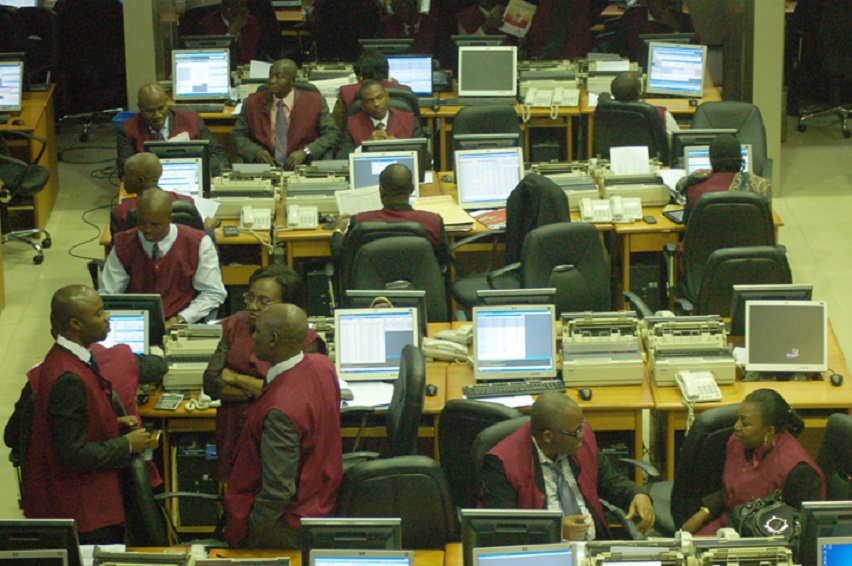
Transactions at the local stock market marginally gained 0.01 percent on Tuesday to reverse the previous day’s bearish closure.

Business Post observed that during trading yesterday, the bulls struggled to overpower the bears despite the Nigerian Stock Exchange (NSE) recording 26 price gainers against only 10 price losers.

The level of activity was low on Tuesday with the volume of shares transacted by investors, the value and number of deals executed all depreciated.

The volume of trades went down by 50.72 percent to 246 million from 499.2 million, the value dropped by 55.83 percent to N2.4 billion from N5.5 billion, while the number of deals crashed by 14.30 percent to 3,320 from 3,874.

Diamond Bank maintained its position as the most actively traded stock on Tuesday, trading 71.6 million units worth N149.1 million.

Access Bank sold 27 million shares for N151.1 million, while GTBank exchanged 26.6 million equities for N847.8 million.

UBA transacted 22 million shares valued at N159.8 million, while FBN Holdings sold 17 million equities worth N123.6 million.

Seplat was the biggest price gainer with N10 added to its share value to settle at N540 per unit, while GTBank gained 40 kobo to end at N32.10k per share.

Red Star Express also rose by 40 kobo to finish at N4.80k per share, Custodian Investment appreciated by 35 kobo to settle at N6.50k per share, while Zenith Bank increased its share value by 30 kobo to end at N21.80k per share.

At the other side, Presco Oil topped the losers’ chart, losing N2 of its share price to finish at N60 per share.

CCNN went down by N1.90k to close at N25 per share, while Nigerian Breweries fell by N1 to end at N80 per unit.

NEM Insurance and UBA both lost 10 kobo each to finish respectively at N2.50k and N7.25k.

On the major market indices, the All-Share Index (ASI) increased by 4.16 points to settle at 30,736.88 points, while the market capitalisation appreciated by N1 billion to finish at N11.462 trillion.


Dipo Olowookere is a journalist based in Nigeria that has passion for reporting business news stories. At his leisure time, he watches football and supports 3SC of Ibadan. Mr Olowookere can be reached via [email protected]

Click to comment

Leave a Reply

Your email address will not be published. Required fields are marked *

Economy

Oil Prices Close 2% Lower on US-Iran Deal Uncertainty

Published

on

Crude Oil Prices

By Adedapo Adesanya

Oil prices settled lower by 2 per cent on Thursday as uncertainty over prospects for resolving the US-Israel conflict ‌with Iran weighed on the market, with Brent crude futures trading at $102.58 a barrel after it shed $2.44 or 2.3 per cent, and the US West Texas Intermediate (WTI) futures at $96.35 per barrel after it lost $1.9 or 1.9 per cent.

Prices had earlier surged on reports that Iran’s supreme leader issued a directive that dented hopes for a swift resolution to the war, before reversing course later in ​the day.

The directive ​from Supreme Leader Ayatollah Mojtaba Khamenei could further complicate negotiations and frustrate US President Donald Trump’s efforts to broker an end to the war.

President Trump then later said the US will eventually recover Iran’s stockpile of highly enriched uranium, which the US believes is destined for a nuclear weapon, though Tehran says it is intended purely for ​peaceful purposes.

Meanwhile, Iran has announced a new “Persian Gulf Strait Authority,” which would oversee a “controlled maritime zone” in the Strait of Hormuz, the key waterway that controls about 20 per cent of crude and gas flows. It also warned against further ​attacks and unveiled steps to entrench its control of the strait, which remains mostly closed.

Economic activity ‌in the Euro ⁠zone shrank at its sharpest rate in more than 2-1/2 years in May as a war-driven surge in living costs hammered demand for services across Europe, and firms accelerated layoffs.

Seven leading oil-producing countries in the Organisation of the Petroleum Exporting Countries and its allies (OPEC+) will likely agree to a modest hike in July output when they meet on June 7. The monthly target ​set by the members is expected to be raised ​by about 188,000 barrels per day, a figure which has been trimmed since May after the United Arab Emirates (UAE) left the group.

OPEC+ ​held output steady in the first quarter of 2026 but has raised its ​target each month since April, despite the war. Despite the hikes, the war has reduced oil production ⁠to 33.19 million barrels per day in April from 42.77 million barrels per day in February, with output by Gulf producers falling by 9.9 million barrels per day.

In the US, an Energy Information Administration (EIA) report on Wednesday showed that the country withdrew nearly 10 million barrels of oil from its Strategic Petroleum Reserve (SPR) last week ⁠for its ​biggest drawdown on record. US crude inventories also fell by more than expected last week, according to EIA data.

Continue Reading

Economy

Renewed Buying Interest Advances Nigerian Exchange by 0.05%

Published

on

Nigerian Exchange

By Dipo Olowookere

The Nigerian Exchange (NGX) Limited rebounded by 0.05 per cent on Thursday following renewed buying interest in Unilever Nigeria, International Breweries, Wema Bank, and others.

The upliftment recorded yesterday happened amid weak investor sentiment as the bourse ended with 18 appreciating equities and 45 declining equities, implying a negative market breadth index.

According to data from Customs Street, International Energy Insurance gained 10.00 per cent to trade at N3.41, ABC Transport grew by 9.93 per cent to N9.08, Unilever Nigeria appreciated by 9.80 per cent to N168.00, Academy Press soared by 9.74 per cent to N8.45, and Eunisell chalked up 9.41 per cent to sell for N209.95.

On the other side, Berger Paints depreciated by 10.00 per cent to finish at N147.60, Learn Africa moderated by 9.96 per cent to N11.75, DAAR Communications eased by 9.95 per cent to N1.90, RT Briscoe retreated by 9.93 per cent to N12.79, and May and Baker lost 9.61 per cent to settle at N46.55.

Yesterday, the consumer goods and the banking indices were up by 0.52 per cent and 0.03 per cent, respectively, while the insurance sector went down by 0.55 per cent, the energy index decreased by 0.10 per cent, and the industrial goods segment crumbled by 0.01 per cent.

When trading activities ended for the session, the All-Share Index (ASI) increased by 113.02 points to 249,175.39 points from 249,062.37 points, and the market capitalisation expanded by N72 billion to N159.733 trillion from N159.661 trillion.

A total of 1.1 billion stocks valued at N31.0 billion exchanged hands in 62,448 deals during the session versus the 600.2 million stocks worth N32.7 billion traded in 58,958 deals at midweek, indicating a shortfall in the trading value by 5.20 per cent, and a surge in the trading volume and number of deals by 83.27 per cent and 5.92 per cent, respectively.

Sterling Holdings led the activity chart with 322.7 million units valued at N2.6 billion, Japaul exchanged 96.4 million units worth N416.2 million, Fidelity Bank traded 57.0 million units for N1.3 billion, Access Holdings sold 52.2 million units worth N1.3 billion, and Lasaco Assurance transacted 42.5 million units valued at N86.7 million.

Continue Reading

Economy

Meta Contributes $820m Annually to Nigerian Economy—Research

Published

on

Meta $820m Nigerian Economy

By Aduragbemi Omiyale

New independent research has revealed that the parent company of Facebook, WhatsApp, and Instagram, Meta, contributes about $820 million to the Nigerian economy every year.

In the new report titled Nigeria’s Digital Economy, conducted by Public First, it was discovered that about 14 million Nigerian small and medium enterprises (SMEs) used Meta’s apps like Facebook, Instagram, WhatsApp, Messenger, Meta AI, and Threads, to start and grow their businesses in 2025, contributing $2 billion to the country’s gross domestic product (GDP) and delivering an estimated $640 million in productivity gains through more efficient instant messaging.

Business Post gathered from the study released in Abuja on Thursday that the adoption of artificial intelligence (AI) is set to add about $22 billion to Nigeria’s DGP by 2035.

It was observed that virtually all Nigerian businesses surveyed confessed that Meta’s platforms have expanded their customer reach, with the company’s platforms functioning as essential digital infrastructure connecting Nigerian entrepreneurs to customers, markets, and new economic opportunities.

WhatsApp is Nigeria’s gateway to AI

WhatsApp is playing a central role in connecting Nigerians to AI and new economic opportunities across the region. The platform serves as Nigerians’ primary AI surface — reflecting the wider regional pattern where 93 per cent of Meta AI prompts in Sub-Saharan Africa are made via WhatsApp — demonstrating how AI adoption in Nigeria is happening through the tools people already use every day.

“Nigeria is one of the most dynamic, entrepreneurial and digitally engaged markets in the world — and this research makes clear the scale of what is possible when Nigerian ambition meets the right digital tools.

“From a tailor in Lagos reaching customers across the country through Instagram, to a small business owner in Kano taking orders on WhatsApp, to a creator in Abuja building a global audience on Facebook — Meta’s platforms are removing the traditional barriers to growth and unlocking real economic opportunity,” the Director of Public Policy for Sub-Saharan Africa at Meta, Balkissa Ide Siddo, said.

The fact that 80 per cent of Nigerians say access to reliable internet has improved compared to a decade ago speaks to the progress already made, and with continued investment in connectivity, smart policy that supports innovation, and the rise of open-source AI built for and by Africans, Nigeria is exceptionally well positioned to lead the continent’s next decade of digital growth. We are proud to be a long-term partner in that journey,” Ide Siddo added.

AI and Nigeria’s next growth frontier

The research highlights the transformative potential of artificial intelligence for Nigeria’s economy and innovation ecosystem.

SMEs are reaching new customers across Nigeria

For Nigerian small businesses, Meta’s platforms have become a primary sales and discovery channel. 81 per cent of online businesses surveyed said Facebook, Instagram, and WhatsApp have expanded their customer base beyond their local geography — reducing customer acquisition costs and giving a business in Kano access to the same advertising and commerce tools available to businesses in Lagos, London or New York.

“Nigeria’s digital transformation is creating new opportunities for businesses, creators and consumers alike. The findings show that Meta’s platforms are helping Nigerian firms grow across formal and informal sectors, supporting entrepreneurship and strengthening participation in one of the world’s most rapidly expanding digital economies.

“With the right combination of infrastructure, platform access and open-source AI, the upside for Nigeria is significant,” a Director at Public First, Alison Neyle, stated.

Continue Reading

Trending