Connect with us

Economy

Nigerian Stocks Further Bow to Sell Pressure by 0.28%

Published

on

Investment in Nigerian Stocks

By Dipo Olowookere

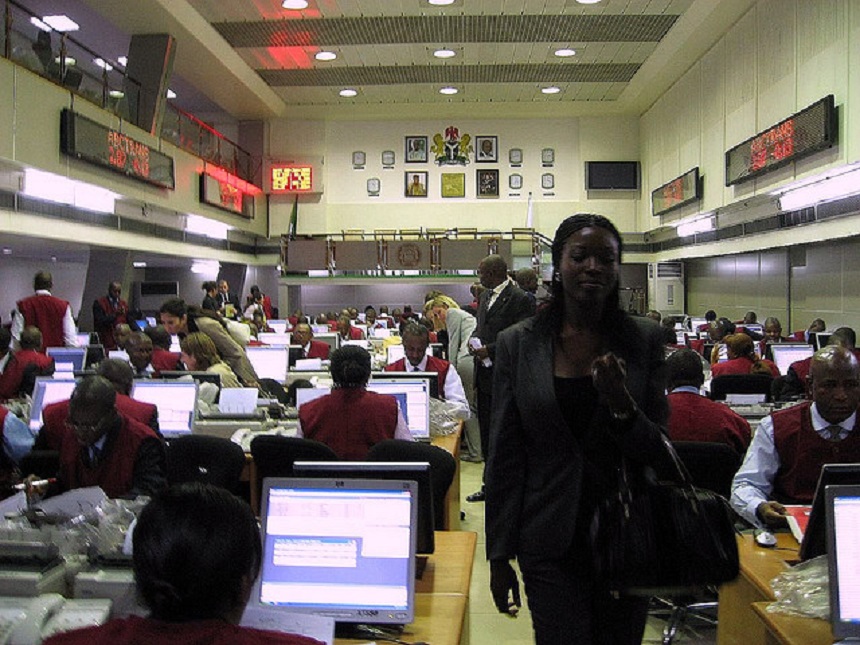
The sustained sell pressure on Nigerian stocks further weakened prices of equities at the local market on Wednesday.

It was observed that investors further booked profit on some shares, which have gained in the past few sessions, leaving the market with a 0.28 per cent deep cut as only seven stocks appreciated in value compared with the 23 price losers.

Okomu Oil was the leader of the decliners’ gang yesterday, losing N1 to sell for N78 per share, while Unilever Nigeria followed with a 60 kobo loss to settle at N14.40 per share.

Zenith Bank fell by 50 kobo to close at N16.40 per unit, C&I Leasing depreciated by 35 kobo to settle at N3.55 per unit, while UAC Nigeria declined by 30 kobo to trade at N6 per share.

On the flip side, Fidson topped the gainers’ log at the session after adding 27 kobo to its share price to quote at N3.98 per share, while PZ Cussons appreciated by 25 kobo to sell for N4.25 per share.

Custodian Investment improved by 15 kobo to close at N4.95 per unit, Lafarge Africa gained 10 kobo to trade at N12.15 per share, while FCMB gained 6 kobo to quote at N2.26 per share.

At the midweek trading session, the volume of shares traded by investors rose by 7.01 per cent to 269.6 million from 252.0 million, while the value of trades jumped by 40.48 per cent to N2.9 billion from N2.0 billion, with the number of deals declining by 0.72 per cent to 4,155 deals from 4,185 deals.

Zenith Bank was the most traded stock on Wednesday, selling 35.8 million units worth N592.1 million, while FBN Holdings transacted 33.4 million shares valued at N166.9 million.

UBA transacted 29.8 million equities valued at N182.6 million, GTBank exchanged 24.9 million stocks for N605.1 million, while Access Bank sold 19.2 million shares for N126.3 million.

Business Post reports that apart from the industrial goods sector, which grew by 0.05 per cent yesterday, every other performance indicators closed in the red region.

The banking space lost 1.54 per cent, the insurance sector depreciated by 0.39 per cent, the consumer goods counter fell by 0.19 per cent, while the energy index decreased by 0.11 per cent.

Also, the All-Share Index (ASI) depreciated by 72.41 points to 25,424.91 points from 25,497.32 points, while the market capitalisation reduced by N38 billion to N13.264 trillion from N13.302 trillion.


Dipo Olowookere is a journalist based in Nigeria that has passion for reporting business news stories. At his leisure time, he watches football and supports 3SC of Ibadan. Mr Olowookere can be reached via [email protected]

Click to comment

Leave a Reply

Your email address will not be published. Required fields are marked *

Economy

Naira Maintains Stability Against US Dollar at Official Market

Published

on

funds in Naira accounts

By Adedapo Adesanya

The Naira maintained stability against the US Dollar in the Nigerian Autonomous Foreign Exchange Market (NAFEX) on Monday, July 13, at N1,379.65/$1.

However, it appreciated against the Pound Sterling in the official market by N2.44 to exchange at N1,848.18/£1 compared with the previous rate of N1,850.62/£1, and lost 73 Kobo against the Euro to sell at N1,576.39/€1 versus last Friday’s N1,575.66/€1.

At the GTBank fore counter, the Naira declined by N2 to settle at N1,388/$1, in contrast to the previous session’s rate of N1,386/$1, and at the black market, it traded flat at N1,400/$1.

Market analysts expect the Naira to trade within a relatively stable range, supported by sustained FX inflows and a continued market intervention by the Central Bank of Nigeria (CBN), although persistent underlying FX demand is likely to keep depreciation pressures elevated.

According to Monday’s trading data, interbank FX turnover surged by 21.14 per cent to $86.136 million from $71.044 million at the previous trading session on Friday.

However, interbank deal counts declined to 85 from 87 on Monday, reflecting the absence of pressure from US Dollar payments against local units. Last week, total foreign exchange inflows amounted to $0.97 billion, according to a Coronation Merchant Bank research report.

Analysts reported that foreign portfolio investors (FPIs) remained the largest source of inflows, contributing 30.29% or $0.29 billion, closely followed by Exporters and Importers at 30.14 per cent.

Non-bank corporates accounted for 26.49 per cent or $0.26 billion, while the CBN contributed 6.93 per cent or $0.07 billion. Other sources made up the remaining 5.4 per cent of total inflows.

In the cryptocurrency market, major coins came under pressure following heightened expectations for a Federal Reserve interest-rate increase as soon as July, just ahead of key US inflation data and congressional testimony from Chairman Kevin Warsh came into focus.

Bitcoin (BTC) fell by 0.2 per cent to $62,627.03, Solana (SOL) dipped by 1.5 per cent to $75.18, TRON (TRX) depreciated by 0.2 per cent to $0.3248, Ripple (XRP) slumped by 0.6 per cent to $1.06, and Cardano (ADA) lost 0.6 per cent to close at $0.1589.

On the flip side, Ethereum (ETH) appreciated by 0.5 per cent to $1,784.26, Dogecoin (DOGE) grew by 0.2 per cent to $0.073, and Binance Coin (BNB) jumped by 0.2 per cent to $569.23, while the US Dollar Tether (USDT) and the US Dollar Coin (USDC) traded flat at $1.00 apiece.

Continue Reading

Economy

Brent Jumps Nearly 10% to $83 on Renewed Hormuz Supply Concerns

Published

on

Brent Price

By Adedapo Adesanya

Brent jumped to $83 per barrel on Monday after the United States announced a fresh blockade that reignited concerns over energy shipments through the Strait of Hormuz.

The international crude benchmark soared by $7.29 or 9.59 per cent to $83.30 per barrel, while the US West Texas Intermediate (WTI) crude gained $6.73 or 9.42 per cent to trade at $78.14 a barrel.

US President Donald Trump announced that he would reinstate a blockade on Iran, forcing traders to once again price in the risk of prolonged disruption to energy flows through the Strait of Hormuz. The blockade, due to begin on Tuesday, will cover Iran’s entire coastline, ports and oil terminals, as well as all vessels regardless ‌of flag.

The US President also said vessels receiving protection while transiting Hormuz would reimburse the country through a 20 per cent charge on cargoes, Reuters reported.

President Trump’s idea would mean that a 20 per cent fee on a supertanker that carries about 2 million barrels of crude at $80 per barrel would be equivalent to around $32 million, or an additional cost of $16 per barrel.

“This is significantly higher than the $1/bbl toll for which Iran has been pushing,” ING’s strategists said.

The proposal was also criticised by the International Maritime Organisation (IMO) because international law does not provide for mandatory transit fees through straits used for international navigation. Energy companies have also rejected similar proposals previously advanced by Tehran, arguing that freedom of navigation remains a cornerstone of global maritime trade.

Iran’s top joint military command had earlier said it would not allow ​the US to intervene in the management of the strait, and any attempt by the US to transit without its authorisation would be confronted.

Analysts now expect countries to work on ways to permanently bypass the Strait of Hormuz. Goldman Sachs estimated that expanding pipeline capacity in the Middle East could shield more than 60 per cent of pre-war Gulf oil exports from any future Hormuz disruptions by the end of 2028.

The bank’s base-case forecast assumes pipeline capacity bypassing Hormuz will rise by 3.8 million barrels per day by end-2027 and 7.3 million barrels per day cumulatively by end-2028, taking total effective bypass capacity to more than 14 million barrels per day by end-2028.

The Organisation of the Petroleum Exporting Countries (OPEC) has trimmed its 2026 global oil demand growth forecast for the third straight month, even as crude production rebounds across the Gulf and tanker traffic slowly returns to the Strait of Hormuz.

In its monthly oil market report released Monday, OPEC lowered expected oil demand growth this year to 780,000 barrels per day, down another 190,000 barrels per day from last month’s forecast. The producer group still expects stronger consumption than many other forecasters, including the International Energy Agency, and even raised its demand growth estimate for 2027 by 210,000 barrels per day to 1.94 million barrels per day.

Continue Reading

Economy

Sell-Offs in PZ Cussons, BUA Cement Shrink Nigerian Exchange by 0.84%

Published

on

BUA Cement NSE

By Dipo Olowookere

The Nigerian Exchange (NGX) Limited further depreciated by 0.84 per cent on Monday as a result of sell-offs in PZ Cussons, BUA Cement and others.

During the session, apart from the consumer goods index, which closed higher by 0.59 per cent, every other index closed lower, with the industrial goods sector the heaviest loser after shedding 3.28 per cent. The insurance space declined by 2.18 per cent, the banking sector depleted by 1.44 per cent, and the energy segment shrank by 0.09 per cent.

Consequently, the All-Share Index (ASI) retreated by 2,049.65 points to 241,749.11 points from 243,798.76 points, and the market capitalisation contracted by 1.315 trillion to N155.130 trillion from N156.445 trillion.

The market was under selling pressure yesterday, as reflected in the market breadth index, which was negative after closing with 48 price losers and 22 price gainers, indicating weak investor sentiment.

PZ Cussons was the worst-performing stock after shedding 10.00 per cent to finish at N81.00, BUA Cement lost 9.99 per cent to settle at N306.20, Red Star Express declined by 9.98 per cent to N22.10, RT Briscoe depreciated by 9.70 per cent to N12.10, and C&I Leasing dropped 9.38 per cent to trade at N28.12.

The best-performing equity for the day was International Breweries, which chalked up 9.77 per cent to quote at N14.60, NAHCO improved by 8.36 per cent to N177.00, UAC Nigeria expanded by 8.11 per cent to N199.95, DAAR Communication grew by 6.67 per cent to N1.76, and Vitafoam Nigeria gained 5.87 per cent to close at N194.80.

During the session, investors bought and sold 523.5 million shares worth N22.3 billion in 59,945 deals compared with the 441.3 million shares valued at N19.4 billion traded in 44,938 deals last Friday, indicating an increase in the trading volume, value, and number of deals by 18.63 per cent, 14.95 per cent, and 33.40 per cent, respectively.

FCMB closed the day as the most traded stock, with 102.2 million units valued at N1.0 billion. International Breweries sold 26.8 million units worth N387.2 million, Access Holdings exchanged 24.8 million units for N618.2 million, McNichols traded 20.3 million units worth N95.0 million, and Stanbic IBTC transacted 18.4 million units valued at N2.9 billion.

Continue Reading