Connect with us

Economy

Nigerian Stocks Lose 0.12% as Market Corrections Persist

Published

on

Nigerian Stocks

By Dipo Olowookere

The equity market returned to the red territory on Wednesday after closing positive on Tuesday by 0.10 percent.

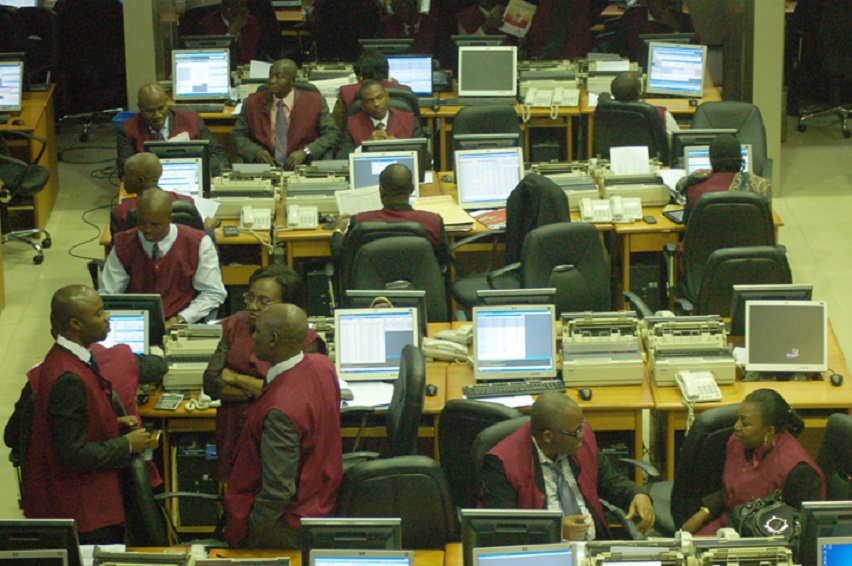
Business Post reports that the Nigerian Stock Exchange (NSE) depreciated by 0.12 percent today as market corrections continue especially from the bullish run recorded at the beginning of this year on the back of the strong performance in 2017.

At the close of transactions today, the All-Share Index (ASI) declined by 47.05 percent to finish at 40,755.73 points, while the market capitalisation decreased by N17.2 billion to settle at N14.721 trillion.

Despite the loss today, the volume and value of shares transacted by investors increased by 42.34 percent and 42.93 percent respectively.

A total of 351 million shares exchanged hands on Wednesday in 5,020 deals valued at N4.6 billion against 246.6 million units traded on Tuesday in 4,918 deals worth N3.2 billion.

At the end of trading activities, the Financial Services sector led the activity chart with 274.8 million shares exchanged for N3 billion, while the Consumer Goods followed with 23.8 million equities sold for 741 million.

FBN Holdings dominated trading at the stock market today with a total of 80.1 million shares sold for N1 billion.

It was followed by UBA, which traded 60 million units worth N684.5 million, and Fidelity Bank, which exchanged 40.6 million equities valued at N101.9 million.

Access Bank sold 32.5 million shares valued at N366.8 million, while Flour Mills transacted 16 million equities worth N538.2 million.

The market breadth finish positive at the close of trades on Wednesday after recording 24 price risers and 22 price fallers.

Nestle Nigeria closed as the biggest price gainer after appreciating by N74.60k to end at N1568.20k per share.

It was trailed by Seplat, which increased by 27.90k to settle at N765 per share, and Forte Oil, which rose by N4.40k to settle at N47.70k per share.

Presco grew by N3.30k to finish at N69.30k per share, while GlaxoSmithKline went up by 70k to close at N24 per share.

On the other hand, shares of Total Nigeria depreciated by N11.20k at the stock market today to wrap the day at N222.60k per share.

Dangote Cement lost N3 to finish at N245 per share, while FBN Holdings went down by N1.20k to settle at N12.20k per share.

Lafarge declined by 85k to close at N42.40k per share, while Oando shares decreased by 45k to end at N8.70k per share.


Dipo Olowookere is a journalist based in Nigeria that has passion for reporting business news stories. At his leisure time, he watches football and supports 3SC of Ibadan. Mr Olowookere can be reached via [email protected]

Click to comment

Leave a Reply

Your email address will not be published. Required fields are marked *

Economy

NGX Bounces Back by 0.18% Amid Bearish Sentiment

Published

on

domestic investors NGX

By Dipo Olowookere

Bearish investor sentiment on Monday could not keep the Nigerian Exchange (NGX) Limited in the red territory, as the bourse closed higher by 0.18 per cent.

According to data from Customs Street, there were 25 price gainers and 38 price losers, indicating a negative market breadth index.

Eterna expanded by 10.00 per cent to quote at N36.30, Caverton also improved by 10.00 per cent to N5.50, Omatek soared by 9.88 per cent to trade at N1.78, AVA Capital grew by 9.70 per cent to N9.05, and Vitafoam Nigeria appreciated by 7.90 per cent to N194.00.

Conversely, Ecobank declined by 9.95 per cent to N80.10, Cadbury Nigeria went down by 9.92 per cent to N58.10, Thomas Wyatt slumped by 9.82 per cent to N3.95, Coronation Insurance depreciated by 9.80 per cent to N2.30, and CMFC dipped by 9.79 per cent to N3.50.

Yesterday, market participants transacted 923.0 million stocks for N37.9 billion in 72,544 deals compared with the 943.0 million stocks worth N46.7 billion traded in 55,480 deals last Friday.

This indicated that the number of deals increased by 30.76 per cent, the trading volume shrank by 2.12 per cent, and the trading value dropped 18.84 per cent.

Access Holdings was the most active equity on the first trading day of this week and month, with a turnover of 166.6 million units worth N4.4 billion. Honeywell Flour sold 93.6 million units for N1.6 billion, Sterling Holdco exchanged 57.1 million units valued at N455.4 million, Universal Insurance traded 51.8 million units worth N45.8 million, and Chams transacted 33.8 million units valued at N152.5 million.

But when trading activities ended for the session, the All-Share Index (ASI) went up by 446.85 points to 245,730.53 points from 245,283.68 points, and the market capitalisation jumped by N289 billion to N158.615 trillion from N158.326 trillion.

Continue Reading

Economy

Crude Oil Plunges 7% as Trump Pauses Attack on Iran

Published

on

crude oil wells

By Adedapo Adesanya

Crude oil declined by about 7 per cent on Monday after US President Donald ​Trump held off on a fresh attack on Iran in the hope of sealing a quick deal that could boost oil supplies from the ‌Gulf.

Brent futures fell by $6.35 or 7.0 per cent to settle at $83.77 a barrel, while the US West Texas Intermediate (WTI) crude depreciated by $4.33 or 5.1 per cent to trade at $80.34 per barrel.

Over the weekend, President Trump repeated a pattern that has ⁠emerged throughout the past five months: announcing plans for “massive attacks” on Iran, only to cancel them at the last minute.

The US President on Monday said talks with Iran “are going on ​right now”, adding that Iran faced “decapitation” if Tehran did not agree to a pact to end the conflict.

However, Iran said there were no talks underway with the US and no plans for any meetings, contradicting the American leader who had cited ​talks he said would take place that afternoon as justification for calling off attacks.

Iran’s Foreign Ministry said it also had no plans to host foreign delegations or send negotiators abroad in the coming days.

Despite this, the renewed hopes for diplomacy in the US-Iran conflict eased some concerns.

Six Saudi-flagged supertankers have changed course in the Gulf of Aden in recent days and are heading to southern Africa following threats by the Iran-backed Houthi movement in Yemen to target Saudi shipping.

However, over the weekend, two tankers laden with Saudi oil crossed the Bab el-Mandeb Strait between the Red Sea and the Gulf of Aden, while traffic in the Strait of Hormuz between Iran and Oman slowed following reports of vessel ​attacks.

Russia said on Monday it was stepping up protection of ships in the Azov-Black ​Sea basin while also ⁠developing alternative cargo routes, in a move that follows a sharp escalation of attacks at sea by both sides in the war in Ukraine.

The Organisation of the Petroleum Exporting Countries and its allies (OPEC) approved an oil production quota increase on Sunday of around 188,000 barrels per day from September.

This means Saudi ⁠Arabia, Russia, Iraq, Kuwait, Algeria, Kazakhstan and Oman have finished the phased rollback of a 1.65 million barrels per day supply cut ​originally agreed in 2023, when the group still included the United Arab Emirates (UAE).

Due to export disruptions from the Gulf, Russia ​and Kazakhstan caused by the Iran and Ukraine wars, successive monthly OPEC+ hikes over most of this year have remained largely ​on paper with little impact on the market.

Continue Reading

Economy

Nigerian Private Sector’s Stanbic IBTC PMI for July Eases to 52.5 Points

Published

on

Nigerian Private Sector Stanbic IBTC PMI

By Aduragbemi Omiyale

The Stanbic IBTC Bank Nigeria Purchasing Managers’ Index (PMI) for the Nigerian private sector in July 2026 contracted to 52.5 points from 53.4 points in June 2026, a statement made available to Business Post has shown.

This occurred despite the business environment sustaining its growth last month, with an increase in new orders experienced, as inflationary pressures softened, and output and employment modestly rising.

The Head of Equity Research West Africa at Stanbic IBTC Bank, Mr Muyiwa Oni, said the PMI indicated that the private sector recorded its slowest since March 2026, as businesses also increased their input purchasing activity to keep up with current demand requirements and prepare for future workloads.

“Nigerian businesses reported improved customer demand in July while better pricing and new product launches also helped them to capture new orders arising from the increase in demand. These factors helped to keep the private sector activity in an expansionary territory, although this moderated when compared to June,” he was quoted as saying.

It was stated that while input costs increased at their slowest pace in five months, panellists reported higher costs for fuel and raw materials. Selling prices also softened in line with the picture for input costs in July.

Headline inflation eased slightly to 15.91 per cent y/y in June from 15.93 per cent y/y in May, snapping three consecutive months of price increases.

Although July inflation is likely to be higher m/m, it is expected to print lower, likely at 15.72 per cent y/y, primarily driven by favourable base effects from the corresponding period of last year, because there are no expectations of the magnitude of m/m inflation witnessed in July 2025 (1.99 per cent) to materialise this year.

“We retain our 2026 growth forecasts at 4.1 per cent as we see the oil sector growing by 3.45 per cent y/y in 2026, from 8.50 per cent y/y in 2025, while the non-oil sector is likely to grow by 4.11 per cent y/y, from 3.71 per cent y/y in 2025.

“The risks to our outlook include country-wide insecurity which may constrain food production, exchange rate pressures resurfacing, extreme-weather related conditions and higher fertiliser prices impacting crop yield, and a volatile global environment which may affect sentiment and constrain capital flows,” Mr Oni noted.

Continue Reading