Economy
Nigeria’s Exit from Grey List Good for Capital Market—Agama
By Adedapo Adesanya
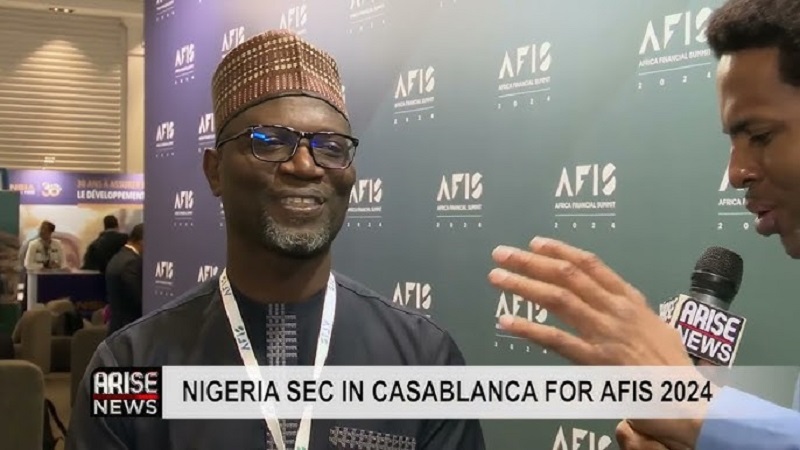
The Director General of the Securities and Exchange Commission (SEC), Mr Emomotimi Agama, has said the removal of Nigeria from the Financial Action Task Force (FATF) grey list would be beneficial to the Nigerian capital market.
Recall that last Friday, FATF announced the exit of Nigeria from its grey list of countries with deficiencies in Anti-Money Laundering/Countering the Financing of Terrorism (CFT)/Countering Proliferation Financing (CPF) regimes.
According to the Paris-based body, Nigeria, alongside South Africa, Mozambique, and Burkina Faso, have addressed the shortfalls on these issues. For Nigeria, it has worked on its inter-agency coordination.
Speaking on Channels Television’s Morning Brief on Monday, the Director General of the capital market regulator said the development would boost investor confidence, noting that they would realise the federal government’s efforts to strengthen the nation’s anti-money laundering and countering the financing of terrorism.
He explained that the development would chart a new course for the country, boost the nation’s economy, and that foreign investors would be attracted to Africa’s most populous nation.
“It means so much for us in the capital market; it means so much for us in the financial system. It brings about something that we have been craving for, investor confidence.
“The release of Nigeria from the FATF grey list means that investors confidence would be boosted. Delisting from that grey list sends a very strong signal to investors and trading partners that Nigeria has made significant progress in strengthening its anti-money laundering and countering of financing of terrorism regulations.
“That is very significant in the space of financial investment. For Nigerians as a whole, this is welcome call to new investments into our economy and boosting of the economy in terms of productivity,” the DG stated.
In February 2023, Nigeria was placed on the grey list after the FATF identified strategic deficiencies in its Anti-Money Laundering and Countering the Financing of Terrorism (AML/CFT) systems.
Now, more than two years later, the FATF has removed Nigeria from the list following the country’s successful implementation of a 19-point action plan aimed at strengthening its AML/CFT framework.
President Bola Tinubu in a statement on Friday, described the development as “a major milestone in Nigeria’s journey towards economic reform, institutional integrity and global credibility.”
Economy
World Bank Report: FG Counters Claims of Diverted Federation Earnings
By Aduragbemi Omiyale
The federal government has said there is no iota of truth in reports making the rounds that a significant portion of federation earnings is being “diverted”.
The claims came from a recent World Bank report, which the government said the media misinterpreted as “hidden spending.”
In a statement signed on Sunday by the Minister of State for Finance, Mr Taiwo Oyedele, the federal government emphasised that the characterisation of the Federation Account Allocation Committee (FAAC) deductions as “waste” or missing funds was “incorrect,” noting that the World Bank report presented the deductions as statutory transfers, savings and investments, security-related expenditures, cost-of-collection charges, refunds to Ministries, Departments and Agencies (MDAs), and transfers and interventions benefiting subnational governments.
“It is important to emphasise that refunds and transfers to states and other tiers of government are not leakages. They represent legitimate fiscal flows, including repayments of obligations and statutorily backed allocations,” the statement said.
It was further stressed that, “The World Bank explicitly notes that reforms implemented in early 2026, including the recently signed Executive Order to safeguard remittance of petroleum revenues, are already addressing concerns around deductions, and are expected to improve transparency while increasing revenues available to all tiers of government by about 0.4 per cent of GDP annually.”
“Misinterpreting one aspect of the analysis without acknowledging the progressive reforms and measures already introduced to enhance distributable federation revenues gives a distorted picture,” it submitted.
The Nigerian authorities averred that the broader message of the World Bank report is positive and forward-looking, as economic growth is becoming more broad-based across sectors, inflation is declining due to deliberate policy actions, Nigeria’s external position has strengthened, and debt indicators have improved.
The government declared that the World Bank did not say in the report that “Nigeria’s fiscal system is collapsing or that reforms have failed. Rather, it states that reforms are working, and they must be sustained and deepened to translate macroeconomic gains into inclusive growth.”
The statement appealed to “stakeholders, media organisations, and the public to engage constructively with fiscal information and avoid twisted interpretations that may undermine reform efforts and fuel public discord.”
Economy
Nigerian Stocks Attract N195.3bn Investments in One Week
By Dipo Olowookere
On the floor of the Nigerian Exchange (NGX) Limited last week, 3.588 billion shares valued at N195.313 billion exchanged hands in 254,553 deals, higher than the 3.361 billion shares worth N151.948 billion traded in 229,442 deals a week earlier.
Over a quarter of these transactions were centred around the trio of Sterling Holdco, Access Holdings, and Zenith Bank, which specifically accounted for 1.038 billion stocks worth N46.081 billion in 33,067 deals, contributing 28.92 per cent and 23.59 per cent to the total equity turnover volume and value, respectively.
They helped the financial equities to lead the activity chart with 2.498 billion units sold for N94.005 billion in 111,052 deals, contributing 69.62 per cent and 48.13 per cent to the total trading volume and value, respectively.
Services stocks traded 329.034 million units valued at N3.452 billion in 14,050 deals, and energy shares transacted 152.472million units worth N42.511 billion in 19,022 deals.
In the week, 61 equities appreciated versus 25 equities in the previous week, as 36 stocks depreciated compared with 54 stocks of the preceding week, while 49 shares remained unchanged, in contrast to 67 shares of the previous trading week.
Trans-Nationwide Express gained 60.48 per cent to sell for N6.05, Ecobank appreciated by 46.30 per cent to N67.30, Stanbic IBTC rose by 36.63 per cent to N188.55, Royal Exchange improved by 29.37 per cent to N1,85, and Aradel grew by 28.93 per cent to N1,649.00.
On the flip side, Coronation Insurance lost 14.38 per cent to close at N2.50, Ikeja Hotel declined by 14.36 per cent to N33.40, International Energy Insurance shrank by 13.80 per cent to N3.06, Academy Press slumped by 12.57 per cent to N7.65, and Honeywell Flour crumbled by 11.01 per cent to N19.00.
Business Post reports that the All-Share Index (ASI) went up by 6.57 per cent to 217,167.57 points, and the market capitalisation advanced by 6.60 per cent to N139.827 trillion, as the demand for Nigerian stocks soared.
Also, all other indices finished higher apart from the insurance and growth indices, which fell by 0.04 per cent and 0.99 per cent, respectively.
Economy
Naira Slips to N1,343/$ at NAFEX
By Adedapo Adesanya
The Naira sold at N1,343.64/$1 Nigerian Autonomous Foreign Exchange Market (NAFEX) on Friday, April 17, after shedding N1.34 or 0.10 per cent against the greenback from the previous day’s rate of N1,342.30/$1.
In the same vein, the Nigerian currency depreciated against the Pound Sterling in the same market window during the session by N5.03 to quote at N1,824.39/£1 versus the previous rate of N1,819.36/£1, and lost N10.05 against the Euro to sell at N1,591.14/€1 versus N1,581.09/€1.
At the GTBank FX desk, the exchange rate of the Naira to the Dollar remained unchanged at N1,355/$1, and it also maintained stability in the parallel market at N1,375/$1.
Interbank liquidity increased to N124.34 million from N74.255 million the previous day, data from the Central Bank of Nigeria (CBN) showed.
Meanwhile, external reserves remain at $48.70 billion, down from the 2009 peak of $50 billion amidst uncertainties in the global commodities market.
Global oil prices dropped sharply on Friday after Iran signalled that the Strait of Hormuz would remain open to commercial shipping during a temporary ceasefire in the Middle East.
Crypt assets also gained on the news from Iran’s foreign minister, who declared the Strait of Hormuz open, drawing a positive response from President Donald Trump. The development helped ease worry around risky assets like crypto.
Meanwhile, the cryptocurrency market was bullish, as traders weighed possible scenarios ahead of next week’s US-Iran cease-fire deadline.
Ethereum (ETH) appreciated by 3.2 per cent to $2,410.53, Bitcoin (BTC) jumped by 2.8 per cent to $77,124.22, Ripple (XRP) rose by 2.7 per cent to $1.47, Binance Coin (BNB) expanded by 2.5 per cent to $643.97, Dogecoin (DOGE) added 1.0 per cent to close at $0.0988, Cardano (ADA) improved by 0.9 per cent to $0.2578, Solana (SOL) soared by 0.4 per cent to $88.53, and TRON (TRX) gained 0.4 per cent to sell at $0.3275, while the US Dollar Tether (USDT) and the US Dollar Coin (USDC) traded flat at $1.00 apiece.
-
Feature/OPED6 years agoDavos was Different this year
-
Travel/Tourism10 years ago
Lagos Seals Western Lodge Hotel In Ikorodu
-
Showbiz3 years agoEstranged Lover Releases Videos of Empress Njamah Bathing
-
Banking8 years agoSort Codes of GTBank Branches in Nigeria
-
Economy3 years agoSubsidy Removal: CNG at N130 Per Litre Cheaper Than Petrol—IPMAN
-
Banking3 years agoSort Codes of UBA Branches in Nigeria
-
Banking3 years agoFirst Bank Announces Planned Downtime
-
Sports3 years agoHighest Paid Nigerian Footballer – How Much Do Nigerian Footballers Earn