Connect with us

Economy

Nigeria’s House of Reps Directs Trade Ministry to Halt UK Deals

Published

on

House of Reps

By Adedapo Adesanya

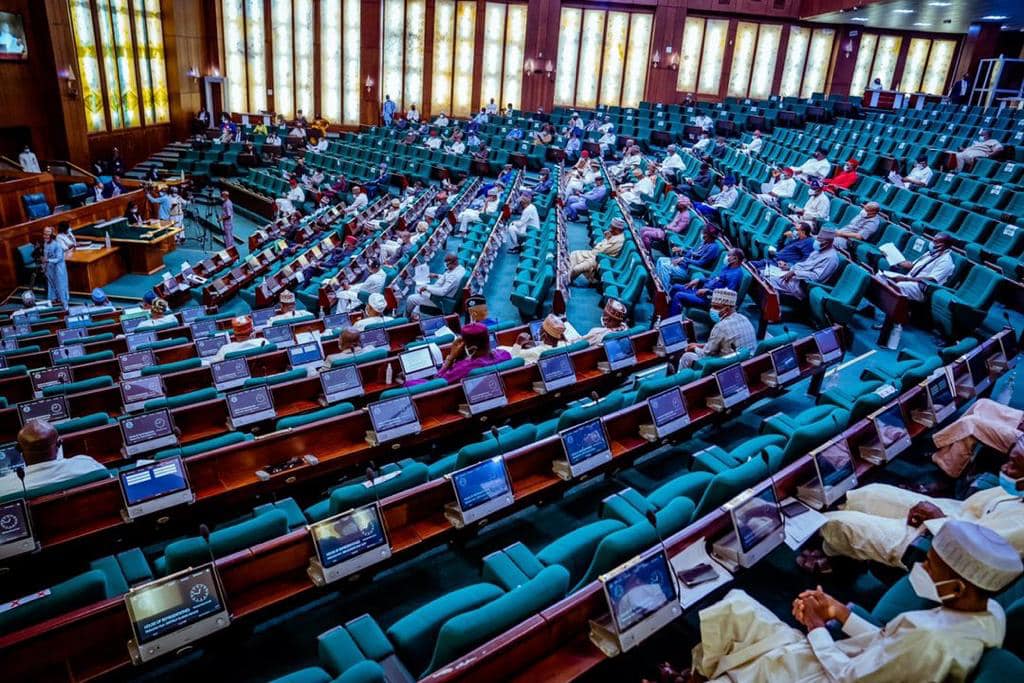
The House of Representatives has urged the Ministry of Industry, Trade, and Investments to halt any further signing and implementation of the trade partnership with the United Kingdom.

The lower legislative chamber said the agreement should cease until the terms and conditions governing it were fully examined and ascertained.

The resolution followed the adoption of a motion by a lawmaker from Rivers State, Mr Kingsley Chinda, at the plenary in Abuja on Tuesday, noting that although the economic and trade partnership between the United Kingdom and Nigeria was aimed at exploring new opportunities in key sectors like energy, legal, and financial services, it appeared to be one-sided.

Recall that a series of trade partnerships was signed with the UK as the once-leading economic power looks to boost its dwindling economy.

The lawmaker said the conditions around trade deals became heightened as the legal aspect appeared lopsided and tilted mainly in favour of the UK to the detriment of qualified Nigerian lawyers.

He added that the agreement sought to allow UK lawyers to enter the Nigerian legal space and practice but not vice versa.

According to him, while the deal seeks to foster collaboration between the film and media industries in the UK and Nigeria, it does not cater for the interests of Nigerian lawyers.

He added that there were no such provisions or opportunities for them to practice their trade in the UK.

He said while it was good for Nigeria to enter into partnership deals with other countries, such deals must be seen to promote, preserve, and protect the interests of the generality of Nigerians.

He said there is an urgent need for the house to investigate the trade deal between the UK and Nigeria to ascertain the terms and conditions.

“Unless immediate steps are taken to investigate the issue, Nigeria may unwittingly be entering into a deal whose terms and conditions may be unfavourable to the country.”

Adopting the motion, the House mandated its Committee on Treaties, Protocols, and Agreements to investigate the matter and report back within four weeks for further legislative action.


Adedapo Adesanya is a journalist, polymath, and connoisseur of everything art. When he is not writing, he has his nose buried in one of the many books or articles he has bookmarked or simply listening to good music with a bottle of beer or wine. He supports the greatest club in the world, Manchester United F.C.

Economy

Oil Market Rallies 6% Over US-Iran Peace Talks Uncertainty

Published

on

crude oil market

By Adedapo Adesanya

The oil market soared around 6 per cent in Monday trading ​on uncertainty over peace talks between the United States and Iran after violence flared around the Strait ‌of Hormuz.

Brent crude futures went up by $5.10 or 5.64 per cent to $95.48 per barrel, while the US West Texas Intermediate (WTI) crude futures advanced by $5.76 or 6.87 per cent to $89.61 per barrel.

The latest round of escalations in the Middle East pushed prices up, renewing fears of a drastic global energy shock, following a weekend of tensions, where shipping in the Strait of Hormuz has once again ground to a halt after a brief opening on Friday.

More than ⁠20 ships ​passed through the strait on Saturday, carrying oil, liquefied petroleum gas, ​metals and fertilisers, which was the highest number of vessels crossing the waterway since March 1.

However, the new regime in Iran has warned that the latest closure will remain in place until the US blockade is lifted.

Over the weekend, the US seized an ​Iranian cargo ship that tried to break through its blockade while Iran said it would ⁠retaliate, heightening fears of a resumption in hostilities.

Iran has warned that it cannot guarantee safe passage through the Strait of Hormuz if its oil exports continue to be restricted, saying that security for shipping in the waterway cannot be separated from pressure on its own crude flows.

Prior to that, Iran said that passage for all commercial vessels through the ​Strait of Hormuz was open for the remainder of a ceasefire announced earlier. Shipping ​traffic through the Strait of ​Hormuz typically handles roughly ⁠one-fifth of the world’s oil and liquefied gas supply.

The renewed pressure also comes as Iran-aligned Houthis have threatened to target the Bab el-Mandeb Strait, raising concerns about additional risks to alternative export routes for Middle East crude.

With the two-week ceasefire set to expire later this week, the renewed hostilities ​cast doubts over prospects for a second round of talks between the US and Iran in Pakistan.

Meanwhile, US President Donald Trump said he was sending a new delegation to Pakistan for peace talks, which follows a previous 21-hour stint led by Vice President JD Vance, failing to broker an agreement. Reuters reported on Monday that Iran is considering attending the peace talks.

Continue Reading

Economy

Unlisted Securities Market Rises 0.59% Week-on-Week

Published

on

Nigeria's unlisted securities market

By Adedapo Adesanya

The NASD Over-the-Counter (OTC) Securities Exchange increased by 0.59 per cent in Trading Week 16 of 2026, with the market capitalisation adding N13.58 billion to settle at N2.329 trillion compared with the previous week’s N2.315 trillion, and the NASD Unlisted Securities Index (NSI) up by 22.70 points to 3,893.15 points from 3,870.45 points in week 15.

Over the course of five trading sessions of the week, the total volume of stocks transacted by market participants went down by 50.2 per cent to 3.87 million units from 7.77 million units, but the value increased by 20.9 per cent to N150.9 million from N124.9 million. These trades were carried out in 162 deals across 20 stocks.

The most traded stock by value for the week was Okitipupa Plc with N46.7 million, followed by Central Securities Clearing System (CSCS) Plc with N36.3 million. Friesland Campina Wamco Nigeria Plc recorded N31.9 million, MRS Oil Plc posted N14.6 million, and 11 Plc achieved N12.6 million.

The most active stock by volume was Geo-Fluids Plc with 1.5 million units, and trailed by UBN Property Plc with 0.828 million units. CSCS Plc traded 0.609 million units, Friesland Campina Wamco Nigeria Plc quoted 0.325 million units, and Okitipupa Plc sold 0.26 million units.

Last week, 11 securities recorded movements, with eight on the green side and three on the red side.

MRS Oil Plc gained N33.75 to close at N197.75 per unit versus N164.00 per unit, Nipco Plc which rose by N31 to N344.00 per share versus N313.00 per share, Okitipupa Plc appreciated by N20 to N280.00 per unit from N260.00 per unit, Friesland Campina Wamco Nigeria Plc improved by N5.21 addition to N97.21 per share from N92.00 per share, NASD Plc chalked up N1.14 to sell at N38.50 per unit versus N37.36 per unit, Food Concepts Plc appreciated by 26 Kobo to N2.94 per share from N2.68 per share, Industrial and General Insurance (IGI) Plc increased by 6 Kobo to 63 Kobo per unit from 57 Kobo per unit, and Lighthouse Financial Plc expanded by 6 Kobo to 72 Kobo per share from 66 Kobo per share.

Conversely, 11 Plc lost N10.22 to quote at N212.08 per unit versus N222.30 per unit, CSCS Plc declined by N5.50 to N58.00 per share from N63.50 per share, and First Trust Mortgage Bank Plc shrank by 2 Kobo to N2.30 per unit from N2.32 per unit.

Continue Reading

Economy

World Bank Report: FG Counters Claims of Diverted Federation Earnings

Published

on

dampen growth in Nigeria

By Aduragbemi Omiyale

The federal government has said there is no iota of truth in reports making the rounds that a significant portion of federation earnings is being “diverted”.

The claims came from a recent World Bank report, which the government said the media misinterpreted as “hidden spending.”

In a statement signed on Sunday by the Minister of State for Finance, Mr Taiwo Oyedele, the federal government emphasised that the characterisation of the Federation Account Allocation Committee (FAAC) deductions as “waste” or missing funds was “incorrect,” noting that the World Bank report presented the deductions as statutory transfers, savings and investments, security-related expenditures, cost-of-collection charges, refunds to Ministries, Departments and Agencies (MDAs), and transfers and interventions benefiting subnational governments.

“It is important to emphasise that refunds and transfers to states and other tiers of government are not leakages. They represent legitimate fiscal flows, including repayments of obligations and statutorily backed allocations,” the statement said.

It was further stressed that, “The World Bank explicitly notes that reforms implemented in early 2026, including the recently signed Executive Order to safeguard remittance of petroleum revenues, are already addressing concerns around deductions, and are expected to improve transparency while increasing revenues available to all tiers of government by about 0.4 per cent of GDP annually.”

“Misinterpreting one aspect of the analysis without acknowledging the progressive reforms and measures already introduced to enhance distributable federation revenues gives a distorted picture,” it submitted.

The Nigerian authorities averred that the broader message of the World Bank report is positive and forward-looking, as economic growth is becoming more broad-based across sectors, inflation is declining due to deliberate policy actions, Nigeria’s external position has strengthened, and debt indicators have improved.

The government declared that the World Bank did not say in the report that “Nigeria’s fiscal system is collapsing or that reforms have failed. Rather, it states that reforms are working, and they must be sustained and deepened to translate macroeconomic gains into inclusive growth.”

The statement appealed to “stakeholders, media organisations, and the public to engage constructively with fiscal information and avoid twisted interpretations that may undermine reform efforts and fuel public discord.”

Continue Reading

Trending