
Economy
Nigeria’s Upstream Petroleum Activities Pick Up as Oil Rigs Hit 43

By Adedapo Adesanya
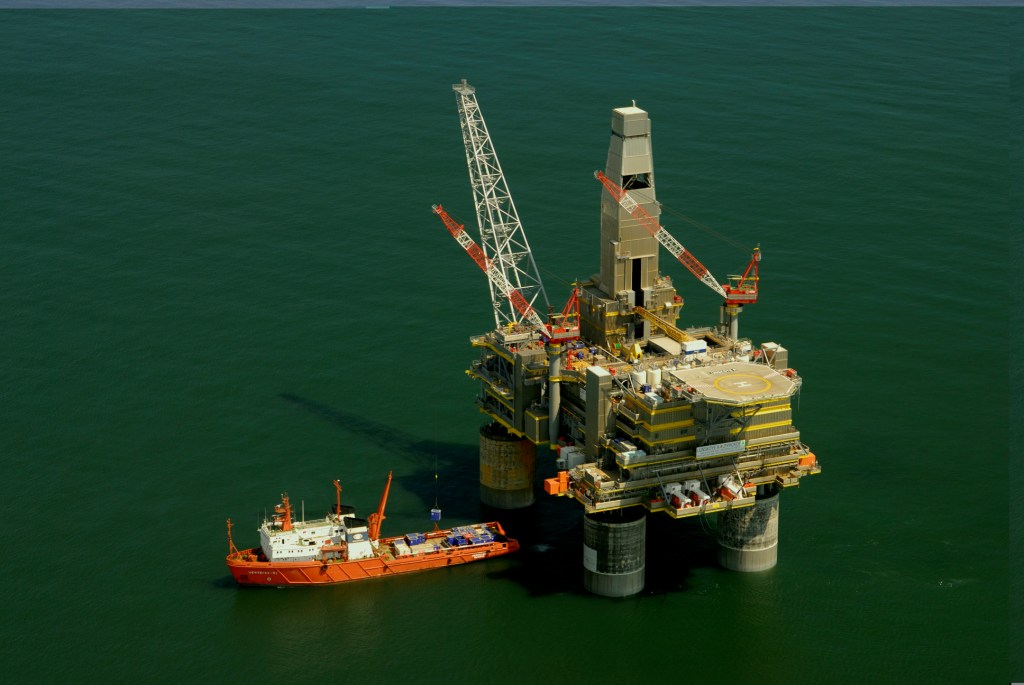
The Nigerian Upstream Petroleum Regulatory Commission (NUPRC) announced that rig counts have risen from just 8 in 2021 to 43 as of September 2025.
This development signals renewed investor confidence in the country’s upstream sector and a rebound in its oil and gas exploration and production activities.
This was disclosed by the chief executive of NUPRC, Mr Gbenga Komolafe, at the Africa Oil Week in Accra, Ghana, recently, attributing the surge to regulatory clarity, fiscal reforms, and decisive policies.
“In nearly four years, the Commission has rolled out 24 transformative regulations, 19 of which are now gazetted to operationalize key provisions of the Petroleum Industry Act,” Mr Komolafe stated.
“These reforms have dismantled barriers, unlocked opportunities, and created a more transparent, competitive operating environment,” Mr Komolafe stated
The NUPRC boss explained that the rise in rig activity underscores the effectiveness of Nigeria’s Regulatory Action Plan (RAP) which was designed to fast-track licensing, remove bottlenecks, and attract fresh capital into the upstream oil and gas sector.
He stressed that energy security remains at the heart of Nigeria’s strategy:
“Energy security is the cornerstone of economic growth, national resilience, and shared prosperity in Africa. Nigeria’s upstream revival demonstrates that reforms, when implemented with discipline, can deliver measurable results,” he stressed.
Highlighting the broader transformation, Mr Komolafe pointed to the approval of five major acquisition deals worth over $5 billion, alongside high-profile Final Investment Decisions (FIDs), such as the $5 billion Bonga North project and the $500 million Ubeta Gas Project.
“These FIDs, along with other expected projects like HI NAG Development, Ima Gas, Owowo Deep Offshore, and Preowei Fields, signal renewed long-term commitments from operators and affirm Nigeria’s competitiveness,” he said.
Mr Komolafe further noted that bid rounds and concession awards, including the 57 Petroleum Prospecting Licenses awarded in 2022, the 2022 Mini-Bid Round, and the 2024 Licensing Round, were executed with “unprecedented transparency,” attracting exceptional investor participation.
According to him, Nigeria has deliberately optimized signature bonus requirements and widened accessibility to new entrants, resulting in 27 out of 31 blocks offered in 2024 being successfully awarded.
“With the Petroleum Industry Act as our foundation, reinforced by bold Presidential Executive Orders and transformative regulatory initiatives, we are not just opening our doors to investment; we are building a world-class upstream oil and gas environment that rewards ambition, innovation, and responsibility,” Mr Komolafe declared.
He concluded that the combination of rising rig counts, record Field Development Plan approvals, and renewed investor confidence affirms that Nigeria’s upstream sector is “standing at the dawn of a new era defined by clarity, competitiveness, and confidence.”









By Adedapo Adesanya
Seven price gainers flipped recent declines at the NASD Over-the-Counter (OTC) Securities Exchange, raising the alternative stock market by 2.19 per cent on Friday.
According to data, the market capitalisation added N51.24 billion to end N2.389 trillion compared with the previous day’s N2.338 trillion, while the NASD Unlisted Security Index (NSI) climbed 85.65 points to close at 3,994.32 points, in contrast to the 3,908.67 points it ended a day earlier.
Business Post reports that the advancers were led by MRS Oil Plc, which improved its value by N13.00 to N200.00 per share from N187.00 per share, FrieslandCampina Wamco Nigeria Plc gained N7.40 to settle at N91.55 per unit versus the previous day’s N84.15 per unit, Central Securities Clearing System (CSCS) Plc appreciated by N6.08 to N71.00 per share from N64.92 per share, Afriland Properties Plc added 66 Kobo to finish at N17.17 per unit versus N16.51 per unit, IPWA Plc rose 37 Kobo to N4.15 per share from N3.78 per share, First Trust Mortgage Bank Plc grew by 11 Kobo to N1.20 per unit from N1.09 per unit, and Food Concepts Plc went up by 10obo to N3.70 per share from N3.60 per share.
On the flip side, there were two price losers led by Geo-Fluids Plc, which depreciated by 28 Kobo to N3.32 per unit from N3.60 per unit, and Industrial and General Insurance (IGI) Plc dropped 5 Kobo to sell at 45 Kobo per share from 50 Kobo per share.
Yesterday, the volume of trades went down by 92.0 per cent to 3.7 million units from 45.8 million units, the value of transactions fell by 59.4 per cent to N84.5 million from N208.2 million, while the number of deals went up by 7.7 per cent to 42 deals from 39 deals.
CSCS Plc remained the most traded stock by value (year-to-date) with 32.6 million units exchanged for N1.9 billion, trailed by Geo-Fluids Plc with 119.6 million units valued at N470.3 million, and Resourcery Plc with 1.05 billion units traded at N408.6 million.
Resourcery Plc closed the day as the most traded stock by volume (year-to-date) with 1.05 billion units sold for N408.7 million, followed by Geo-Fluids Plc with 119.6 million units worth N470.3 million, and CSCS Plc with 32.6 million units worth N1.9 billion.
By Adedapo Adesanya
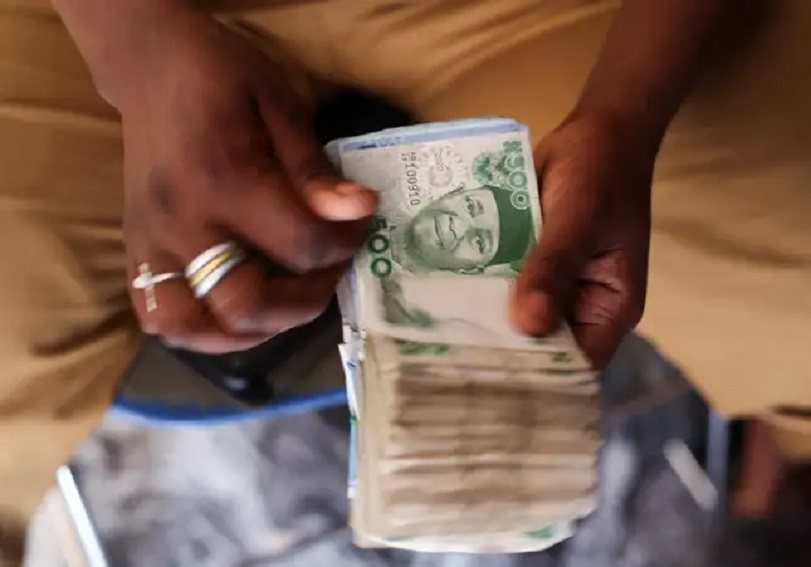
The Naira weakened further against the United States Dollar in the Nigerian Autonomous Foreign Exchange Market (NAFEX) on Friday, February 20, by N4.97 or 0.37 per cent to N1,346.32/$1 from the N1,341.35/$1 it was transacted on Thursday.
Heightened FX demand tilted the market toward the downside yesterday, exerting upward pressure on rates despite efforts by the Central Bank of Nigeria (CBN) to stabilise the foreign exchange market.
Also in the official market, the domestic currency depreciated against the Pound Sterling during the session by N9.39 to sell for N1,815.25/£1 versus the previous day’s N1,805.86/£1, and lost N7.33 against the Euro to close at N1,584.62/€1 compared with the preceding session’s N1,577.29/€1.
The story was not different for the Nigerian Naira at the GTBank FX desk, where it depleted against the Dollar by N7 on Friday to quote at N1,356/$1 versus the N1,349/$1 it was sold a day earlier, but remained unchanged in the black market at N1,370/$1.
It was observed that risky sentiment among Foreign Portfolio Investors (FPIs) contributed to the FX market, amid fears of hot money flight due to capital gains tax and other factors.
As for the cryptocurrency market, it was mostly green yesterday in reaction to a Supreme Court verdict dismissing a fresh 10 per cent global levy by President Donald Trump.
The apex court on Friday described Mr Trump’s global tariff rollout as illegal. The decision did not clarify what should happen to tariff revenue already collected, and it doesn’t necessarily spell the end of the trade agenda, with multiple legal and executive avenues still available.
Litecoin (LTC) grew 2.7 per cent to $55.00, Cardano (ADA) appreciated 2.6 per cent to trade at $0.2815, Binance Coin (BNB) expanded by 2.6 per cent to $627.19, Dogecoin (DOGE) recouped 1.3 per cent to quote at $0.1, Ripple (XRP) jumped 0.7 per cent to $1.43, Solana (SOL) improved by 0.5 per cent to $84.15, and Ethereum (ETH) soared 0.1 per cent to $1,962.78.
However, Bitcoin (BTC) lost 0.2 per cent to sell for $67,850.49, while the US Dollar Tether (USDT) and the US Dollar Coin (USDC) traded flat at $1.00 each.

By Dipo Olowookere
A further 0.99 per cent was gained by the Nigerian Exchange (NGX) Limited on Friday after a positive market breadth index supported by 53 price gainers, which outweighed 23 price losers, representing bullish investor sentiment.
During the trading day, the trio of Jaiz Bank, Fidson, and NPF Microfinance Bank chalked up 10.00 per cent each to sell for N11.00, N86.90, and N6.27, respectively, while Deap Capital appreciated by 9.96 per cent to N7.62, and Mutual Benefits increased by 9.94 per cent to N5.42.
Conversely, Secure Electronic Technology shed 10.00 per cent to trade at N1.62, Sovereign Trust Insurance slipped by 9.73 per cent to N2.32, Ellah Lakes declined by 7.91 per cent to N12.80, International Energy Insurance retreated by 5.56 per cent to N3.40, and ABC Transport moderated by 5.26 per cent to N9.00.
Data from Customs Street revealed that the insurance counter was up by 2.52 per cent, the industrial goods sector grew by 2.28 per cent, the banking space expanded by 1.43 per cent, the consumer goods index gained 1.23 per cent, and the energy industry rose by 0.05 per cent.
As a result, the All-Share Index (ASI) went up by 1,916.20 points to 194,989.77 points from 193,073.57 points, and the market capitalisation moved up by N1.230 trillion to N125.164 trillion from Thursday’s N123.934 trillion.
Yesterday, investors traded 820.5 million stocks valued at N28.3 billion in 63,507 deals compared with the 898.5 million stocks worth N38.5 billion executed in 61,953 deals, showing a jump in the number of deals by 2.51 per cent, and a shortfall in the trading volume and value by 8.68 per cent and 26.49 per cent apiece.
Closing the session as the most active equity was Mutual Benefits with 79.0 million units worth N427.1 million, Zenith Bank traded 44.0 million units valued at N3.8 billion, Chams exchanged 43.9 million units for N182.0 million, AIICO Insurance transacted 42.4 million units valued at N179.8 million, and Veritas Kapital sold 36.0 million units worth N90.6 million.









-
 Feature/OPED6 years ago
Davos was Different this year
-
Travel/Tourism10 years ago
Lagos Seals Western Lodge Hotel In Ikorodu
-

 Showbiz3 years ago
Estranged Lover Releases Videos of Empress Njamah Bathing
-
 Banking8 years ago
Sort Codes of GTBank Branches in Nigeria
-

 Economy3 years ago
Subsidy Removal: CNG at N130 Per Litre Cheaper Than Petrol—IPMAN
-

 Banking3 years ago
Sort Codes of UBA Branches in Nigeria
-

 Banking3 years ago
First Bank Announces Planned Downtime
-

 Sports3 years ago
Highest Paid Nigerian Footballer – How Much Do Nigerian Footballers Earn