Connect with us

Economy

NRS Bets on e-Invoicing to Boost Tax Compliance, Transparency

Published

on

NRS e-Invoicing

By Adedapo Adesanya

The Nigeria Revenue Service (NRS) says the rollout of electronic invoicing (e-invoicing) will strengthen tax compliance, curb revenue leakages and improve transparency in tax administration as it moves to fully digitise the country’s tax system.

The Project Lead for the NRS e-Invoicing Project, Mr Mohammed Bawa, stated this at the DigiTax E-Invoicing Compliance Breakfast Session held in Lagos on Wednesday.

The event, organised by DigiTax, an NRS-accredited e-invoicing platform, formed part of efforts to support the agency’s ongoing education and sensitisation campaign on the e-invoicing mandate.

Mr Bawa said the initiative aligns with global trends in tax digitisation and is expected to help improve Nigeria’s tax-to-GDP ratio, which remains one of the lowest in Africa.

According to him, the system will provide the NRS with greater visibility into transactions across sectors, formalise activities within the informal economy and standardise invoice formats nationwide using globally recognised invoice schemas.

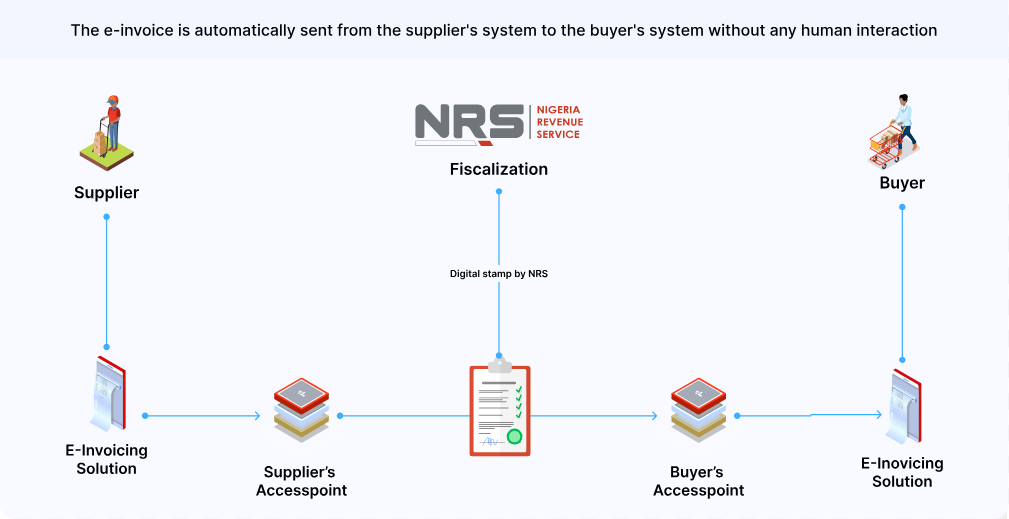
He added that e-invoicing would improve operational efficiency for both businesses and tax authorities while supporting the NRS’ transition from manual and electronic tax administration processes to a fully automated system-to-system interaction model.

Mr Bawa noted that the legal framework for implementation is backed by the Nigeria Tax Administration Act, which prescribes penalties for non-compliance.

He disclosed that the NRS has completed onboarding large taxpayers and is preparing to enforce compliance with defaulting entities.

According to him, medium taxpayers are expected to begin compliance in the third quarter of 2026, while onboarding of emerging taxpayers will commence in 2027, with full adoption targeted for all taxpayers by the end of 2028.

Mr Bawa urged taxpayers yet to be onboarded onto the platform to begin the process and work with accredited service providers to ensure compliance.

On his part, Country Director of DigiTax Nigeria, Mr Olumide Akinsola, urged businesses to look beyond their internal systems and assess the compliance status of suppliers and counterparties.

He warned that businesses whose suppliers fail to transmit invoices through the MBS platform risk losing eligibility to claim Value Added Tax (VAT) input credits on such transactions, describing the resulting supply chain exposure as a significant commercial risk that many organisations have yet to quantify.

Mr Akinsola also announced the launch of DigiTax’s white paper, The State of E-Invoicing Readiness in Nigeria, which examines compliance adoption trends and the readiness gap across different taxpayer segments.

He added that DigiTax operates in Nigeria, Kenya, Zambia and the United Arab Emirates (UAE), noting that experience from those markets shows businesses that integrate early are better positioned to avoid disruptions when enforcement begins.


Adedapo Adesanya is a journalist, polymath, and connoisseur of everything art. When he is not writing, he has his nose buried in one of the many books or articles he has bookmarked or simply listening to good music with a bottle of beer or wine. He supports the greatest club in the world, Manchester United F.C.

1 Comment

1 Comment

  1. Pingback: E-invoicing In Nigeria — Who Must Comply And When - FinanceTracked

Leave a Reply

Your email address will not be published. Required fields are marked *

Economy

Nigerian Businesses Expect Naira to Appreciate on Dollar Till January 2027

Published

on

Naira 4 Dollar

By Adedapo Adesanya

Businesses in the country expect the Naira to gradually appreciate against the US Dollar between now and January 2027, according to the Central Bank of Nigeria’s (CBN) July 2026 Business Expectations Survey Report released on Thursday.

The report showed that the Business Confidence Index (BCI) remained positive throughout the review period despite perceived macroeconomic challenges. It noted that all sectors expressed optimism about the economy, with the electricity, gas and water sector posting the highest Business Confidence Index of 59.4 points and the strongest expansion prospects for August 2026.

According to the report, “In July 2026, the Business Confidence Index was 5.7 points, reflecting continued optimistic sentiment among formal businesses.”

It attributed the positive sentiment mainly to increased demand (22.3 per cent), economic diversification (21.4 per cent), and improved access to finance (15.0 per cent). However, respondents identified inflation (27.7 per cent), energy-related challenges (23.4 per cent), insecurity (22.4 per cent), and heightened geopolitical uncertainties (16.5 per cent) as the major factors weighing on business confidence.

On the outlook by broad sector, the central bank said confidence remained positive across all sectors in July. The Industry sector recorded a modest improvement, with its index rising to 11.5 points from 10.5 points, while the Services sector increased to 3.6 points from 2.9 points.

By contrast, the Agriculture sector recorded a significant moderation, with its index falling to 3.4 points from 12.2 points.

Despite this, the apex bank said the six-month outlook remained upbeat, with confidence indices across all sectors indicating positive expectations over the review period.

On the macroeconomic outlook by region, the report noted a divergence in sentiment, with businesses in Northern Nigeria expressing stronger confidence than their Southern counterparts in July. Nevertheless, respondents across all regions maintained positive expectations for August.

Continue Reading

Economy

SEC Engages Abuja Investors on Unclaimed Capital Market Assets

Published

on

Investments and Securities Act 2025

By Aduragbemi Omiyale

A programme, tagged Probate and Unclaimed Monies Awareness and Investor Clinic, has been organised by the Securities and Exchange Commission (SEC).

The event, held on Thursday, August 6, 2026, was put together to educate investors and beneficiaries on how to recover unclaimed monies and inherited investments in the Nigerian capital market.

It is part of a nationwide awareness campaign launched by the capital market regulator in collaboration with Meristem Registrars and Probate Services Limited to improve investor protection, financial literacy and confidence in the capital market.

According to the Director General of the agency, Mr Emomotimi Agama, the campaign is to help investors and beneficiaries understand the procedures for recovering investments due to them while strengthening public confidence in the Nigerian capital market.

Thousands of investors and beneficiaries across the country remain unaware that they may be entitled to unclaimed funds arising from scheme consideration, return monies or inherited investments belonging to deceased relatives, largely because they are unfamiliar with the required documentation and claims procedures.

“Investor protection remains at the heart of the Commission’s mandate. Through this awareness campaign and Investor Clinic, we are bringing regulators and market operators together to help investors and beneficiaries understand the claims process, recover investments due to them and strengthen public confidence in the Nigerian capital market,” the SEC DG stated.

At the programme, participants received one-on-one support from SEC officials, registrars and other capital market professionals on issues relating to unclaimed investments, share ownership, probate, share transmission and beneficiary claims.

Continue Reading

Economy

Tinubu Pushes for 100% Listing of NNPC on NGX

Published

on

Tinubu kill Abu-Bilal Al-Manuki

By Adedapo Adesanya

President Bola Tinubu has reaffirmed plans to list the entire Nigerian National Petroleum Company (NNPC) Limited on the Nigerian Exchange (NGX) Limited.

The President made this known on Thursday while receiving a delegation of the NGX Group Plc at the State House, Abuja.

The team was led by the NGX Group chairman, Mr Umaru Kwairanga, and its chief executive, Mr Temi Popoola. The President was briefed on the capital market’s growth from about N30 trillion in 2023 to N160 trillion.

According to a statement by the Special Adviser to the President on Information and Strategy, Mr Bayo Onanuga, President Tinubu said the planned listing of NNPC would form a key part of his administration’s ongoing economic reforms.

He described the move as part of broader reforms aimed at expanding investment opportunities for Nigerians and deepening the country’s capital market.

“One day, not just the arms and legs, the totality of it will be listed on the Nigerian Exchange,” he said.

The President also reaffirmed that his administration’s target of building a $1 trillion economy remained achievable, citing Nigeria’s population and human capital as major advantages.

“I can see the excitement in the room. All I can do is to celebrate you all today. When we took over, it was very challenging. I had to talk to myself and define my background to accept the assets and liabilities of my predecessor. I asked for the job, and I have to do it,” President Tinubu said.

Reflecting on the administration’s monetary reforms, the President praised the Governor of the Central Bank of Nigeria (CBN), Mr Yemi Cardoso’s role in restoring confidence in the financial system.

“My capable partner in one of the thinking and reasoning days was Yemi Cardoso, whom I put at CBN. We were in the negative with monetary policy and the reserve. We had N30 trillion printed, and there were liabilities. I thank you very much, Yemi Cardoso,” he said.

President Tinubu said the performance of the stock market reflected broader improvements in the Nigerian economy.

“If the stock market is doing well, then we are doing well. We can teach this in classrooms to our undergraduates. If they can be in the classroom without the harrowing feeling of how to pay and what to pay, then we can build a nation of success and prosperity. My assurance to you is that I won’t stop reading, thinking and supporting you,” he said.

The President also reiterated his belief in private sector-led investments, recalling his longstanding support for the Dangote Refinery project.

“If we can push the private sector to invest in the economy wisely, then we will grow. It is one reason why I backed Aliko Dangote even before I became President. God bless the soul of Muhammadu Buhari. We discussed how we can support the private sector to go into the refinery business,” he added.

On his part, NGX Group CEO Temi Popoola told the President that the total value of listed equities had increased from nearly N30 trillion when the administration assumed office in 2023 to about N160 trillion, with projections to reach N230 trillion before the end of the year.

“The picture today is that when you took office in 2023, the total value of stocks listed in Nigeria was just shy of N30 trillion. Today, Mr President, that figure is N160 trillion. By the end of this year, with the listings we are seeing in our market, we expect that figure to rise to N230 trillion,” Popoola said.

He added that the Nigerian All-Share Index had risen from 52,000 points to 244,000 points, while the reforms had created an estimated 500,000 to 900,000 new millionaires, attributing the market’s performance to the administration’s reforms and expressing confidence that Nigeria could attain a $1 trillion economy before 2030.

Continue Reading