Economy
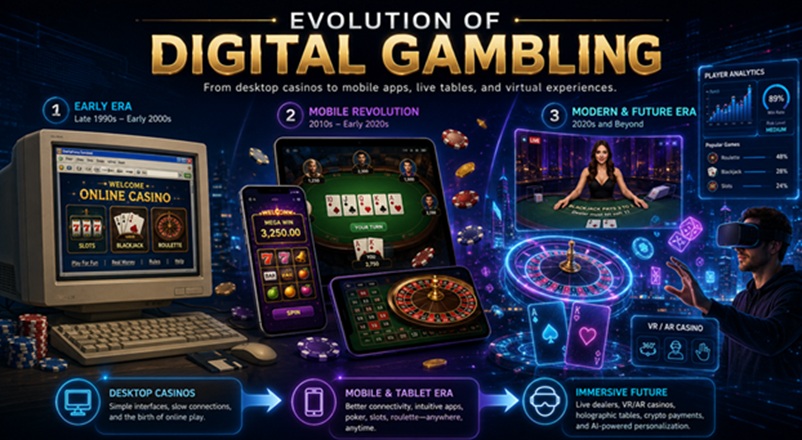
Evolution of Digital Gambling: How Virtual Establishments Changed the Culture of Modern Entertainment
The world of entertainment over recent decades has undergone fundamental transformations, moving the main centers of gravity from noisy city streets straight into our pockets. If previously a trip to a real gambling house required long planning, significant logistics expenses, and adherence to strict rules, today the popular Pinco casino platform opens access to hundreds of exciting disciplines in one click. The virtual gaming industry has turned into an important part of global media culture, offering people a comfortable way to relieve tension after a grueling workday. Virtual sites changed the very perception of excitement, turning it from a risky adventure into a safe and controllable format of evening leisure among friends or in a cozy home environment.
From Basic Scripts to High-Tech Ecosystems
The history of digital gambling establishment formation began with rather primitive web pages, where loading one reel spin took over a minute. Early online gaming platforms had a modest catalog and often raised doubts about algorithm fairness. Over time, the appearance of high-speed internet and the development of graphics engines completely changed the situation, allowing developers to create full-fledged three-dimensional worlds with surround sound and complex storylines.
In March 2026, modern gaming servers process millions of requests per second, ensuring uninterrupted access to games from anywhere on the planet. Cloud computing integration allowed getting rid of the need to download heavy software onto devices, transferring all complex mathematical calculations to remote data centers. The user receives instant feedback, smooth animation, and full data security even during network signal fluctuations.
Evolutionary Leap: Comparison of Gambling Eras
To clearly see the colossal path traveled by the virtual entertainment industry, let us look at the key characteristics of platforms from different years.
| Comparison Parameter | First Wave Establishments (2000s) | Modern Gaming Ecosystems (March 2026) |
| Technological basis | Simple Flash scripts, slow site loading | HTML5, cloud servers, artificial intelligence for adaptation |
| Gaming hall availability | Only via stationary PCs with wired internet | Cross-platform capability, instant launch on smartphones and tablets |
| Variety of formats | Basic two-dimensional slots, simple text roulette | HD broadcasts with live dealers, crash games, VR rooms |
| Security and control | Basic protection protocols, long payout checks | Multi-level encryption, automatic instant payouts |
New Standards of Rest in Digital Space
Nowadays, classic online casinos are perceived by society on par with popular streaming services or video games. The main value for the visitor has become the opportunity to manage their own time independently and create ideal conditions for relaxation.
The famous Pinco brand pays special attention to audience comfort, offering transparent game rules and certified content from leading world studios. The results of each round are determined by unbiased random number generators that regularly undergo inspection in international auditing organizations.
In addition, the modern format completely removes the psychological barrier of confidence that often arises in beginners when visiting land-based halls. A person can calmly learn the rules in a free demonstration mode, test different strategies, and choose the exact pace of play that brings the most pleasure.
When the desire to distract oneself from daily routine arises after long work at the monitor, visiting Pinco becomes a great solution for easy leisure, where you can easily switch your attention.
Toolkit of the Modern User
Technology development allowed creating a flexible system of user interaction, where every interface element works to increase comfort and security. The direction of digital entertainment became more predictable, transparent, and understandable to the general public.
Here are the key options that make modern online halls a convenient place for rest:
- Smart filtering system: the ability to instantly sort games by theme, mechanics, payout percentage, or presence of specific bonus modes.
- Interactive live studios: quality broadcasts with professional hosts creating the effect of true presence in a hall without the need to leave home.
- Fast disciplines with short sessions: special entertainment where a round lasts a few seconds, which is ideal for short breaks during the day.
- Personal privilege programs: an incentive system that automatically adapts to user activity and offers relevant bonuses.
Thanks to these functions, every visitor can customize the gaming space to their own preferences, guaranteeing themselves quality and safe rest.
Responsible Leisure and the Vector for the Future
Analyzing the sector’s future under the name future of casino entertainment, we can confidently state that the main emphasis of developers will be directed at strengthening security and implementing conscious gambling principles. Modern gambling business is interested in making sure that visiting the site remains a pleasant hobby for a person and does not go beyond the planned entertainment budget.
The Pinco platform actively supports global standards of responsible gaming, providing users with convenient self-control tools. A player can independently set deposit limits, restrict session duration, or set a reminder about the time spent on the site.
All these factors indicate that digital evolution has brought gambling entertainment to a qualitatively new level. Today, it is a technological, transparent, and comfortable type of leisure that allows distracting oneself from daily worries, preserving full security of personal data, and getting bright emotions at any convenient moment.
Economy
Nigeria Mulls 5% Revenue Fines for Anti-Competitive Midstream, Downstream Operators
By Adedapo Adesanya
The Nigerian Midstream and Downstream Petroleum Regulatory Authority (NMDPRA) could impose fines of up to five per cent of the annual turnover of petroleum operators found guilty of serious anti-competitive practices in the midstream and downstream sectors.
This was contained in the draft regulations of the proposed Midstream and Downstream Petroleum Prevention of Anti-Competitive Practices and Behaviour Regulations, 2026.
According to the proposal, errant companies of serious offences such as price-fixing, bid-rigging, market allocation, abuse of market dominance and other conduct capable of causing significant harm to competition could be fined between three and five per cent of their annual turnover.
It further proposed that persistent or serious offenders may also have their licences suspended or revoked, while the NMDPRA may impose daily penalties on operators that fail to comply with its orders or continue prohibited conduct after being directed to stop.
The draft regulation stated: “Where the Authority determines, after investigation and due process, that a licensee or any other person has engaged in anti-competitive conduct or breached any provision of this Regulation or the Act, it may impose administrative fines as provided herein.
The maximum administrative fine shall not exceed five per cent of the annual turnover of the offending undertaking for the preceding financial year.
“For purposes of these regulations, ‘annual turnover’ means gross revenues or sales derived from the regulated business activities in Nigeria. Where multiple entities or group structures are involved, the Authority may consider the turnover of the group, subsidiary, or segment most directly involved in the infringement.”
“Where a licensee or person fails to comply with an order or directive of the Authority, a daily penalty may be imposed for each day the violation continues.
“Where a prohibited practice continues after a final order, the daily penalty could rise to between N10m and N50m. Before imposing a fine, the NMDPRA would issue a Notice of Intention to Fine setting out the facts and findings, the nature of the infringement, the basis for calculating the proposed fine and the proposed deadline for payment,” it proposed.
Economy
Otedola Acquires Fresh 147.7 million First HoldCo Shares Worth N20.7bn
By Adedapo Adesanya
Nigerian billionaire, Mr Femi Otedola, the chairman of First HoldCo, has acquired an additional 147.74 million shares of the financial services group through his investment vehicle, Calvados Global Services Limited.
According to a regulatory filing obtained from the Nigerian Exchange (NGX) Limited on Monday, Mr Otedola purchased the stocks valued at N20.68 billion.
The notice said the investor purchased about 147,737,699 ordinary shares at N140 per share on August 14.
The transaction increases Mr Otedola’s stake in the financial services group from 11.99 billion shares (26.1 per cent) to 12.13 billion shares (26.4 per cent).
The acquisition comes less than two weeks after the billionaire bought 138.04 million ordinary shares for about N18.11 billion.
Prior to that, Mr Otedola had said he had invested more than N600 billion of his personal wealth in the bank, describing the investment as a “long-term generational commitment” rather than a turnaround play.
Responding to speculation about increasing his stake, Mr Otedola said his investment philosophy favours majority control.
“My investment threshold is always over and above 51 per cent,” the billionaire had said.
“One of my key investment principles is that firm shareholder control, with due regard for minority interest, is a key ingredient to executing reforms and restructuring to deliver value to all stakeholders.”
The bank’s share price had recently risen to an all-time high of N140 per share, pushing its market capitalisation to N6.37 trillion.
In recent months, Mr Otedola has also made other high-profile investments outside the banking sector, including the acquisition of a luxury residence in London’s exclusive Mayfair district, further expanding his international real estate portfolio.
He is also believed to have participated in a financing arrangement involving the Dangote Refinery, providing funds to support its working capital needs as the facility scaled up operations.
Economy
FrieslandCampina, CSCS Tumble NASD Exchange by 0.89%
By Adedapo Adesanya
The duo of FrieslandCampina Wamco Nigeria Plc and Central Securities Clearing System (CSCS) Plc pulled down the NASD Over-the-Counter (OTC) Securities Exchange by 0.89 per cent on Monday, August 17.
The price of FrieslandCampina went down by N9.85 to N160.00 per unit from N169.85 per unit, and CSCS Plc depreciated by 96 Kobo to N98.50 per share versus N99.46 per share.
As a result, the market capitalisation further lost N23.90 billion to end at N2.656 trillion, in contrast to the preceding session’s N2.68 trillion, and the NASD Security Index (NSI) dropped 39.81 points to close at 4,426.02 points from 4,465.83 points.
During the trading session, the share price of Industrial and General Insurance (IGI) Plc was up by 1 Kobo to 55 Kobo per unit from 54 Kobo per unit.
Yesterday, the volume of securities transacted by market participants decreased by 79.3 per cent to 652,081 units from 3.2 million units, the value of securities slid by 78.2 per cent to N10.7 million from N375.7 million, and the number of deals went south by 54.4 per cent to 21 deals from 46 deals.
Great Nigeria Insurance (GNI) Plc remained the most traded stock by value on a year-to-date basis, with 3.4 billion units worth N8.4 billion, followed by Infrastructure Credit Guarantee (Infracredit) Plc with 2.3 billion units valued at N6.5 billion, and CSCS Plc with 79.6 million units transacted for N5.8 billion.
GNI Plc also ended the session as the most traded stock by volume on a year-to-date basis, with 3.4 billion units exchanged for N8.4 billion, followed by Infracredit Plc with 2.3 billion units traded for N6.5 billion, and Resourcery Plc with 1.1 billion units sold for N415.7 million.