Connect with us

Economy

NSE All-Share Index Gains 3.71% to Hit 16-month High

Published

on

NSE All-Share Index

By Dipo Olowookere

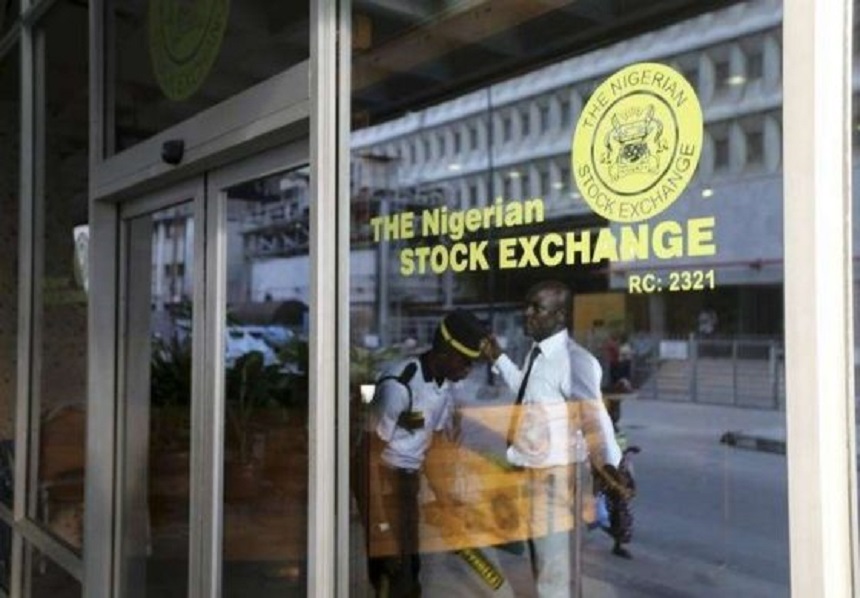
The stock market in Nigeria continued its recent bull run on Friday, appreciating by 3.71 per cent after more positive Q3 earnings inspired investors to expand their portfolios.

The bargain-hunting pushed the All-Share Index (ASI) to a level last seen in June 2019 as it crossed 30,000 points at the close of transactions. The index increased yesterday by 1,093.09 points to settle at 30,530.69 points versus 29,437.60 points it ended on Wednesday.

Business Post recalled that the last time the ASI was near 30,530.69 was on Thursday, June 6, 2019, when the market lost 1.30 per cent and the index closed at 30,527.07 points.

Yesterday, the market capitalisation inched closer to the N16 trillion region as it increased by N571 billion to finish at N15.958 trillion in contrast to N15.387 trillion it ended the previous session.

It was observed that all the five key sub-sectors of the market closed positive with the consumer goods space rising by 5.58 per cent and was followed by the industrial goods sector, which gained 5.53 per cent.

The banking counter appreciated by 3.48 per cent, the oil/gas index rose by 3.07 per cent, while the insurance sector moved up by 2.32 per cent.

There were 43 price gainers at the close of business on Friday, higher than the 11 price losers and the 10 stocks, which had their prices unchanged.

The biggest price riser was Nestle Nigeria, which appreciated by N129.20 to close at N1421.70 per share and was trailed by Mobil Nigeria, which gained 17.80 to finish at N196.10 per unit.

Total Nigeria rose by N11 to end at N129.90 per share, Dangote Cement appreciated by N4.70 to trade at N160 per unit, while BUA Cement chalked up N4.10 to sell at N45.50 per share.

Guinness Nigeria was the heaviest price loser on Friday after depreciating by 55 kobo to quote at N17 per unit and was followed by NAHCO, which lost 12 kobo to settle at N2.10 per share.

PZ Cussons shed 10 kobo to trade at N4.45 per unit, Prestige Assurance declined by 6 kobo to sell at 54 kobo per share, while Ecobank depleted by 5 kobo to N5.65 per unit.

On the activity chart, the trading volume, value and number of deals increased by 115.27 per cent, 126.60 per cent and 36.42 per cent respectively.

This was because a total of 807.8 million shares worth N10.5 billion were traded in 8,113 deals yesterday compared with the 375.2 million stocks worth N4.6 billion transacted in 5,947 deals on Wednesday.

There was no trading activity on the floor of the Nigerian Stock Exchange (NSE) on Thursday as a result of the public holiday declared by the federal government to celebrate Eid-el-Maulud, which is the birthday of Prophet Mohammed.

UBA was the most traded stock on Friday as a result of the 108.6 million units of its shares worth N816.7 million traded by market participants.

Access Bank transacted 94.7 million equities valued at N746.9 million, FBN Holdings exchanged 89.6 million stocks for N581.5 million, Zenith Bank traded 75.2 million shares valued at N1.7 billion, while GTBank transacted 56.2 million stocks worth N1.8 billion.


Dipo Olowookere is a journalist based in Nigeria that has passion for reporting business news stories. At his leisure time, he watches football and supports 3SC of Ibadan. Mr Olowookere can be reached via [email protected]

Economy

Naira Trades Flat Across FX Market Windows as CBN Moves to Ease Pressure

Published

on

Naira-Denominated Assets

By Adedapo Adesanya

The Naira was flat against the US Dollar in the Nigerian Autonomous Foreign Exchange Market (NAFEX) on Tuesday, December 16, retaining the previous closing value of N1,451.82/$1.

In the same vein, the local currency saw no movement against the Pound Sterling and the Euro in the spot market during the session at N1,943.98/£1 and N1,705.74/€1, respectively.

Also, the Nigerian Naira remained unchanged in the black market yesterday at N1,475/$1 and was N1,460/$1 at the GTBank forex counter.

The Central Bank of Nigeria (CBN) has strengthened US Dollar supply with $250 million to authorised dealer banks at the official window cumulatively as foreign portfolio investors, exporters and non-bank corporate supply dripped.

The spread between official and other non-regulated markets decreased to N30.59$/1 from N44.57/$1, from the previous week, research subsidiary of Coronation Merchant Bank Limited said in a report.

FX analysts said foreign exchange inflows through the Nigerian Foreign Exchange Market decreased to $716.3 million from $844.70 million in the previous week , a 15 per cent drop in a week.

Foreign portfolio investors accounted for the highest share of inflows at 32.98 per cent, followed by exporters at 30.84 per cent, the CBN (17.36 per cent), Non-bank Corporates (16.94 per cent), others (0.72 per cent) and Individuals (0.63 per cent).

On Monday, Nigeria’s headline inflation rate eased to 14.45 per cent in November 2025, down from 16.05 per cent recorded in October, according to the latest Consumer Price Index (CPI) report released by the National Bureau of Statistics (NBS), representing a decrease of 1.6 percentage points month-on-month and marks a significant moderation compared to the same period last year.

As for the cryptocurrency market, there was some recoveries after overall capitalization falling below $3 trillion for the third time in a month. Large-cap assets, particularly those with Exchange Traded Fund (ETF) exposure, are experiencing selling pressure as institutional investors reassess risk.

Ripple (XRP) appreciated by 1.5 per cent to $1.92, Litecoin (LTC) expanded by 1.5 per cent to $78.91, Dogecoin (DOGE) rose by 0.8 per cent to $0.1308, Solana (SOL) went up by 0.4 per cent to $127.60, Binance Coin (BNB) grew by 0.3 per cent to $865.40, and Bitcoin (BTC) gained 0.2 per cent to sell at $86,735.17.

On the flip side, Cardano (ADA) depreciated by 1.0 per cent to $0.3802 and Ethereum (ETH) slumped by 0.4 per cent to $2,935.85, while the US Dollar Tether (USDT) and the US Dollar Coin (USDC) were flat at $1.00 each.

Continue Reading

Economy

Stock Investors’ Portfolios Swell N14bn as Index Rises 0.01%

Published

on

stock investors' portfolios

By Dipo Olowookere

A marginal 0.01 per cent rise was recorded by the Nigerian Exchange (NGX) Limited on Tuesday. This was different from the flattish mode of the market the previous day.

Investor sentiment remained bullish as Customs Street finished with 31 price gainers and 26 price losers, implying a positive market breadth index.

Aluminium Extrusion topped the gainers’ log after it improved its price by 10.00 per cent to N9.35, Guinness Nigeria appreciated by 9.98 per cent to N263.40, Multiverse expanded by 9.95 per cent to N12.15, MeCure Industries also soared by 9.95 per cent to N45.85, and Sovereign Trust Insurance advanced by 9.89 per cent to N4.11.

Conversely, Haldane McCall led the losers’ chart after it shed 9.93 per cent to settle at N3.72, Veritas Kapital lost 9.09 per cent to close at N1.60, LivingTrust Mortgage Bank also declined by 9.09 per cent to N3.50, and Linkage Assurance depreciated by 5.71 per cent to N1.65.

During the trading day, the All-Share Index (ASI) went up by 21.23 points to 149,459.11 points from the previous day’s 149,437.88 points and the market capitalisation increased by N14 billion to N95.281 trillion from N95.267 trillion.

Yesterday, traders transacted 1.0 billion equities for N21.8 billion in 23,701 deals compared with the 553.1 million equities valued at N13.3 billion traded in 28,907 deals on Monday, representing a decline in the number of deals by 18.01 per cent, and a surge in the trading volume and value by 80.80 per cent and 63.91 per cent apiece.

Access Holdings traded 385.8 million stocks worth N7.7 billion, Champion Breweries transacted 111.8 million shares valued at N817.8 million, Sterling Holdings exchanged 85.5 million equities for N589.9 million, FCMB sold 74.7 million shares valued at N791.5 million, and First Holdco transacted 51.9 million equities worth N1.8 billion.

Continue Reading

Economy

Brent Crude Drops Below $60 Per Barrel

Published

on

brent crude oil

By Adedapo Adesanya

The price of the global crude oil benchmark, Brent crude, lost 2.71 per cent or $1.64 to settle at $58.92 per barrel on Tuesday, its lowest level since early 2021, as a looming surplus and possible peace agreement in Ukraine weigh on the market.

The US West Texas Intermediate (WTI) crude fell 2.73 per cent or $1.55 to close at $55.27 per barrel, the lowest since February 2021 during the COVID-19 pandemic.

Fears of an oversupply were marginally offset by the US seizing an oil tanker off Venezuela last week, but traders and analysts said a glut of floating storage.

Also, a surge in Chinese buying from Venezuela in anticipation of sanctions were also limiting the market impact.

The oil market is under pressure this year as members of the Organisation of the Petroleum Exporting Countries and its allies (OPEC+) have rapidly ramped up production after years of output cuts.

Investors are also pricing in the possibility of lower geopolitical risk as President Donald Trump pressures Ukraine to accept a peace agreement with Russia.

The threat of supply disruptions has loomed over the oil market since Russia launched its full-scale invasion of Ukraine in 2022. The US and its European allies targeted Russia’s crude industry with sanctions in response.

Now, with the US offering to provide NATO-style security guarantees for Ukraine and European negotiators reporting progress in talks on Monday, there was renewed optimism that an end to the war was closer.

Ukraine’s attacks on oil infrastructure and US sanctions on Russian oil companies would likely be lifted relatively quickly in the event of an agreement.

Market analysts noted that the end of US sanctions on Russia would also change the incentives for OPEC+ as the group would likely resume a strategy to retake market share through higher production. More supply could lead to weaker prices.

Adding to the pressure, soft Chinese economic data on Monday further fuelled concerns that global demand may not be strong enough to absorb recent supply growth.

Falling oil prices could signal a slowing economy after the US job growth totalled 64,000 in November but declined by 105,000 in October. The unemployment rate hit a four-year high of 4.6 per cent.

Barclays analysts expect Brent to average $65 per barrel in 2026, slightly ahead of the forward curve, due to the expected 1.9 million barrels per day surplus they see as being priced in already.

Continue Reading

Trending