Connect with us

Economy

NSE Approves Delisting of First Aluminium Shares

Published

on

By Dipo Olowookere

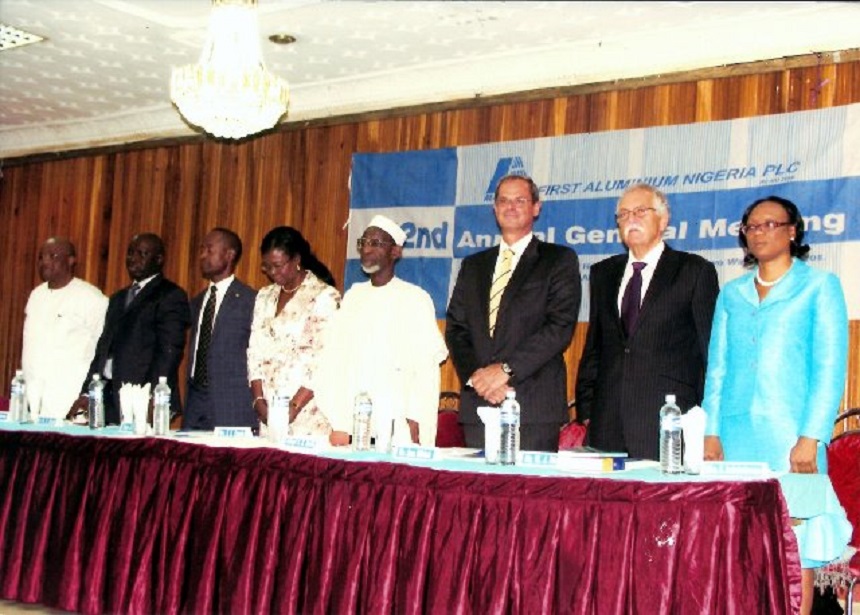
The voluntary delisting of the entire shares of First Aluminium Nigeria Plc has been approved by the Nigerian Stock Exchange (NSE).

Business Post confirmed at the weekend that the approval was given by the stock market regulator on Thursday, May 9, 2019.

First Aluminium Nigeria had sent an application to the NSE for delisting of its entire shares from the daily official list.

The reason for this move, according to the company, was due to the low trading of the shares of the company at the equity market.

Last month, the board of aluminium firm explained that the inactivity on the shares of the company as well as the inability of the current listing to help in realizing the corporate objectives of the company are the main reason behind the delisting.

The firm had intended to raise fresh capital to boost its operations, but its current illiquidity has rendered this primary corporate objective unattainable.

According to the company, over the last 12 months, there has been a significant fall in average daily trading volumes to 2,918 shares between July 2017 and June 2018 and further dip to 2,816 shares between July 2018 and December 2018.

“Neither the company nor any shareholder is benefiting from the continued listing on the NSE. Furthermore, rationalization of operational expenses to support the company’s business and to meet the needs of various stakeholders as the attendant cost required to comply with its listing requirements including filing fees, penalties or sanctions, are not commensurate with the benefits to the company,” First Aluminium stated.

According to the company, over the past seven years, there have been little or no trading activity on the shares held by the minority shareholders while the share price was stuck at 50 kobo for about six years. It has since dropped further below nominal value.

“Shareholders are not benefitting from the continued listing as they are not getting exit opportunities and their investments have been locked up, thereby finding it difficult of their shareholding. Neither the company nor its shareholders have benefitted as the company’s shares continue to trade at a significant discount to the intrinsic value,” First Aluminium added.

ALUCON Holdings SA, the majority core investor that holds about 75.48 percent equity stake in First Aluminium Nigeria, is offering to buy out willing minority shareholders, which represents about 24.52 percent equity stake in the company.

ALUCON Holdings is offering to pay 55 kobo per share. Alternatively, shareholders can trade their shares on the NSE. However, a shareholder that desires to remain a shareholder of an unlisted First Aluminium Nigeria Plc shall be free to do so.


Dipo Olowookere is a journalist based in Nigeria that has passion for reporting business news stories. At his leisure time, he watches football and supports 3SC of Ibadan. Mr Olowookere can be reached via [email protected]

Click to comment

Leave a Reply

Your email address will not be published. Required fields are marked *

Economy

Naira Rallies N7.27 on Dollar to N1,372/$1 at NAFEM

Published

on

weakening Naira

By Adedapo Adesanya

The Naira further appreciated against the US Dollar by N7.27 or 0.39 per cent to N1,372.41/41 in the Nigerian Autonomous Foreign Exchange Market (NAFEX) on Wednesday, July 1 compared with the previous day’s N1,379.68/$1.

The local currency also further improved against the Pound Sterling in the official market by N3.32 to close at N1,821.73/£1 compared N1,825.05/£1, and gained N7.61 on the Euro to sell at N1,565.37/€1 versus N1,572.98/€1.

Meanwhile, the Naira traded flat against the Dollar at the parallel market yesterday at N1,395/$1, and also closed flat at the GTBank FX desk at N1,389/$1.

Interbank FX deals count reduced to 91 from 166, reducing pressures on foreign currency supply at the FX window. A lower number of deals and turnover suggested that bank customers’ Dollar requests eased today, pointing to low demand and alleviating pressure on the Naira.

Nigeria’s gross external reserves closed the first half of 2026 at $51.46 billion following a sequence of additional FX inflows from across key sources, including oil sales.

The market also got affirmations of stronger policy direction as the Central Bank of Nigeria (CBN) continued to sanitise the financial system with the revocation of 46 microfinance banks across the country with immediate effect.

In the cryptocurrency market, the market was positive after the US Federal Reserve Chairman, Mr Kevin Warsh, said inflation risks had eased, giving a market that spent most of June grinding lower its first clear lift in weeks.

Speaking at the European Central Bank’s annual forum in Sintra, Portugal, on Wednesday, Mr Warsh said “inflation risks have come down” while reaffirming the Fed’s commitment to returning inflation to 2 per cent.

Solana (SOL) grew by 3.9 per cent to $78.02, Bitcoin (BTC) rose by 2.5 per cent to $60,385.27, Ethereum (ETH) expanded by 2.3 per cent to $1,623.09, Cardano (ADA) jumped by 2.1 per cent to $0.1542, Ripple (XRP) appreciated by 0.9 per cent to $1.05, Dogecoin (DOGE) increased by 0.7 per cent to $0.0726, and Binance Coin (BNB) soared by 0.4 per cent to $551.50.

On the flip side, TRON (TRX) fell by 0.2 per cent to $0.3154, while the US Dollar Tether (USDT) and the US Dollar Coin (USDC) remained unchanged at $1.00 each.

Continue Reading

Economy

Aradel, Dangote Cement, Others Pull Back Stock Exchange by 1.65%

Published

on

Aradel Holdings

By Dipo Olowookere

The gains recorded by the Nigerian Exchange (NGX) Limited on Tuesday were quickly erased on Wednesday after stocks like Dangote Cement, Aradel Holdings, International Breweries and others recorded losses.

Apart from the insurance index, which closed higher by 0.42 per cent, every other sector ended in the red, with the energy space down by 4.41 per cent. The industrial goods segment lost 3.63 per cent, the banking sector depreciated by 1.49 per cent, and the consumer goods counter fell by 0.93 per cent.

Consequently, the All-Share Index (ASI) contracted by 3,729.11 points to 225,690.07 points from 229,419.18 points, and the market capitalisation retreated by N2.393 trillion to N144.825 trillion from N147.218 trillion.

Investor sentiment was bearish after the stock exchange closed the day with 22 appreciating equities and 32 depreciating equities, indicating a negative market breadth index.

Neimeth shed 10.00 per cent to settle at N8.10, Aradel bled by 10.00 per cent to quote at N1,275.80, NASCON crashed by 9.98 per cent to N197.60, International Breweries lost 9.52 per cent to trade at N9.50, and Livestock Feeds slipped by 9.43 per cent to N28.12.

On the flip side, Austin Laz gained 10.00 per cent to sell for N3.30, Guinea Insurance appreciated by 9.89 per cent to N1.00, DAAR Communications rose by 9.60 per cent to N1.37, Regency Alliance expanded by 9.52 per cent to 92 Kobo, and Sovereign Trust Insurance grew by 7.85 per cent to N2.06.

Business Post reports that the level of activity dropped yesterday, and Sterling Holdings led the activity log, with a turnover of 124.6 million units worth N980.6 million. UPDC traded 40.1 million units for N130.4 million, Access Holdings exchanged 36.8 million units valued at N811.6 million, Honeywell Flour transacted 33.8 million units worth N490.1 million, and United Capital sold 28.4 million units for N469.1 million.

At the close of transactions, market participants traded 488.1 million units valued at N14.0 billion in 46,929 deals versus the 966.7 million units worth N40.0 billion executed in 49,579 deals in the previous session, implying a drop in the trading volume, value, and number of deals by 49.51 per cent, 65.00 per cent, and 5.35 per cent, respectively.

Continue Reading

Economy

Crude Oil Drops Nearly 2% as Trump Hails Iran Talks

Published

on

Crude Oil Theft special court

By Adedapo Adesanya

Crude oil was down by nearly 2 per cent ​on Wednesday as optimism over US-Iran talks eased supply concerns after US President Donald ‌Trump said discussions in Qatar had gone well.

Brent futures gave up $1.38 or 1.89 per cent to sell for $71.57 a barrel, and the US West Texas Intermediate (WTI) crude lost 92 cents or 1.32 per cent to trade at $68.58 a barrel.

President Trump said on Wednesday that the US was getting along ⁠very well with Iran and that recent meetings in Qatar went well.

“The denuclearisation of ​Iran is moving along well,” the American President ​told reporters. “They’ve had very good meetings, and ⁠we’ll see.”

The US and Iran held technical talks in Doha as they seek ​to agree on the flow of shipping through the Strait of Hormuz and secure a lasting ceasefire, a source with direct knowledge ​of the talks and an Iranian official said.

The US and Iran have sparred publicly over the meaning of the interim pact, exchanging military strikes over the past week.

Meanwhile, US Vice President JD Vance again signalled that the White House is prepared to use force against Iran if diplomacy fails, raising the stakes around a 60-day memorandum of understanding (MOU) that has halted open hostilities but left the core disputes unresolved.

Crude oil inventories in the United States decreased by 3.8 million barrels during the week ending June 26, according to new data from the U.S. Energy Information Administration (EIA) released on Wednesday. The EIA’s data release follows figures by the American Petroleum Institute (API) that were released a day earlier, which reported that crude oil inventories saw a draw of 6.072 million barrels in the period.

Analysts have cut their 2026 oil price forecasts for the first time since the Iran war began, as the reopening of the Strait of Hormuz eased concerns over prolonged supply disruptions.

Meanwhile, a sub-group of oil-producing countries in the Organisation of the Petroleum Exporting Countries and its allies (OPEC+) will likely agree on a further hike ​in their output targets from August when they meet on Sunday. The target will increase by about 188,000 barrels per day for August, the same as for June and July.

The seven core OPEC+ members have increased their output quotas from April to July by almost 800,000 barrels ​per day even as the Iran war led to a sharp drop in production among key members.

Continue Reading

Trending