Economy
Oando Gains 34.12% in One Week After Share Buy-Out News
By Dipo Olowookere
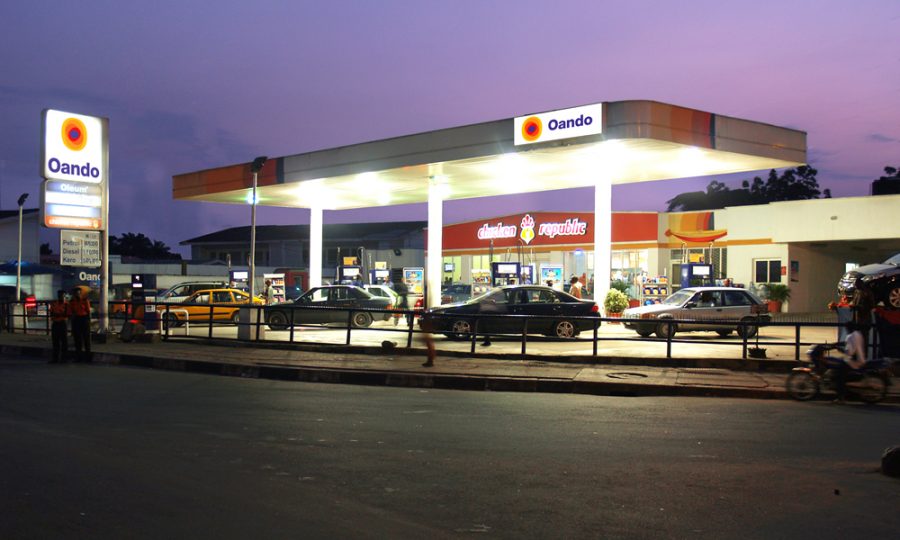
The stock price of Oando Plc appreciated by 34.12 per cent on the floor of the Nigerian Exchange (NGX) Limited last week to close at N5.70 versus the preceding week’s N4.25.
This appreciation happened after its share buy-out news and its return to profitability in the 2021 financial year, according to its financial statements released in the week.
Investors pounced on the information and pushed the energy firm to the top of the gainers’ chart last week, with Ikeja Hotel after it appreciated by 18.45 per cent to N1.22. Champion Breweries rose by 13.27 per cent to N5.55, Royal Exchange grew by 13.04 per cent to 78 Kobo, and UPDC increased by 11.46 per cent to N1.07.
On the flip side, Prestige Assurance topped the losers’ log after it depreciated by 11.11 per cent to 40 Kobo, NCR Nigeria shed 9.79 per cent to N2.12, CWG depleted by 9.38 per cent to 87 Kobo, Dangote Cement fell by 7.10 per cent to N17.00, and United Capital decreased by 6.67 per cent to N11.20.
Business Post reports that in the week, 37 stocks finished on the advancers’ chart versus 28 stocks in the previous week, while 30 equities were on the decliners’ table versus 27 equities in the preceding week, with 90 shares closing flat compared with 102 shares a week earlier.
Data showed that profit-taking dominated the ecosystem, leading to a 1.20 per cent decline in the All-Share Index (ASI) and the market capitalisation to close 54,232.34 points and N29.544 trillion, respectively.
It was observed that all other indices finished higher except NGX main board, NGX 30, energy, Lotus II, industrial goods and growth indices, which dwindled by 0.95 per cent, 1.24 per cent, 2.02 per cent, 0.70 per cent, 3.26 per cent and 2.53 per cent, respectively, while the ASeM and sovereign bond indices closed flat.
The turnover for the week increased to 2.071 billion shares worth N17.562 billion in 17,917 deals from the 1.689 billion shares worth N11.066 billion traded in 14,019 deals a week earlier.
The financial services industry dominated the activity chart with 948.792 million equities valued at N7.621 billion traded in 7,903 deals, contributing 45.80 per cent and 43.40 per cent to the total trading volume and value apiece.
The conglomerates sector followed with 930.664 million stocks worth N1.486 billion in 1,591 deals, while the energy counter recorded a turnover of 60.510 million shares worth N1.472 billion in 1,369 deals.
The trio of Transcorp, Living Trust Mortgage Bank and Fidelity Bank accounted for 1.429 billion stocks worth N3.461 billion in 1,620 deals, contributing 69.00 per cent and 19.71 per cent to the total trading volume and value, respectively.
Economy
Nigeria’s Headline Inflation Slows Marginally to 15.91% in June
By Adedapo Adesanya
Nigeria’s headline inflation rate in June 2026 moderated to 15.91 per cent from 15.93 per cent in May, as pressure from the Iran war mildly eased, though it largely remained in focus during the review month.
In the report on Wednesday, the statistical office showed that the headline inflation rate for June on a month-on-month basis was 1.66 per cent, 0.09 per cent lower than the 1.75 per cent recorded in May 2026.
On an annualised basis, the print was down from 25.29 per cent in the same month of the preceding year (June 2025). This was due to the rebasing of the calculation year from 2009 to 2024.
The rise in prices, which stemmed from the continued conflict in the Middle East, continued to stoke food prices and energy costs, which account for a huge chunk of average spending.
The food inflation rate in May 2026 on a month-on-month basis was 3.75 per cent, up by 0.77 percentage points from May 2026 (2.98 per cent), while on a year-on-year basis, it was 17.52 per cent and stood at 25.41 per cent in the same month of the preceding year (June 2025).
At 15.91 per cent print, the inflation marginally beat expectations by Meristem Research, predicted at 15.95 per cent.
There had been expectations that the ceasefire between the United States and Iran would help drive oil prices lower, raising expectations of some relief on the inflation front. However, with conflicts now flaring up again, oil prices are likely to increase again, and the anticipated easing in energy-driven inflation may not materialise as broadly as earlier envisaged.
Meristem Research said it expects inflationary pressures to re-emerge across key economies in the near term, as the re-escalation of the US-Iran conflict has reignited upward pressure on global oil prices.
This will be a core factor that the Monetary Policy Committee (MPC) of the Central Bank of Nigeria (CBN) will be looking at when it meets for the next policy meeting. At its last meeting, the committee left benchmarked interest rates at 26.5 per cent.
Economy
PenCom Assures Strong Risk Controls for PFA Investments in Custodians’ Parent Companies
By Adedapo Adesanya
The National Pension Commission (PenCom) has defended its decision to allow Pension Fund Administrators (PFAs) to invest in the parent companies of their custodians, insisting that adequate safeguards are in place to protect contributors’ funds.
The director-general of the pension regulator, Ms Omolola Oloworaran, speaking on Tuesday during the Meet the Press Briefing at the Presidential Villa, Abuja, said the commission’s decision to relax the investment restriction followed a comprehensive risk assessment that found minimal conflict of interest.
She explained that under PenCom’s investment regulations, PFAs are only permitted to invest pension assets in carefully selected instruments that meet stringent criteria, including profitability, strong credit ratings and proven track records.
According to her, the commission regularly reviews its investment regulations, conducts routine examinations and spot checks on PFAs to ensure strict compliance with established risk management guidelines.
“PFAs cannot just go into the stock market and buy any kind of stock. There are strict guidelines. Companies must demonstrate profitability, have a proven track record and satisfy other criteria before pension funds can invest,” she said.
Ms Oloworaran noted that each PFA also operates under the oversight of a board, an investment committee and a risk management committee, providing additional layers of governance to safeguard contributors’ funds.
She said PenCom recently issued a circular allowing PFAs to invest in the parent companies of their custodians after determining that the potential conflict of interest was negligible.
The PenCom boss explained that the parent companies involved are largely Tier-1 banks, including First Bank, United Bank for Africa (UBA) and Zenith Bank, which she described as A-rated institutions with strong financial foundations.
She said the policy was intended to widen investment opportunities for pension funds without compromising safety.
Using Stanbic IBTC as an example, Ms Oloworaran explained that if its custodian is Zenith Bank, the previous restriction prevented the pension administrator from investing in Zenith Bank shares despite the bank’s strong performance.
“We reviewed the risks and any potential conflict of interest and found the risks to be very low. That is why we opened that investment window,” she said.
Economy
Meristem Forecasts 15.95% Inflation Rate for June 2026
By Aduragbemi Omiyale
Analysts at Meristem Research have predicted that the inflation rate for June 2026 in Nigeria should marginally rise to 15.95 per cent on a year-on-year basis from the 15.93 per cent reported in May 2026.
The National Bureau of Statistics (NBS) is expected to release inflation numbers for last month later today, Wednesday, July 15, 2026.
In its report sighted by Business Post, Meristem Research said it expects inflationary pressures to re-emerge across key economies in the near term, as the re-escalation of the US-Iran conflict has reignited upward pressure on global oil prices.
It disclosed that this marks a sharp reversal from most of June, when the ceasefire between the two countries helped drive oil prices lower, raising expectations of some relief on the inflation front.
With conflicts now flaring up again, oil prices are likely to increase again, and the anticipated easing in energy-driven inflation may not materialise as broadly as earlier envisaged.
“Nonetheless, some relief is likely from the food segment, where robust supply conditions across major producing regions and softening demand should continue to ease food price pressures,” it stated.
The team also explained that it projected a 15.95 per cent inflation rate because of the lingering effects of persistent food price pressures.
“However, we expect core inflation to moderate as the sharp reversal in energy prices begins to filter through to transportation, distribution, and other energy-related costs, easing underlying price pressures.
“On a month-on-month basis, the combined effect of lower petrol prices, a relatively stable Naira, and the gradual pass-through of reduced energy costs across the supply chain should exert further downward pressure on inflation.
“Based on our assessment, food inflation is expected to remain the key swing factor, as seasonal pre-harvest supply constraints are likely to offset some of the gains from lower logistics costs,” it said.