Economy
Oil-Producing Communities Urge FG to End Petrol, Diesel Importation
By Aduragbemi Omiyale
The federal government has been urged to put an end to the importation of premium motor spirit (PMS), commonly known as petrol, and automated gas oil (AGO), otherwise known as diesel, because it is putting the nation at the mercy of some oil cartels and international oil companies (IOCs).
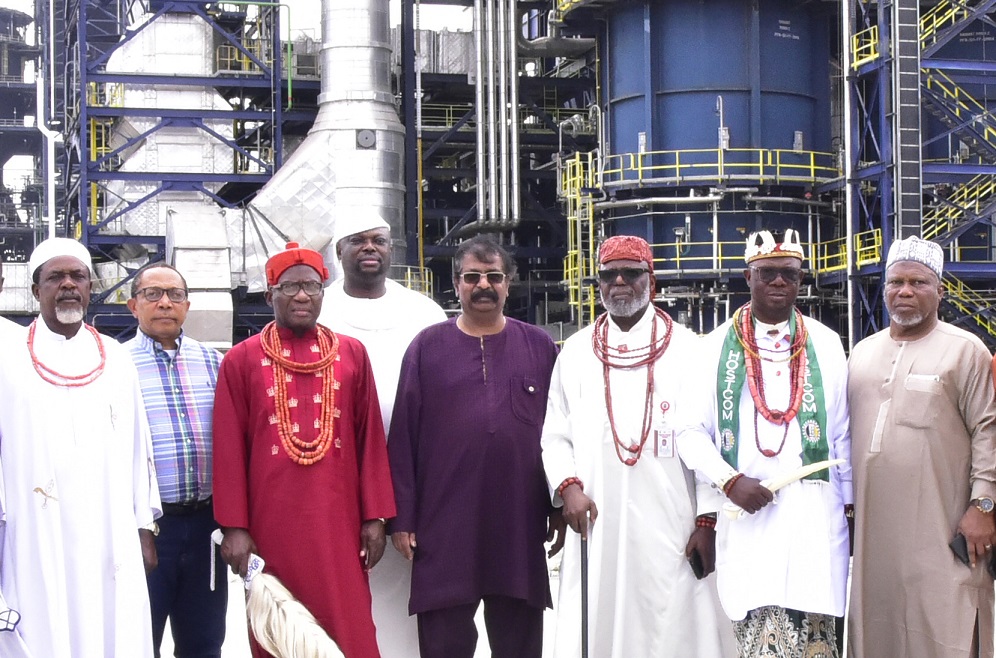
This appeal was made by a group known as the Host Communities of Nigeria Producing Oil and Gas (HOSTCOM) over the weekend.
The association was reacting to the recent development involving the lamentation of Africa’s richest man, Mr Aliko Dangote, who claimed that IOCs were frustrating the operations of his $20 billion refinery in Lagos.
HOSTCOM lamented that despite the billions of dollars spent on turnaround maintenance of Nigeria’s refineries, the country remains reliant on importing refined products.
This persistent issue, it argues, highlights the widespread corruption within Nigeria’s oil and gas industry, allegedly orchestrated by influential cabals who are intent on maintaining the status quo of exporting crude oil while importing refined petroleum products, warning that it will not hesitate to publicly name these identified cabals if necessary.
It threatened to renew agitation for greater autonomy and control of its natural resources if the Nigerian National Petroleum Company (NNPC) Limited and the IOCs fail to sell and supply crude oil to Dangote Refinery and other local refineries in their bid to ensure that Nigeria becomes self-sufficient in the local production of petroleum products.
The National President of HOSTCOM, Mr Benjamin Tamaramiebi, accompanied by his executives and traditional rulers from the Niger Delta region, during a tour of the Dangote Petroleum Refinery & Petrochemicals and the Dangote Fertiliser Limited complex in Lagos, also called for the removal of the chief executive of the Nigerian Midstream and Downstream Petroleum Regulatory Authority (NMDPRA), Mr Farouk Ahmed, over his recent statement that the government would not halt the importation of refined petroleum products.
“Our visit today to the largest and magnificent 650,000 bpd private refinery in Africa (Dangote Refinery) has opened our eyes to several ills, particularly the monumental corruption going on in the Nigerian oil and gas industry,” Mr Tamaramiebi said.
“It is obvious why the existing federal government refineries in Port Harcourt, Warri, and Kaduna can never work or operate maximally despite the billions of dollars spent on so-called turn-around maintenance (TAM) over the years.
“It is now clear that some persons in government and outside government have been identified as the cabal holding Nigeria’s oil sector by the jugular. We have identified them, and we shall reveal their names to the people of Nigeria if this trend continues,” he added.
Mr Tamaramiebi called on President Bola Tinubu to support and sustain Dangote Refinery, advising him to “do away with the cabals holding the oil sector to ransom,” emphasising that the government must not tolerate the economic sabotage being carried out by the IOCs operating in Nigeria, which have refused to sell crude oil to the Dangote Refinery and other modular refineries.
“We call on Mr President to direct NNPC or NNPCL to compel the IOCs operating in our communities to sell and supply crude oil to Dangote Refinery and other local refineries in line with Section 109 of the Petroleum Industry Act PIA 2021, particularly Section 109(4)(b), which states that “the supply of crude oil shall be commercially negotiated between the lessee and the crude oil refining licensee, having regard to the prevailing international market price for similar grades of crude oil.”
In his remarks, the Vice President for Oil and Gas at Dangote Industries Limited, Mr Devakumar Edwin, in his remarks, explained that the refinery was established primarily to source and refine local crudes for the benefit of Nigeria while also exporting excess production to boost the economy.
He noted that the lack of sufficient Nigerian crude supplies has necessitated importing crude from other countries and continents, adding that if the refinery had not been designed to process a wide range of crudes, including various African and Middle Eastern crudes as well as US Light Tight Oil, it would have become inactive due to the lack of Nigerian crude supplies.
Economy
NCDMB Issues NCEC Guidance Notes to Ease Oil Contracts, Cut Production Costs
By Adedapo Adesanya
The Nigerian Content Development and Monitoring Board (NCDMB) says it has issued the Nigerian Content Equipment Certificate (NCEC) guidance notes to speed up oil and gas industry contracting processes, weed out firms lacking technical capacity to perform, and to reduce Nigeria’s cost of oil production.
The document forms part of concerted efforts to operationalize the Presidential Directives (PDs) on Local Content Requirements, which mandates NCDMB to take further steps to eliminate intermediaries in the contracting process, lacking demonstrable capacity.
Emphasising that one of the key requirements for participating in the Nigerian oil and gas industry contracting process is the possession of NCECs issued by the NCDMB, the document states that “Unmerited possession and/or misapplication of the NCECs during tendering/bid evaluations contribute to contracting delays and admittance of unqualified intermediaries into the contracting process”.
According to NCDMB, the goal of the new document is to “tackle cases of single and multiple NCEC applications not matched to capacities on ground, submission of fake/forged documents, under declaration of personnel, non-existent offices/equipment, and many other dubious applications.”
It will also enhance timely review and approval of applications from genuine service companies as the document provides all the requirements needed to complete credible application at first attempt.
The eight NCEC categories cover Manufacturing & Related Services (MS); Fabrication & Construction (FC); Construction & Moveable Equipment (EC); Services & Support (SS); Quality Control Inspection and Testing (QS); Non-Moveable Assets (DA); Procurement & Supplies (PS); and Consultancy Services (CS).
The document advised service companies to provide details of their specific service offering with sufficient supporting evidence while applying for any of the NCEC categories via the application portal. Providing further explanation, NCDMB stressed that it does not solicit or require any payment for the application, processing, or approval of NCEC or any of its certifications.
It added that “in line with the Presidential directive on Local Content compliance, NCDMB prohibits the use of agents/middlemen/third parties in raising/submission of NCEC application on behalf of service companies. Service Companies registered on the NOGIC-JQS are liable for any claims/documentations submitted in support of application for NCEC or any other NCDMB certifications using their assigned login in details.”
The document also indicated that companies and their subsidiaries or local partners cannot apply for or obtain NCEC as separate companies using the same facilities, equipment, assets, or documentation and NCEC is not transferable for use by another company.”
Continuing, the guidance notes enjoined service companies to only apply for NCECs based on their core service area, noting that spurious applications contribute to delays in the processing of genuine applications, warning that cases determined to constitute abuse of NCEC applications shall attract applicable sanctions.
The NCEC notes also indicated that companies applying for multiple NCECs must have the capacities in terms of assets, facilities, equipment and personnel to execute the scope of activities under the target NCEC categories, adding that NCDMB will carry out facility visits to ascertain the capacities and capabilities claimed by the company in all the multiple NCEC applications.
It stated further that NCECs are not granted in anticipation of establishment of local capacities but are approved based on functional equipment/assets with dedicated resources/utilities in place to operate or perform the services, hence applicants must be ready to demonstrate operability and availability of owned assets/equipment as may be required during facility visit by NCDMB team.
The document also listed services which do not require NCECs. They include GSM service providers, commercial airlines, educational institutes, legal advisory services, public relations and events management, government agencies, and CSR projects with community vendors.
Speaking on the guidance notes, the Executive Secretary of NCDMB, Mr Felix Ogbe enjoined oil and gas stakeholders to study the guidance notes while applying for NCECs, warning that submission of forged, altered, or falsified documents constitutes a criminal offence and will attract legal consequences as well as board’s administrative punishments.
He noted that NCDMB had set target timelines for the review and processing of NCEC applications, with the portal providing timestamp of all activities/interactions undertaken from the point of submission of application and all reviews by the board.
Economy
Nigeria’s Forex Reserves Now $49bn on Reforms—Cardoso
By Adedapo Adesanya
The Governor of the Central Bank of Nigeria (CBN), Mr Yemi Cardoso, has disclosed that Nigeria’s external reserves have risen to about $49 billion as of February 5, 2026, describing the development as a clear sign of improving confidence in the country’s economy.
Mr Cardoso spoke on Monday in Abuja at the second edition of the National Economic Council (NEC) conference, where he explained that the growth in reserves represents a 4.93 per cent increase from the last figure of $46.7 billion which marks a major turnaround from what the country faced when the current leadership took over the apex bank.
“This is obviously a very important statistic,” Mr Cardoso said. “When we took over, the net reserve figure was about $3 billion. As at the end of last year, the net reserve figure had gone up strongly into the 30s. And as I said, as of February 5, 2026, it is $49 billion. We are now net buyers.”
He explained that the central bank now allows the foreign exchange market to largely determine prices, while the bank steps in to buy foreign exchange when necessary. According to him, this approach has helped to close the gap between the official and parallel market exchange rates. “The premium between the official and parallel market rates has collapsed to under two per cent,” he said.
Mr Cardoso said remittances from Nigerians living abroad have played a major role in boosting the country’s foreign reserves. He noted that Nigerians in the diaspora come from all parts of the country and are keen to support the economy by sending money home.
“Remittances have made a big difference to how we have grown our reserves,” he said. “The diaspora come from every single state represented here. We have engaged with them and made it easier for them to remit money back to Nigeria.”
He added that the cooperation of state governors and other leaders would be crucial in sustaining this progress in the coming years.
The CBN helmsman said recent reforms have also made foreign exchange more accessible to ordinary Nigerians, especially those travelling abroad.
“When people travel now, you don’t have to look for foreign exchange to travel,” he said. “You use your Naira card and pay for whatever you want. Now the Naira is more competitive and people are not afraid to hold Naira.”
He warned Nigerians who are holding foreign currency without real need that such actions could lead to losses.
“Those holding unnecessary foreign exchange reserves are losing money every day,” he said.
Economy
Six Price Gainers Rally OTC Securities Exchange by 2.09%
By Adedapo Adesanya
Six price gainers lifted the NASD Over-the-Counter (OTC) Securities Exchange by 2.09 per cent on Monday, February 9, amid a surge in activity level.
According to data, the volume of securities significantly increased by 3,499.1 per cent to 13.3 million units from the 384,784 units recorded in the preceding trading session, as the value of securities soared by 518.0 per cent to N99.3 million from N16.1 million, and the number of deals moved up by 95.8 per cent to 47 deals from the preceding session’s 24 deals.
Central Securities Clearing System (CSCS) Plc ended the day as the most active stock by value on a year-to-date basis with 16.9 million units exchanged for N699.9 million, followed by Geo-Fluids Plc with 23.2 million units valued at N123.6 million, and FrieslandCampina Wamco Nigeria Plc with 1.8 million units traded for N118.5 million.
However, Geo-Fluids Plc became the most traded stock by volume on a year-to-date basis, with 23.2 million units worth N123.6 million, as CSCS Plc was pushed down the pecking order as second with 16.9 million units transacted for N699.9 million, while Mass Telecom Innovation Plc sold 15.1 million units for N6.1 million.
The price gainers were led yesterday by Okitipupa Plc after it gained N17.00 to trade at N237.00 per share versus the previous price of N220.00 per share, FrieslandCampina Wamco Nigeria Plc added N6.00 to sell at N66.00 per unit versus N60.00 per unit, and CSCS Plc grew by N5.35 to N58.85 per share from N53.50 per share.
Further, IPWA Plc appreciated by 23 Kobo to N2.59 per unit from N2.36 per unit, UBN Property Plc increased its value by 19 Kobo to N2.19 per share from N2.00 per share, and Industrial and General Insurance (IGI) Plc advanced by 5 Kobo to 59 Kobo per unit from 54 Kobo per unit.
However, Nipco Plc lost N9.00 on Monday to close at N250.00 per share versus last Friday’s price of N259.00 per share, and Geo-Fluids Plc dipped by 22 Kobo to N4.08 per unit from N4.30 per unit.
At the close of business, the market capitalisation of the bourse was up by N46.2 billion to N2.253 trillion from N2.207 trillion, and the NASD Unlisted Security Index (NSI) jumped 77.22 points to 3,766.94 points from 3,689.72 points.
-
Feature/OPED6 years agoDavos was Different this year
-
Travel/Tourism10 years ago
Lagos Seals Western Lodge Hotel In Ikorodu
-
Showbiz3 years agoEstranged Lover Releases Videos of Empress Njamah Bathing
-
Banking8 years agoSort Codes of GTBank Branches in Nigeria
-
Economy3 years agoSubsidy Removal: CNG at N130 Per Litre Cheaper Than Petrol—IPMAN
-
Banking3 years agoSort Codes of UBA Branches in Nigeria
-
Banking3 years agoFirst Bank Announces Planned Downtime
-
Sports3 years agoHighest Paid Nigerian Footballer – How Much Do Nigerian Footballers Earn