
Economy
Our Inflation Taming Policies Will Yield Results Soon—Cardoso


By Adedapo Adesanya
The Governor of the Central Bank of Nigeria (CBN), Mr Yemi Cardoso, has expressed optimism that the various tools deployed by the lender to tame inflation and create a stable foreign exchange market would yield the needed results soon.
He said after announcing the hiking of the benchmark interest rate, the Monetary Policy Rate, MPR, by 150 basis points to 26.25 per cent from 24.75 per cent on Tuesday in Abuja, the third raise in less than three months as part of efforts to rein in inflation and achieve price stability.
However, the apex bank retained the Cash Reserve Ratio (CRR) for deposit money banks at 45 per cent and the Liquidity Ratio at 30 per cent.
While he emphasised that the CBN won’t relent on efforts to bring down the figure which stood at 33.69 per cent as of April 2024, Mr Cardoso added there was no magic wand.
Recall that the country has set a target of 21.4 per cent and it also expects that inflation will begin to decelerate by May 2024.
Nigeria’s stubborn inflation has sustained an upswing for 16 straight months hitting 33.69 per cent year-on- year as of April, fuelled by food inflation, which is over 40 per cent.
Mr Cardoso noted that despite pressure from food inflation, the general inflation rate was “moderating”, pointing out that “the tools the central bank is using are working”.
“I have several times and will say again, there is no magic wand. These are things that need to take their time.
“I am pleased and confident that we are beginning to get some relief and in another couple of months we will see the more positive outcomes from the central bank have been doing”.
“The committee thus reiterated several challenges confronting the effective moderation of food inflation to include rising costs of transportation of farm produce, infrastructure-related constraints along the line of distribution network, security challenges in some food producing areas, and exchange rate pass-through to domestic prices for imported food items.
“The MPC urged that more be done to address the security of farming communities to guarantee improved food production in these areas,” he emphasised.
The apex bank chief also said investors’ confidence in the country was growing, adding, “We have attempted to make the market more transparent in our dealings which foreign portfolio investors want to see and which gives them the added confidence.
“We have seen that they have responded very positively to the transparency initiatives and that has given a considerable amount of confidence to them.
“The removal of the distortions that we all know about which over time have resulted in a multiplicity of different circulars to address certain things have also helped in no small measure to boost confidence in the sector”.







By Adedapo Adesanya
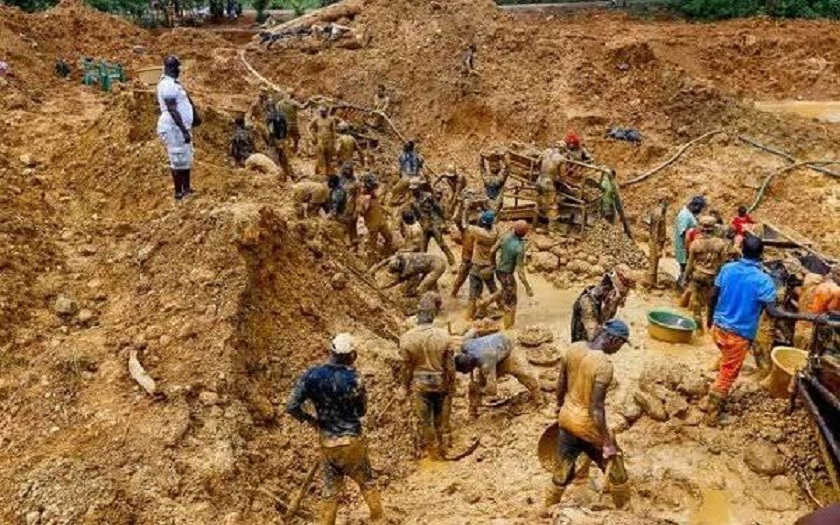
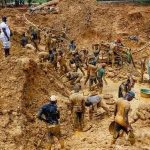
The Governor of Cross River State, Mr Bassey Otu, has imposed a statewide ban on illegal mining, directing all unlicensed operators to immediately shut down their activities.
The directive followed a strategic meeting with stakeholders in the mining industry, where the governor expressed concern over the growing security and environmental risks associated with unregulated mining operations.
Mr Otu said the ban takes immediate effect and applies to all operators without legitimate approvals from the Federal Government of Nigeria, while those with proper documentation will be allowed to continue their activities.
“This sector is strategic to the economic future of our state,” the governor said. “But instead of bringing prosperity to our communities, it is gradually becoming a source of serious concern. We believe wealth can still be created from mining, but it must be done ethically, legally and with full responsibility.”
He revealed that intelligence reports had shown an increasing influx of unregulated mining operators, including foreign nationals whose identities and operations remain largely unknown to the state authorities.
“I have been receiving reports about the influx of strangers and aliens into our various communities,” Otu said. “The truth is that we do not even know the number of these operators. We must know those who are in our state and what exactly they are doing in our environment.”
The governor also accused some local actors of aiding illegal mining activities.
“Some of the people complicating this situation are unfortunately within our own communities,” he said. “Some clan heads and village heads have become part of the problem by facilitating activities that are not properly regulated.”
Mr Otu revealed that the state government had initially attempted to address the problem through dialogue with federal authorities and security agencies responsible for monitoring mining operations, but noted that progress had been slow.
“I personally initiated discussions with federal authorities and security agencies to strengthen monitoring in the sector,” he said. “There were assurances that rangers would be deployed to assist us, but the process has taken far too long.”
He said the state could no longer wait, adding that the government had now decided to act decisively.
“We have given enough time of grace,” the governor declared. “There comes a point where government must act decisively. That time has now come.”
Announcing the directive, he said all illegal mining activities must stop immediately across the state.
“I am imposing a total ban on illegal mining in this state,” he said. “Let everyone return to their locations. When you are ready to come back, you must first report to the ministry and be properly profiled before any activity resumes.”
Mr Otu stressed that only operators with verifiable federal approvals and proper documentation would be allowed to continue operating.
“Those who have legitimate approvals from the federal government and whose activities are already known to the ministry will not be affected,” he said. “But anybody entering our communities to mine without proper authorisation should understand that those days are over.”
He warned that unregulated mining had begun to threaten public safety and agricultural livelihoods in many communities.
“This situation is affecting our security,” he said. “It is affecting our farmers and creating too many problems for our communities. Cross River is a hospitable state, but there is a limit to what we can continue to manage.”
To enforce the directive, the governor ordered the State Security Adviser to coordinate immediate enforcement operations and directed the Anti-Illegal Mining Task Force to commence round-the-clock surveillance in mining areas.
“There must be 24-hour monitoring to ensure that nobody goes behind the government to continue these activities illegally,” he said.
By Adedapo Adesanya
Nigeria will position the Intra-African Trade Fair 2027 (IATF 2027) as a major catalyst for accelerating trade and investment across the continent under the African Continental Free Trade Area (AfCFTA) framework.
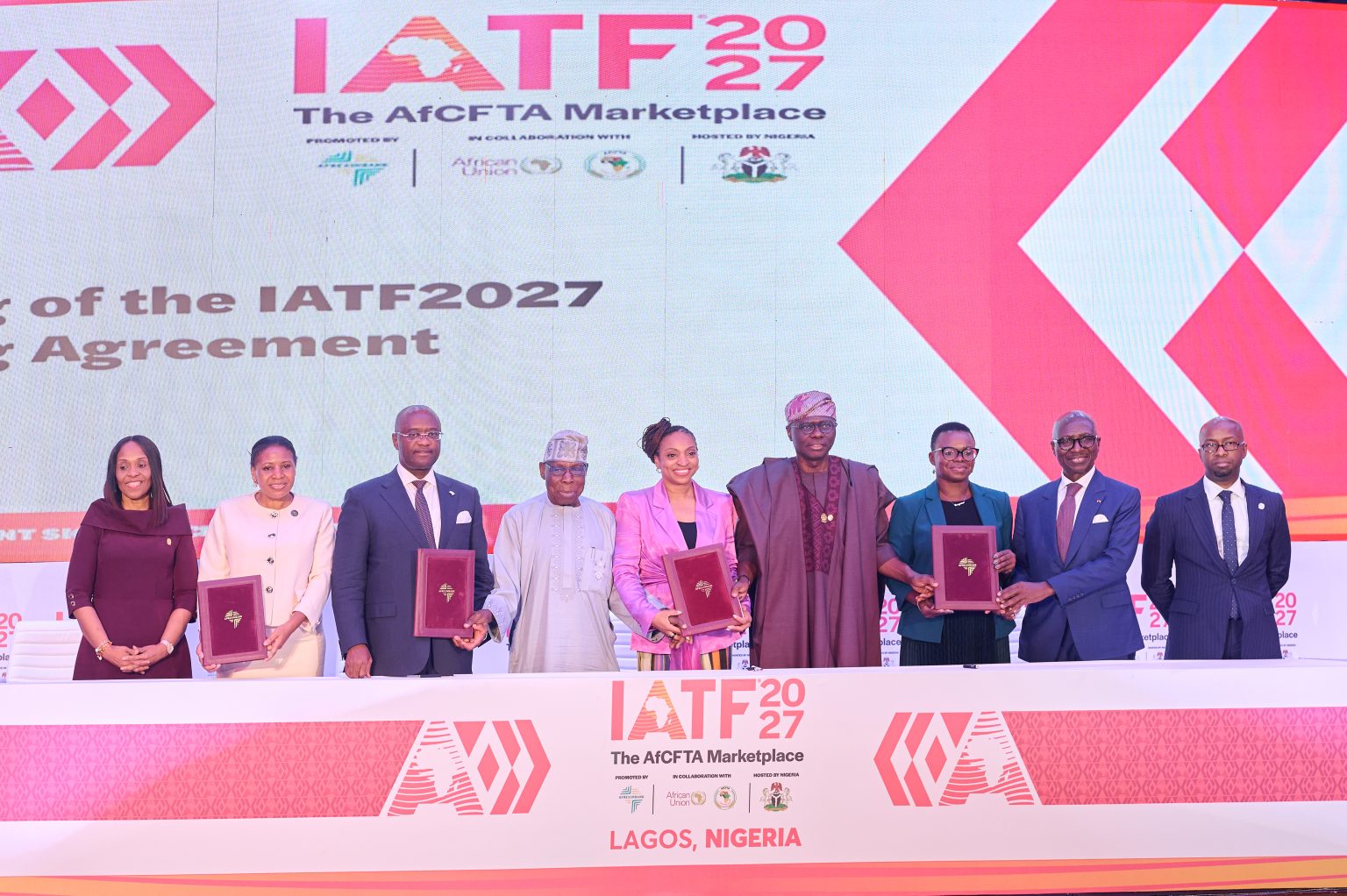
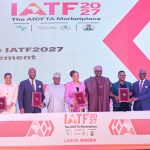
This was disclosed by the Minister of Trade and Investment, Mrs Jumoke Oduwole, while speaking at the IATF 2027 Hosting Signing Ceremony in Lagos on Monday.
Representing President Bola Tinubu at the landmark event, she noted that preparations for the 2027 Trade Fair came as Nigeria marked more than five years since the commencement of AfCFTA implementation, adding that the country became the first AfCFTA state to complete its five-year implementation review in 2025, in line with obligations under the agreement.
Setting some expected benchmarks for the event, Mrs Oduwole noted that the event would witness strong performances, with over 100,000 physical and virtual attendees projected to take part in the trade fair, and will top that of the 2025 edition.
The fourth edition of the fair (IATF 2025) was held in Algiers, Algeria, from September 4 to September 10, 2025, and recorded $48.3 billion in trade and investment deals.
“We’re expecting to host over 100,000 physical and virtual guests. We’re expecting to have over $50 billion worth of deals from IATF 2027.
“The IATF has made connections with the Caribbean and the diaspora, and we are positioning Nigeria to lead economically in this renaissance,” she stated.
Mrs Oduwole noted that in line with President Tinubu’s Renewed Hope Angle, the fair will provide an important instrument for advancing economic cooperation, boosting intra-African trade and fostering shared prosperity across the continent.
She described the trade fair as a major platform for advancing the objectives of the African Continental Free Trade Area (AfCFTA), which aims to create a unified African market.
The Minister added that the Federal Ministry of Industry, Trade and Investment (FMITI) is leading the coordination efforts for the event, working with agencies such as the Nigerian Export Promotion Council (NEPC) and other stakeholders to ensure successful delivery.
Also speaking at the event, Nigeria’s former president and Chairperson of the IATF Advisory Council, Mr Olusegun Obasanjo, said the hosting of the fifth edition of the Intra-African Trade Fair 2027 in Lagos represents a major milestone for the country and the continent’s drive toward deeper economic integration.
Mr Obasanjo noted that the agreement formally grants the country the right to stage the trade fair, which is scheduled to take place from November 5 to November 11, 2027, in Lagos.
“The signing of this host agreement marks a momentous milestone for Nigeria and for the continent. Bringing IATF2027 to Lagos is historically significant, as this city hosted the Lagos Plan of Action adopted in 1980, which championed Africa’s industrialisation and economic self-sufficiency. We have to work hard to keep moving towards the Africa we want. I am confident that IATF 2027 will surpass all previous editions in both scope and impact as we advance our shared goal for a unified African marketplace under the AfCFTA,” he remarked.
Also speaking at the event, the President and Chairman of the Board of Directors of the African Export-Import Bank (Afreximbank), Mr George Elombi, expressed confidence that hosting IATF 2027 in Lagos, Nigeria.
He noted that the trade fair has generated an average of $40 billion in deals across its previous four editions.
Mr Elombi said such success stories demonstrate the transformative power of the trade fair in creating partnerships, driving innovation, and improving Africa’s global economic image.
“Nigeria’s vibrant entrepreneurial spirit gives us confidence that IATF2027 in Lagos will be a remarkable event that strengthens trade and investment across the continent. The trade fair is about building a strong pan-African single market and expanding intra-African trade beyond the levels we see today,” he said.
As the host, Lagos State Governor, Mr Babajide Sanwo-Olu, said the event would be a defining time for Africa to take its rightful place in the comity of nations, assuring that Lagos State would put every necessary thing in place to ensure the event would be the best IATF to be hosted in Africa.
Business Post reports that while the fair will hold next year, Lagos will also play host to Afreximbank’s Creative Africa Nexus (CANEX), scheduled for November 5-8, 2026

By Adedapo Adesanya
The Director of the Nigeria National Single Window (NSW), Mr Tola Fakolade, has assured stakeholders that the platform would not encroach on the statutory revenue-collection functions of agencies operating in the nation’s maritime sector.
Mr Fakolade made the clarification during a sensitisation programme for officers of the Nigeria Customs Service in Lagos, held ahead of the Phase One launch of the platform scheduled for March 27, 2026, on Monday.
He explained that the National Single Window is designed strictly to facilitate trade and streamline processes among government agencies involved in import and export operations.
“The National Single Window is not taking over revenue collection from agencies. What it will do is facilitate ease of trade by integrating processes and improving transparency across all participating agencies,” Mr Fakolade said.
He further stressed that the initiative is not a tax collection mechanism for the Nigeria Revenue Service but a presidential project aimed at modernising Nigeria’s trade infrastructure.
“The National Single Window is a presidential initiative with a steering committee comprising all relevant government agencies, each duly represented and led by the Presidency.
“Although the project is funded by the Nigeria Revenue Service, its objective is not to compete with any agency but to strengthen collaboration and efficiency,” he added.
Also speaking at the event, the Deputy Comptroller-General of the Nigeria Customs Service, Mrs Oluyomi Adebakin, underscored the strategic importance of the platform to Nigeria’s global trade competitiveness.
Mrs Adebakin noted that the National Single Window would significantly enhance operational efficiency within Customs while boosting Nigeria’s reputation in international trade.
According to her, digitising and harmonising trade-related procedures will help position Nigeria more favourably in the global trading environment.
“The National Single Window will improve Nigeria’s image in the committee of nations as it relates to trade. It will simplify procedures, reduce delays, and strengthen transparency within the system,” she said.
The sensitisation exercise is part of ongoing efforts by the National Single Window Secretariat to ensure that all government agencies involved in trade operations are fully aligned with the project’s objectives ahead of its full implementation.
Once operational, the National Single Window is expected to integrate multiple government agencies onto a unified digital platform, allowing traders to submit documentation and complete regulatory procedures through a single interface.









-
 Feature/OPED6 years ago
Davos was Different this year
-
Travel/Tourism10 years ago
Lagos Seals Western Lodge Hotel In Ikorodu
-

 Showbiz3 years ago
Estranged Lover Releases Videos of Empress Njamah Bathing
-
 Banking8 years ago
Sort Codes of GTBank Branches in Nigeria
-

 Economy3 years ago
Subsidy Removal: CNG at N130 Per Litre Cheaper Than Petrol—IPMAN
-

 Banking3 years ago
Sort Codes of UBA Branches in Nigeria
-

 Banking3 years ago
First Bank Announces Planned Downtime
-

 Sports3 years ago
Highest Paid Nigerian Footballer – How Much Do Nigerian Footballers Earn