Economy
Reps to Investigate Total Remittances Flows to Nigeria
By Dipo Olowookere
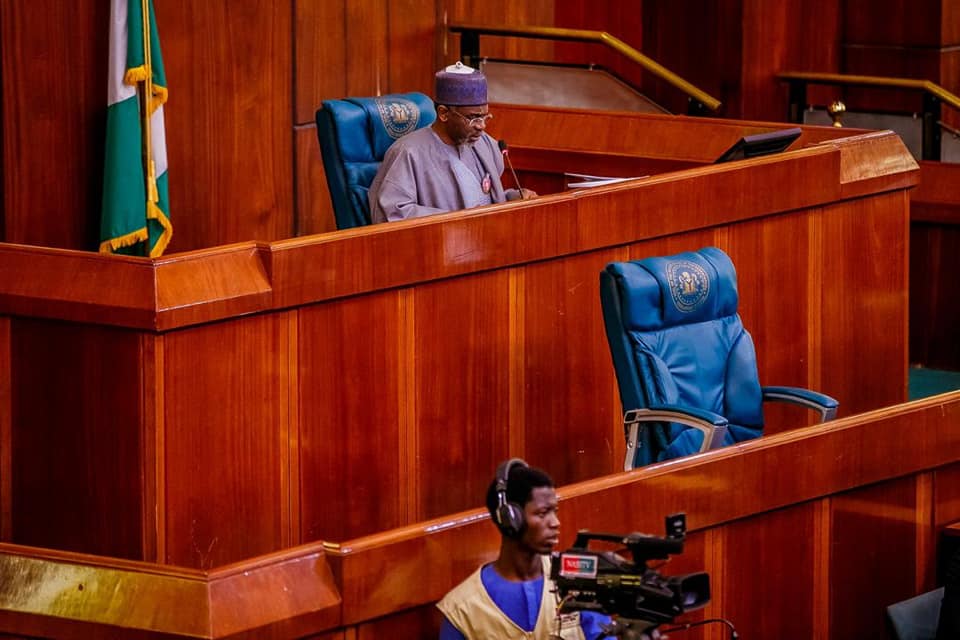
The House of Representatives has mandated its committees on Diaspora, Banking and Currency, National Planning and Economic Development to investigate the actual amount of remittances made into the country in the last three years by Nigerians living abroad.
At the plenary on Tuesday presided over by Speaker of the House, Mr Femi Gbajabiamila, the lower chamber of the National Assembly also directed the committees to collaborate with Nigerians in the Diaspora Commission, the Central Bank of Nigeria (CBN), Money Transfer Operators and other stakeholders for a comprehensive report, which should be submitted within four weeks for further legislative action.
This directive followed a point raised by a lawmaker, Ms Tolulope Akande-Sadipe, who called attention of the green part of the parliament on the need to ascertain remittances made by Nigerians in diaspora and the impact on the nation’s economy.
Members of the parliament emphasised that remittances by Nigerians represent household incomes and investments from foreign economies arising mainly from the temporary or permanent movement of people to those economies and includes cash and non-cash items that flow through formal channels such as electronic wire, or through informal channels, such as money or goods carried across borders.
During the debate, it was noted that remittances inflows into the country could rise to $25.5 billion, $29.8 billion and $34.9 billion in 2019, 2021 and 2023 respectively.
It was further argued that over a 15-year period, total remittances flow to Nigeria would grow by almost double in size from $18.4 billion in 2009 to $34.9 billion in 2023.
The lawmakers, concerned that since many transactions are unrecorded or take place through informal channels, stressed that the actual amount of remittance flows into the country was arguably higher; as in 2018, diaspora remittances to Nigeria was equal to $25 billion, representing 6.1 percent of the Gross Domestic Product (GDP), which also represented 14 percent year-on-year growth from the $22 billion receipts in 2017.
The National Bureau of Statistics (NBS), in report, said that remittances from Nigerians in the diaspora rose from $3.24 billion in 2013 to approximately $25.08 billion in 2018, a rise of 126 percent in 6 years amounting to an estimated $96.5 billion sent to the country.
The World Bank estimated that global remittances grew by 10 percent from $633 billion in 2017 to $689 billion in 2018, with developing countries receiving 77 percent or $528 billion of the total inflows.
In 2018, Egypt and Nigeria accounted for the largest inflows of remittances into Africa, with the latter leading in the continent in terms of remittance receipts in 2017.
According to the United Nations official records, there are 1.24 million migrants from Nigerians in the diaspora and the World Bank Report also showed that the Indian diaspora sent a whopping $79 billion back home in 2018, making the country the world’s top recipient of remittances and at the growth rate of 14 percent in inward remittances.
India has registered significant growth in the flow of remittances over the last 3 years, from $62.7 billion in 2016 to $65.3 billion in 2017, remittances reached the $79 billion mark by 2018.
Nigeria accounts for over a third of migrant remittances flows to Sub-Saharan Africa estimated to have amounted to $23.63 billion in 2018, representing 6.1 percent of the country’s GDP, which translated to 83 percent of the federal government’s budget in 2018 and 11 times the Foreign Direct Investment (FDI) flows in the country within the period and was 7 times larger than the $3.4 billion received in 2017 as foreign aid.
Economy
Expect Naira Below N1,000/$1 with Dangote Refinery at Full Capacity—Otedola
By Adedapo Adesanya
Nigerian businessman, Mr Femi Otedola, has congratulated his billionaire friend, Mr Aliko Dangote, on the Dangote Refinery achieving its full nameplate capacity of 650,000 barrels per day, expressing optimism that this will further strengthen the Naira against the US Dollar in the currency market.
In an X post on Thursday, Mr Otedola described it as a transformative milestone for Nigeria and Africa, noting that the refinery’s operations could ease pressure on Nigeria’s foreign exchange reserves.
“I congratulate my friend and brother, @AlikoDangote, on the remarkable achievement of the Dangote Petroleum Refinery reaching its full 650,000 barrels per day capacity.
“More importantly, it is transformational for Nigeria and Africa. Supplying up to 75 million litres of PMS daily changes our energy narrative and conserving foreign exchange.
“With domestic refining now firmly underway after decades of reliance on imports, pressure on the foreign exchange market should ease significantly. I am optimistic that the Naira will strengthen meaningfully, and trading below N1,000/$1 before year-end is increasingly within reach,” he wrote.
Earlier today, it was reported that all key components, including the naphtha hydrotreater, isomerisation unit, and reformer unit, of the single train refinery are now operating steadily at 650,000 barrels per day. This enables the facility to produce up to 75 million litres of Premium Motor Spirit (petrol) daily, significantly boosting Nigeria’s domestic fuel supply and reducing reliance on imports.
The $20 billion refinery, Africa’s largest, began operations in 2023 and has been ramping up production amid challenges, including crude supply issues.
Mr Dangote announced plans in October 2025 to expand capacity to 1.4 million barrels per day, which would make it the world’s largest refinery, surpassing India’s Jamnagar facility.
Mr Otedola added that his best friend is investing an additional $12 billion in this expansion, including the production of polypropylene and Linear Alkyl Benzene for detergents, with work already underway.
“Aliko is not stopping here. He has embarked on an additional $12 billion expansion to increase refining capacity to 1.4 million barrels per day, alongside 2.4 million tons of polypropylene and 400,000 metric tons of Linear Alkyl Benzene for detergent production. Work has already commenced in earnest.
“Congratulations once again, my brother. Nigeria is proud of you,” he said.
Economy
Trade Facilitation: Customs Okays Lagos Free Zone Green Channel
By Modupe Gbadeyanka
The Nigeria Customs Service (NCS) has approved the activation of the Lagos Free Zone Green Channel to enable the seamless and controlled movement of Free Zone cargo directly from the Lekki Deep Sea Port to the Lagos Free Zone (LFZ).
This development makes LFZ the first and only zone in the country to operate a sanctioned green channel, reflecting globally recognised port-to-free-zone logistics and customs integration models successfully implemented in leading trade hubs in the Middle East and Asia.
With this, businesses in the Lagos Free Zone can now scale their industrial output with total peace of mind, as every consignment is protected by an unbroken chain of 24/7 CCTV surveillance, telemetry, and tamper-evident digital logs that ensure absolute cargo integrity.
This integration not only secures the supply chain but also builds unrivalled investor confidence by establishing a transparent, high-compliance trade environment monitored directly by the customs.
For manufacturers and distributors, the outcome is a predictable, ultra-fast logistics flow that solidifies LFZ as the most efficient regional hub for Nigerian and West African operations.
“This approval is a testament to our commitment to trade modernisation. The Lagos Free Zone Green Channel will enhance Customs visibility while significantly improving investor confidence in Nigeria’s Special Economic Zones,” the Comptroller-General of Customs, Mr Bashir Adeniyi,” stated.
On her part, the chief executive of LFZ, Mrs Adesuwa Ladoja, said, “The activation of the Lagos Free Zone Green Channel is the latest testament to our customer-centricity and our commitment to continually deliver enhanced ease of doing business for our tenants.
“The Green Channel solidifies the advantages of Lekki Deep Sea Port being physically and digitally integrated into our zone. We have effectively removed the ‘last mile’ uncertainty that has historically challenged Nigerian logistics.
“Our tenants no longer need to navigate the complexities of traditional port exits; instead, they benefit from a high-velocity, customs-integrated corridor that moves cargo with precision and speed.
“This is a game-changer for manufacturing and regional distribution, reinforcing Lagos Free Zone as the premier gateway for those looking to dominate the West African market.”
Economy
Dangote Refinery Finally Hits Full 650,000-Barrel Per Day Capacity
By Adedapo Adesanya
Dangote Refinery has reached its full capacity of 650,000 barrels per day following the successful optimisation of critical processing units, marking a turning point for Africa’s largest refinery, located in Lagos.
The $20 billion facility is now operating at full capacity, a world-record milestone for a single-train refinery.
This achievement comes after the completion of an intensive performance testing on the refinery’s Crude Distillation Unit and Motor Spirit production block.
According to the chief executive of Dangote Refinery, Mr David Bird, the refinery is now positioned to supply up to 75 million litres of petrol daily to the domestic market, a dramatic increase from the 45 million – 50 million litres delivered during the recent festive period.
The development can reshape Nigeria’s energy landscape and reduce the country’s longstanding dependence on imported refined products.
“Our teams have demonstrated exceptional precision and expertise in stabilising both the CDU and MS Block,” Mr Bird said. “This milestone underscores the strength, reliability, and engineering quality that define our operations.”
The refinery has completed a 72-hour series of performance test runs in collaboration with technology licensor UOP, a Honeywell company, to validate operational efficiency and confirm that all critical parameters meet international standards.
The tests covered the naphtha hydrotreater, isomerisation unit, and reformer unit, which together form the backbone of the facility’s gasoline production capability.
The milestone marks another achievement for the businessman and majority stake owner at the facility in his ambition to transform Nigeria from Africa’s largest crude oil producer into a refining powerhouse.
Since the commencement of the facility in 2016, it has faced numerous setbacks, including pandemic-related delays, foreign exchange challenges, and technical complications.
It was finally commissioned in May 2023 to help wean Nigeria off imported petroleum products, due to the chronic underperformance of its state-owned refineries.
Despite being Africa’s largest crude producer, the country has not been able to self-produce, even with four state-owned refineries with a combined capacity of 445,000 barrels per day. This has led to decades of high dependency on importation.
The Dangote refinery’s emergence at full capacity has the potential to eliminate this import dependence while positioning Nigeria as a net exporter to West African markets.
Yet, the refinery faces difficulty securing adequate crude oil supplies from Nigerian producers, forcing it to import feedstock from the US, Brazil, Angola, and other countries.
Mr Bird also confirmed that Phase 2 performance test runs for the remaining processing units are scheduled to commence next week, suggesting further capacity optimisation ahead.
The official emphasised the refinery’s commitment to “enhancing Nigeria’s energy security while supporting industrial development, job creation, and economic diversification.”
-
Feature/OPED6 years agoDavos was Different this year
-
Travel/Tourism10 years ago
Lagos Seals Western Lodge Hotel In Ikorodu
-
Showbiz3 years agoEstranged Lover Releases Videos of Empress Njamah Bathing
-
Banking8 years agoSort Codes of GTBank Branches in Nigeria
-
Economy3 years agoSubsidy Removal: CNG at N130 Per Litre Cheaper Than Petrol—IPMAN
-
Banking3 years agoSort Codes of UBA Branches in Nigeria
-
Banking3 years agoFirst Bank Announces Planned Downtime
-
Sports3 years agoHighest Paid Nigerian Footballer – How Much Do Nigerian Footballers Earn