Economy
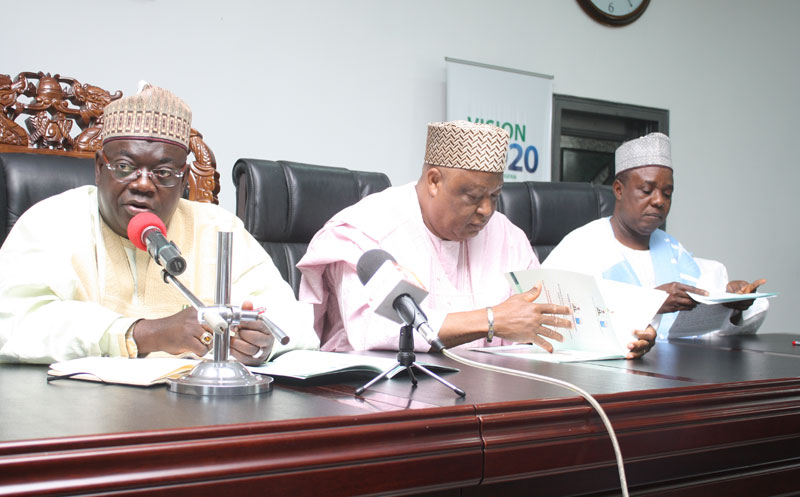
RMAFC Insists Revenue Allocation Formula Legal
By Modupe Gbadeyanka
The management of Revenue Mobilization Allocation and Fiscal Commission (RMAFC) has maintained that revenue allocation formula currently in operation remains legal.
This followed recent media reports where it was alleged that the current revenue allocation formula is illegal on the grounds that it was never submitted to the National Assembly by Mr President.
Reacting in a statement signed by the agency’s image maker, Mr Ibrahim Mohammed, RMAFC recalled that the first Revenue Allocation Formula duly passed by the NASS was in 1982 during the Second Republic of former President Shehu Shagari.
After the military take-over, the Act was amended by Decree No 106 of 1992 which continued to operate up to 1999.
He said it was instructive to note that with the return of democratic rule in 1999, all laws were considered as existing laws as provided for by Section 313 of the 1999 Constitution and therefore Acts of National Assembly which apply to the extent that they conform to the provisions of the Constitution.
Following the Supreme Court ruling in AGF vs Abia and 36 others which voided some of the provisions of CAP 16 as (amended), Mr President as the relevant authority invoked his power under the provision of section 315 Sub Sections 1 and 4 to issue the Modification Order to bring the voided provisions into conformity with the provisions of the 1999 constitution.
Consequently, the President and the Governors met and resolved some grey areas in the provision of the Modification Order, hence the implementation directives released by the Minister of Finance on January 15, 2004 which is the formula currently in operation.
Furthermore, the Commission had in August, 2001 reviewed the Revenue Allocation Formula and submitted its Report and recommendations to President Olusegun Obasanjo.
The advice and recommendations were promptly forwarded to the 4th National Assembly for deliberations. However, the Commission had cause to withdraw its recommendations to make some necessary adjustments because the Supreme Court Judgment of 5th April, 2002 had actually affected some of the recommendations as proposed by the Commission in its 2001 Report.
After the review, the Report was subsequently re-submitted to President Obasanjo in December, 2002 which was also forwarded to the 4th National Assembly.
Unfortunately, the 4th National assembly could not conclude deliberations on the matter up to the end of the first tenure of President Obasanjo in May, 2003.
Again, the 5th National Assembly could not conclude deliberations on that sensitive matter up to the end of the Obasanjo administration in May, 2007.
When the 6th National Assembly came, the Commission was informed that all bills including that of the Revenue Allocation Formula not passed by the 5th National Assembly have elapsed and therefore, should be re-submitted.
Following this development, the Commission prepared another revenue allocation formula report in December 2013 which was duly communicated to former President Dr Goodluck Jonathan in January, 2014.
However, the Commission was not granted audience to submit its recommendations to President Jonathan up to the end of his tenure in May, 2015. The current administration has also been informed of this development.
Economy
Four Securities Erase N51.17bn from NASD Exchange
By Adedapo Adesanya
Four securities weakened the NASD Over-the-Counter (OTC) Securities Exchange by 1.95 per cent on Friday, erasing N41.17 billion from the bourse, which had its market capitalisation at N2.567 trillion compared with the previous session’s N2.618 trillion.
In the same vein, the NASD Unlisted Security Index (NSI) decreased at the close of business by 85.28 points to 4,277.07 points from 4,362.32 points.
The price decliners were led by 11 Plc, which gave up N20.50 to sell at N200.50 per share compared with the preceding day’s N221.00 per share, FrieslandCampina Wamco Nigeria Plc dropped N16.94 to close at N155.20 per unit versus Thursday’s closing price of N172.14 per unit, Central Securities Clearing System (CSCS) Plc went down by N2.11 to N84.68 per share from N86.79 per share, and Afriland Properties Plc lost 11 Kobo to end at N16.74 per unit, in contrast to the N16.85 per unit it closed a day earlier.
During the trading day, the value of transactions jumped by 172.1 per cent to N29.9 million from the preceding session’s N10.9 million, and the volume of trades soared by 136.5 per cent to 955,096 units from the previous 403,901 units, while the number of deals went down by 11.4 per cent to 31 deals from 35 deals.
Great Nigeria Insurance (GNI) Plc remained the most active stock by value on a year-to-date basis, with 3.4 billion units valued at N8.4 billion, followed by Infrastructure Credit Guarantee (Infracredit) Plc with 2.3 billion units worth N6.5 billion, and CSCS Plc with 68.6 million units sold for N4.7 billion.
GNI Plc also ended the session as the most traded stock by volume on a year-to-date basis, with 3.4 billion units exchanged for N8.4 billion, trailed by Infracredit Plc with 2.3 billion units traded for N6.5 billion, and Resourcery Plc with 1.1 billion units transacted for N415.7 million.
Economy
Cautious Trading, Profit-taking Weaken Nigeria’s Stock Exchange by 0.66%
By Dipo Olowookere
The last trading session of this week on the floor of the Nigerian Exchange (NGX) Limited ended on a negative note, with a 0.66 per cent loss on Friday.
This was influenced by sustained selling pressure and cautious trading, which forced investors into profit-taking.
Data obtained by Business Post showed that the energy sector fell by 4.66 per cent, the insurance counter dipped by 2.23 per cent, the consumer goods index depreciated by 0.96 per cent, and the banking segment shed 0.28 per cent, while the industrial goods space remained unchanged.
At the close of business, the All-Share Index (ASI) of Nigeria’s stock exchange went down by 1,531.81 points to 232,049.02 points from 233,580.83 points, and the market capitalisation dropped N983 billion to settle at N148.905 trillion compared with Thursday’s N149.888 trillion.
Aradel was the worst-performing equity after it lost 10.00 per cent to close at N1,417.50. International Energy Insurance slipped by 9.95 per cent to N5.79, Trans-Nationwide Express depreciated by 9.89 per cent to N3.28, eTranzact crashed by 9.79 per cent to N14.75, and UPDC slumped by 9.72 per cent to N28.12.
The best-performing equity for the day was Universal Insurance, which gained 6.32 per cent to close at N1.01, McNichols grew by 5.52 per cent to N8.60, Linkage Assurance expanded by 4.67 per cent to N1.57, NGX Group appreciated by 4.35 per cent to N120.00, and Transcorp increased by 3.62 per cent to N41.50.
As look at the activity level indicated that investors traded 388.7 million stocks worth N18.4 billion in 44,631 deals compared with the 393.7 million stocks valued at N19.2 billion executed in 45,813 deals a day earlier, representing a decline in the trading volume, value, and number of deals by 1.27 per cent, 4.17 per cent, and 2.58 per cent, respectively.
Economy
Official FX Market Sees Naira Dip to N1,380.93/$1
By Adedapo Adesanya
The Naira recorded a loss of 82 Kobo or 0.06 per cent against the United States Dollar in the Nigerian Autonomous Foreign Exchange Market (NAFEX) on Friday, June 26, exchanging at N1,380.93/$1, in contrast to the previous day’s rate of N1,380.11/$1.
Equally, the domestic currency further weakened against the Pound Sterling in the official FX market yesterday by N6.06 to settle at N1,824.90/£1 versus the preceding session’s N1,818.84/£1, and lost N10.74 on the Euro to sell at N1,577 .58/€1 versus N1,566.84/€1.
At the GTBank forex counter, the Naira depreciated against the greenback during the session by N4 to close at N1,387/$1, in contrast to Thursday’s value of N1,383/$1, and at the parallel market, it was unchanged at N1,395/$1.
Interbank FX activity among financial institutions has fluctuated amid a sharp slowdown in forex market interventions by the Central Bank of Nigeria (CBN), as it allows demand and supply to move the market.
Also, a stronger greenback has generally put significant pressure on emerging-market currencies.
Nigeria has accessed the first tranche of a proposed $5 billion derivatives financing arrangement with First Abu Dhabi Bank PJSC, the largest lender in the United Arab Emirates (UAE).
The $5 billion facility, approved by the National Assembly earlier this year, is part of the federal government’s plan to diversify external financing sources and reduce borrowing costs. Structured as a Total Return Swap with First Abu Dhabi Bank, proceeds are earmarked for refinancing debt and supporting infrastructure financing.
If the proceeds are brought into the country through the official FX market, the transaction will increase the currency reserves or Dollar liquidity.
At the cryptocurrency market, Solana (SOL) grew by 2.2 per cent to $71.92, Cardano (ADA) gained 1.1 per cent to trade at $0.1474, Ripple (XRP) also appreciated by 1.1 per cent to $1.05, Dogecoin (DOGE) expanded by 0.9 per cent to $0.0755, and Ethereum (ETH) improved by 0.4 per cent to $1,578.84.
On the flip side, TRON (TRX) slid 0.6 per cent to $0.3203, Binance Coin (BNB) slumped by 0.3 per cent to $564.33, and Bitcoin fell by 0.2 per cent to $60,219.37, while the US Dollar Tether (USDT) and the US Dollar Coin (USDC) traded flat at $1.00 each.
-
Feature/OPED6 years agoDavos was Different this year
-
Travel/Tourism10 years ago
Lagos Seals Western Lodge Hotel In Ikorodu
-
Showbiz3 years agoEstranged Lover Releases Videos of Empress Njamah Bathing
-
Banking8 years agoSort Codes of GTBank Branches in Nigeria
-
Economy3 years agoSubsidy Removal: CNG at N130 Per Litre Cheaper Than Petrol—IPMAN
-
Banking3 years agoSort Codes of UBA Branches in Nigeria
-
Banking3 years agoFirst Bank Announces Planned Downtime
-
Sports3 years agoHighest Paid Nigerian Footballer – How Much Do Nigerian Footballers Earn